[Bunnie]’s Laptop Gets A 900MHz Scope Addon

Scope

Now that [Bunnie]’s open hardware laptop – the Novena – is wrapping up its crowdfunding campaign, it only makes sense that development around the Novena project would move over to the more interesting aspects of a completely hackable laptop. The Novena has a huge FPGA on board, with 2 Gbit of very fast memory hanging off it. Also, every single signal pin of the FPGA is broken out on high-speed connectors, making for some very, very interesting possible add-on boards. [Bunnie] has always wanted a portable, high-end oscilloscope to carry with him, and with the new oscope module, he has something that blows out of the water every scope priced below a thousand dollars.

The oscilloscope module [Bunnie] is working on has either two 8-bit channels at 1 GSPS or one 8-bit channel at 2 GSPS with an analog bandwidth of up to 900MHz. The module also has 10 digital channels, so if you need a logic analyzer, there you go.

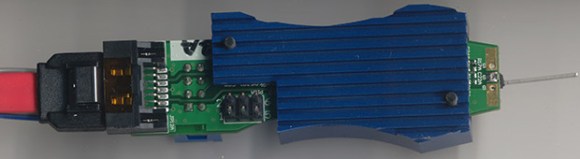
Being a fairly high-end scope, the hardest part of engineering this scope is the probes. The probes for fast, high-end scopes cost hundreds of dollars by themselves, so [Bunnie] looked for a clean-sheet redesign of the lowly oscope probe. To connect the probe to the module, [Bunnie] realized a SATA cable would be a great solution; they’re high bandwidth, support signals in the GHz range, and are rated for thousands of insertions. These active probes can be combined with a number of front ends for application specific probes – digital probes, ones for power signature analysis, and ones for capturing signals across small loops of wire.

The module itself isn’t quite ready for production yet, but by the time the Novena crowdfunding campaign starts shipping, [Bunnie] will probably be working on the next add-on module for his crazy awesome laptop.
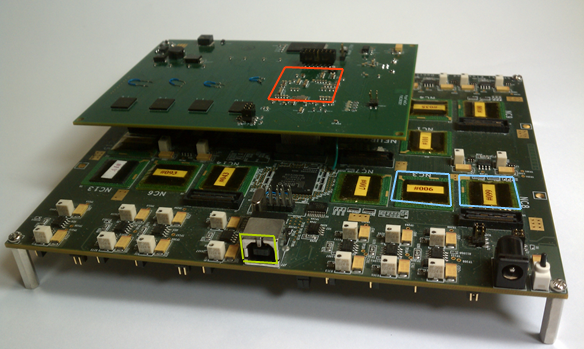
 

Neurogrid circuit board that replicates functions of the human brain.

The Neurogrid – What It Is And What It Is Not

What it is:

Some would argue that replicating the human brain in silicon is impossible. However, the folks over at Brains in Silicon of Stanford University might disagree. They’ve created a circuit board capable of simulating one million neurons and up to 6 billion synapses in real-time. Yes, that’s billion with a “B”. They call their new type of computer The Neurogrid.

The Neurogrid board boasts 16 of their Neurocore chips, with each one holding 256 x 256 “neurons”. It attempts to function like a brain by using analog signals for computations and digital signals for communication. “Soft-wires” can run between the silicon neurons, mimicking the brain’s synapses.

Be sure to stick around after the break, where we discuss the limitations of the Neurogrid, along with a video from its creators.

Continue reading “The Neurogrid – What It Is And What It Is Not”

Spin A PCB For Your Most Beloved Sensors

sensorstick-breakout

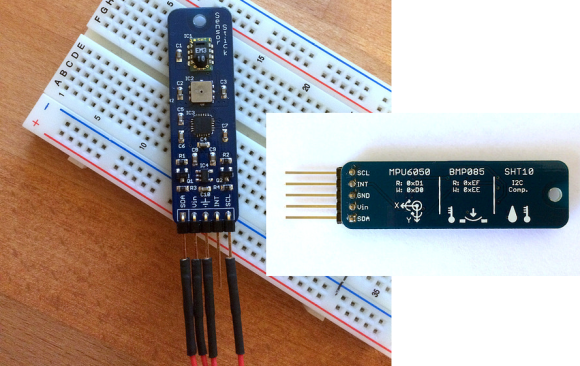
If you follow [Ioannis’] lead you’re going to thank yourself every time you sit down to work on a new prototype. He took all of the sensors which he most commonly uses and spun one dev board to host them all.

As long as you’re willing to wait for delivery, the cost of small-run professionally made PCBs has become unbelievably reasonable. That’s really nice when you need to test your layout before exploring larger production. But it also means you can develop your own dirt-cheap yet reliable dev tools. This example combines three sensors which all communicate via I2C:

  • MPU6050 accelermoter/gyro
  • BMP085 pressure sensor
  • SHT10 humidity sensor

Obviously this is a great idea, but key is the cheat sheet which [Ioannis] included on the bottom of the board. It testifies as to which chips are on the board, but also includes the device addresses for the data bus. We’ve adopted the mantra that if a breadboarded prototype is not working, it’s always a hardware problem. For those oft-used parts this should alleviate some of the heartache at your bench.

You could still make something like this without spinning or etching a board. You’ll just have to be creative with the soldering.

Listening To A Swarm Of Satellites In Orbit

kicksat

A few months ago, we heard of a Kickstarter with an amazing goal: give everyone with $300 burning a hole in their pocket their very own satellite orbiting Earth. Time passes, the mothership has been launched, and in just a few short hours, over a hundred of these personal femtosatellites will be released into low Earth orbit.

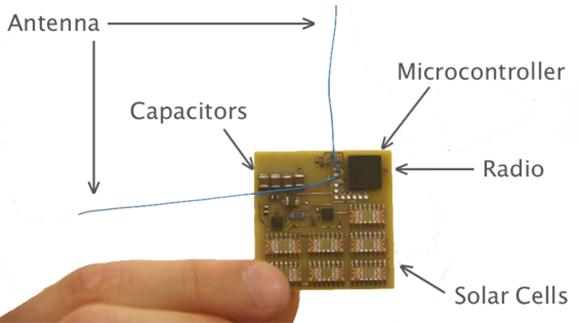
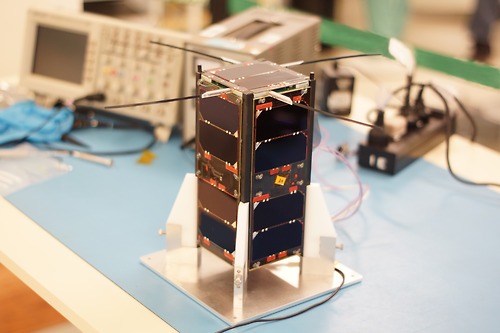
The Kicksat consists of a 3U cubesat that was recently launched aboard the SpaceX CRS-3 mission to the International Space Station. Inside this cubesat are over one hundred satellites called Sprites, loaded up with solar cells, magnetometers, a microcontroller and a radio to communicate with ground stations below. The current mission is a proof of concept, but if everything goes as planned, similar satellites can be deployed into the path of incoming asteroids, or whenever a mission calls for a swarm of small smart devices covering a huge area.

Already the Kicksat mothership has been tracked by a few enterprising amateur radio enthusiasts but the deployment of the Sprites isn’t scheduled until today at 4:00 PM EDT (20:00 GMT). After that, the Sprites will be on their own, spewing out data and the initials of kickstarter backers to most of the population of Earth.

For anyone worrying about these Sprites causing an ablation cascade or a Kessler syndrome, don’t. Orbital decay is a function of surface area and mass, and these extremely lightweight thin rectangles will burn up in the atmosphere in a few week’s time. The lack of radiation hardening on the Sprites won’t be a problem, either. This shouldn’t be a surprise, as they’re orbiting well within our wonderful, protective magnetosphere, and there are digital cameras, tablets, and other much more radiation sensitive electronics that have been working perfectly on the ISS for years now.

You can check out the current location of the orbiting Kicksat mothership on the project website, read the updates on the project blog, or check out our coverage of the Kicksat program from last year’s world maker faire in New York. Relevant videos below.

Oh, and if you have a USB TV tuner, a good antenna, LNA, and some experience with SDR, here’s what you need to listen in.

Continue reading “Listening To A Swarm Of Satellites In Orbit”

Sending Open-Source Satellites To Space

An anonymous reader tipped us about two Argentinian satellites (satellite one, satellite two) that were sent in 2013 to space. What is interesting about them? They are both based on commercial off-the-shelf (COTS) components, and the team released the framework & flight computer software for their main platform (named cubesat, GitHub link). Gunter’s space page not only impresses us by showing the quantity of small/amateur satellites sent each month to space, but also lets us know that the hardware source files for CudeBug 1/2 are meant to be released. In the meantime we can only gather that they’re using a Texas Instruments TMS570 running FreeRTOS. Nevertheless, the two different web pages (in spanish and english) offer us a very interesting glimpse of what it takes to send an electronic project to space and how it later behaves.

You may also be interested in checking out ArduSat, a successful kickstarter campaign aimed at sending Arduino experiments in space.

A Z80 Retro Microcomputer For The Papilio Pro FPGA Board

z80

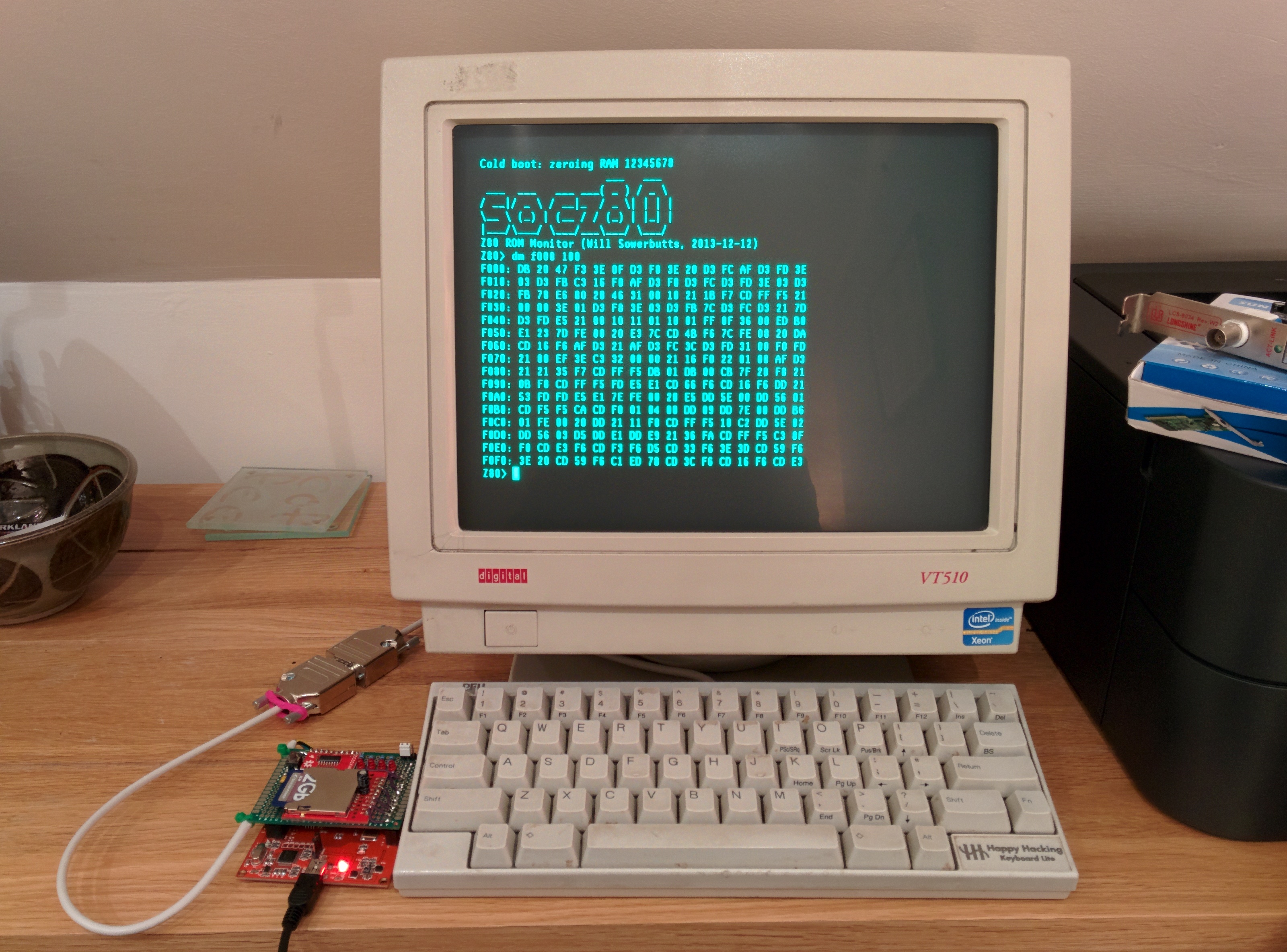
[Will] wrote a 128MHz Z80-based retro microcomputer which runs on a Papilio Pro board. For those who don’t know, the latter is built around a Spartan-6 LX9 FPGA so you may imagine that much work was required to implement all the computer features in VHDL. The T80 CPU core was taken from opencores, the SDRAM controller was imported from Mike Field’s work but [Will] implemented several additional functions on his own:

– a 4KB paged Memory Management Unit to translate the 16-bit (64KB) logical address space into a 26-bit (64MB) physical address space.

– a 16KB direct mapped cache to hide the SDRAM latency, using the FPGA internal block RAM

– a UART interface for external communications

He also ported CP/M-2.2, MP/M-II and UZI (a UNIX system) to the computer. His project is completely open-source and all the source code can be downloaded at the end of [Will]’s write up.

Thanks [hamster] for the tip.

UMotio: An Arduino Compatible 3D Gesture Controller

uMotio

The Mooltipass project USB code contributor [Tom] and his friend [Ignatius] recently launched their Indiegogo campaign: meet the 3D gesture controller uMotio (Indiegogo link). As [Tom] has been spending much of his personal time helping the Mooltipass community, we figured that a nice way to thank him would be to try making their great open project one step closer to a disseminated product.

As you can see in the video embedded after the break, the uMotio is a plug and play system (detected as a USB HID joystick & keyboard with a CDC port) that can be used in many different scenarios: gaming, computer control, domotics, music, etc… The platform is based around an ATMega32u4 and the much discussed MGC3130 3D tracking and gesture controller. This allows a 0 to 15cm detection range with a resolution of up to 150dpi. uMotio is Arduino compatible so adapting it to your particular project can be done in no time especially using its dedicated expansion header and libraries. The uMotio blue even integrates an internal Li-ion battery and a Bluetooth Low Energy module.

Continue reading “UMotio: An Arduino Compatible 3D Gesture Controller”