What Voltage For The All-DC House?

The war of the currents was fairly decisively won by AC. After all, whether you’ve got 110 V or 230 V coming out of your wall sockets, 50 Hz or 60 Hz, the whole world agrees that the frequency of oscillation should be strictly greater than zero. Technically, AC won out because of three intertwined facts. It was more economical to have a few big power plants rather than hundreds of thousands of tiny ones. This meant that power had to be transmitted over relatively long distances, which calls for higher voltages. And at the time, the AC transformer was the only way viable to step up and down voltages.

acdc
No, not that AC/DC

But that was then. We’re right now on the cusp of a power-generation revolution, at least if you believe the solar energy aficionados. And this means two things: local power that’s originally generated as DC. And that completely undoes two of the three factors in AC’s favor. (And efficient DC-DC converters kill the transformer.) No, we don’t think that there’s going to be a switch overnight, but we wouldn’t be surprised if it became more and more common to have two home electrical systems — one remote high-voltage AC provided by the utilities, and one locally generated low-voltage DC.

Why? Because most devices these days use low-voltage DC, with the notable exception of some big appliances. Batteries store DC. If more and more homes have some local DC generation capability, it stops making sense to convert the local DC to AC just to plug in a wall wart and convert it back to DC again. Hackaday’s [Jenny List] sidestepped a lot of this setup and went straight for the punchline in her article “Where’s my low-voltage DC wall socket?” and proposed a few solutions for the physical interconnects. But we’d like to back it up for a minute. When the low-voltage DC revolution comes, what voltage is it going to be?

Continue reading “What Voltage For The All-DC House?”

WiFi Power Bar!

Ever wanted to access a file or run some program on your computer while away from home, but the darned thing is turned off? Finding themselves occasionally working away from home and not wanting to leave their computer on for extended periods, [robotmaker]’s solution was to hack into existence a WiFi-controlled power bar!

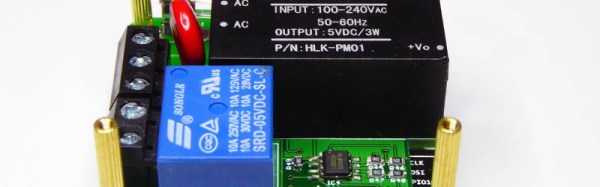
esp8266-powerbar-thumbInside the junction box, an eight-channel relay is connected to an ESP8266 module. The module uses MQTT to communicate with Home Assistant and is powered by a partially dismembered USB AC adapter — wrapped in kapon tape for safe-keeping. The entire bar is wired through a 10A fuse, while also using a fire resistant 4-gang electrical box. Once the outlets were wired in, closing it up finished up the power bar.

[robotmaker] controls the outlets via a cheap smartphone — running HADashboard — mounted to a wall with a 3D printed support. Don’t worry — they’ve set up the system to wait for the PCs to power down before cutting power, and the are also configured to boot up when the relay turns on.

The best part — the power bar only cost $25.

[via /r/homeautomation]

Wireless Doorbell Hacked Into Hands-on MQTT Tutorial

The project itself is very simple: getting push notifications via MQTT when a wireless doorbell sounds. But as [Robin Reiter] points out, as the “Hello, world!” program is a time-honored tradition for coders new to a language, so too is his project very much the hardware embodiment of the same tradition. And the accompanying video build log below is a whirlwind tour that will get the first-timer off the ground and on the way to MQTT glory.

The hardware [Robin] chose for this primer is pretty basic – a wireless doorbell consisting of a battery-powered button and a plug-in receiver that tootles melodiously when you’ve got a visitor. [Robin] engages in a teardown of the receiver with attempted reverse engineering, but he wisely chose the path of least resistance and settled on monitoring the LEDs that flash when the button is pushed. An RFduino was selected from [Robin]’s ridiculously well-organized parts bin and wired up for the job. The ‘duino-fied doorbell talks Bluetooth to an MQTT broker on a Raspberry Pi, which also handles push notifications to his phone.

The meat of the build log, though, is the details of setting up MQTT. We’ve posted a lot about MQTT, including [Elliot Williams]’ great series on the subject. But this tutorial is very nuts and bolts, the kind of thing you can just follow along with, pause the video once in a while, and have a working system up and running quickly. There’s a lot here for the beginner, and even the old hands will pick up a tip or two.

Continue reading “Wireless Doorbell Hacked Into Hands-on MQTT Tutorial”

Heat Pump Gets Brain Transplant; Such Is Life In Latvia

If you buy a used heat pump that was made in China and try to use it in Northern Europe, there are bound to be issues. If said heat pump ends up encased in a block of ice that renders it ineffective, you’ve got two choices: give up and buy a proper heater, or hack a new ice-busting brain board into the heat pump and get back to life.

fnfvpksiz6c8s0h-medium
A little too icy.

[Evalds] chose the latter course, obviously, and in the process he gives us a pretty good look at how heat pumps work and how to overcome their deficiencies. In [Evalds]’ Latvia, winters can be both cold and humid, which can worsen an inherent problem with air-coupled heat pumps: they tend to ice up. As the outside coil is cooled to pick up as much heat as possible from the outside air, water vapor condenses out on the coils and freezes. Most heat pumps account for this by occasionally running in reverse, heating the outdoor coils to clear the ice buildup. [Evalds]’  had nothing more than a simple timer to kick off the defrost cycle, and it wasn’t keeping up with the Latvian winter. An Arduino replaced the OEM controller, and wired up to temperature sensors and an IR sensor that watches for ice buildup on the lower part of the coil, the heat pump is now much better behaved.

Of course it wasn’t as smooth as all that — [Evalds] has some hoops to jump through, including EMI problems and a dodgy Arduino clone. But he stuck with it and brought the heat pump back online, likely at far less expense than HVAC techs would charge for a service call.

Continue reading “Heat Pump Gets Brain Transplant; Such Is Life In Latvia”

Your Internet Of Things Speaks Volumes About You

If only Marv and Harry were burglars today; they might have found it much easier to case houses and — perhaps — would know which houses were occupied by technically inclined kids by capitalizing on the potential  vulnerability that [Luc Volders] has noticed on ThingSpeak.

As an IoT service, ThingSpeak takes data from an ESP-8266, graphs it, and publicly displays the data. Some of you may already see where this is going. While [Volders] was using the service for testing, he realized anyone could check the temperature of his man-cave — thereby inferring when the house was vacant since the location data also happened to be public. A little sleuthing uncovered several other channels with temperature data or otherwise tied to a location that those with nefarious intent could abuse.

Continue reading “Your Internet Of Things Speaks Volumes About You”

Touch Sensitive Cement With Just A Dash Of Neon

For quite some time now we’ve seen people casting their own countertops and other surfaces out of cement. It’s a combination of mold-making and surface finishing that produces a smooth and durable surface at quite a low cost, if you don’t factor in damage done to your back when lifting the thing for installation.

This offering is a little bit different. [Elliott Spelman] built his own touch sensitive cement table top. When you place your grubby hands on the polished surface, a loop of neon lighting is switched on. This is thanks to a 4:1 mix of quick setting cement and iron oxide powder. Bare copper wire was laid around the edges of the surface to be encased by the cement for making connections later.

There were some sad moments when [Elliott] was removing the cast surface from the mold. He ended up cracking it and suggests others be liberal with their use of both wax on the mold before casting, and patience in removing the cement afterward. We might also suggest a strengthening agent like fiber reinforcement. The edges and surface can be sanded to the finish desired and in this case, attaching table legs was easy since the wooden underside of the mold remains on the bottom of the cement.

The neon lighting adds a retro touch to this build. It’s sad to see this technology dying away, so a resurgence of artisanal neon is great in our book. [Elliott] found a Bay Area arts collective called the Crucible which does a lot of art glass education to help him make two hoops of glass tube and fill them with the appropriate gasses. A capacitive touch sensor (once Atmel, now Microchip part) AT42QT2120 (datasheet) monitors the wire coming from the slab and switches the power supply for the tubes using a combination of relay board and Arduino Uno.

We find the prospect of positional sensing in doped cement fascinating. Anyone have ideas for adapting this technique so that a more long and narrow slab could have positional awareness within, say, a few inches? Let us know in the comments.

Continue reading “Touch Sensitive Cement With Just A Dash Of Neon”

Custom Parts Put IKEA Window Shades On IoT

No matter what the project is about, we’re always suckers for nicely integrated builds with good fit and finish. There’s a certain appeal to rat’s nest wiring on a breadboard, and such projects are valuable because they push the limits. But eventually you need to go from prototype to product, and that’s where this IKEA window shade automation project shines.

Integration is more than just putting everything in a nice box, especially for home automation gear – it really needs to blend. [ehsmaes] roller blind motorization project accomplishes that nicely with a 3D-printed case for the electronics, as well as a custom case for the geared stepper motor to drive the shade. The drive replaces the standard spring-loaded cap on the end of the IKEA Tupplur shade, and the neutral color of both cases blends nicely with the shade and surroundings. The control electronics include a NodeMCU and a motor shield; [eshmaes] warns that narrow shades work just fine off of USB power, but that wider windows will need a power boost. The IoT end of things is taken care of by MQTT and OpenHab, allowing the shades to be raised and lowered to any position. The short video below shows the calibration procedure for the shade.

Need a primer on MQTT? We’ve got you covered. Or perhaps you need to control the windows rather than the treatments.

Continue reading “Custom Parts Put IKEA Window Shades On IoT”