Building Fiber Optic Chandeliers

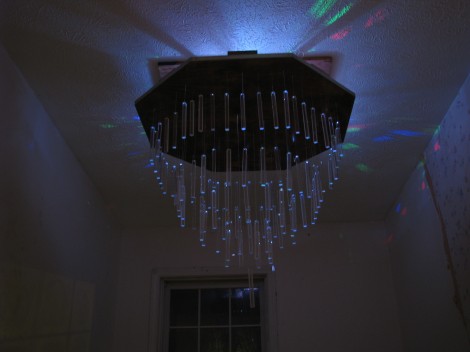
This chandelier keeps the light source hidden and uses fiber optics to illuminate the acrylic diffusers. It’s the second attempt [TheCreator] has made at building his own. Bother projects are interesting in their own way.

The first attempt used marbles as diffusers and had a much different look to it. This time around he’s using what he calls acrylic dowels. They’re not round, but square (which is why we’re not sure dowel is the right term), and he says they work better than marbles for several reasons. The marbles weren’t very heavy so they didn’t really weigh down the glass fibers to keep then straight. They were also difficult to attach to the fibers and prone to breakage.

To attach the dowels he drilled a hole in the end and epoxied a fiber optic strand in place. To direct light into the other end of the filament he built his own frustum (a pyramid with the tip cut off) of inward facing mirror. This helps to focus what is coming from the RGB LEDs in the appropriate direction so that as much light as possible makes it into the fibers.

He didn’t really give any final thoughts so we wonder if it puts out enough light for his needs. We’re sure that if it’s purely a mood piece he’s satisfied.

Automatic Trough Filler Makes Sure The Animals Have Water

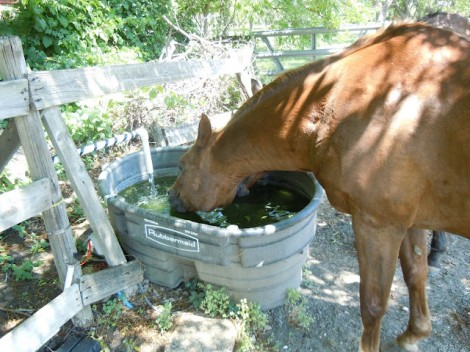
It has been a hot hot summer for many parts of the US. The heat has been dangerous at times and making sure the livestock has the water they need is incredibly important. [Maddox] recently upgraded the automation on their water troughs which will help with the process. Sure, they still have to check on the animals, but this will ensure there’s plenty to drink in between those visits, and that a malfunction doesn’t waste precious water.

There has always been some level of automation here, but it relied on float valves which were frequently malfunctioning. This project seeks to get rid of the float value and use solenoid valves like those used in irrigation. These solenoids can run from a 9V battery and offer quite a bit more reliability than the mechanical vales. There is still a float sensor which measures the water level, filling up the trough when needed.

An MSP430 Launchpad was used for the prototype, from which a PCB was designed. Since this needs to be weather-proof a water tight enclosure was sourced. The company that makes the enclosure also provides DXF templates which [Maddox] used to establish the size and outline of the PCB.

Father/son Team Goes Big With Backyard Observatory

Oh that? It’s just the backyard observatory we built last summer. You know, for fun. This is a conversation we image [Kakon24] and his dad are having quite often these days. They’re astronomy interests just got a big equipment upgrade when they built a huge observatory on their homestead. Now we don’t proclaim to know a lot about observatory quality, but this is head and shoulders above what most people manage to acquire.

It isn’t a simple build either. It’s a full-fledged building of its own, starting with a poured foundation, then stick framing which was covered in stone work. The images tell the story of the build, but for information on the hardware you’ll want to read through the comments over on the Reddit Astronomy thread. Sounds like the scope itself cost over 100 grand so having a proper building to protect it is a must.

Monitoring Your Home Energy Use

[Dave’s] been elbow-deep in mains voltage while building this home energy monitoring rig. He started with an approach that is different from most we’ve seen before. He wanted a system that could make a linear measurement to keep the accuracy as high as possible. His first thought was to use a opto-isolated linear amplifier to measure voltage, but ended up altering that plan since he’s looking for digital values when all is said and done.

He’s using an ADC on the mains side of the interface board, then sending the digital values to an Arduino with opto-isolators to keep the high voltage separate from the low. This does complicate things a little bit, as he has low voltage rails on either side; 0V and 5V to run the ADC on the mains side, and separate 0V and 5V to run the Arduino. To solve the problem of accurate current measurement over the full range a house uses he opted for a Programmable Gain Amplifier. It’s addressed via SPI and allows him to adjust resolution to facilitate accurate measurement of very small currents. We think anyone who has tried to measure small appliances (like an alarm clock) with a Kill-A-Watt and gets a zero reading will appreciate this.

The Arduino sends data via a serial connection, which [Dave] is currently graphing using his laptop. It would be nice to see a simple web-server using the Ethernet shield (or a different board like the RPi) so you could log in from the couch and see what’s been going on with your home grid.

Garage Door Opener Now A Bedroom Door Closer

[Roy] had an extra garage door opener on hand and decided to put it to use as a remote control closing mechanism for his bedroom door. We gather he has some noisy housemates as the inspiration for the project came from not wanting to get out of bed to close the door when the ruckus interrupts his TV watching.

The image above shows the hinged system which translates the linear motion from the garage opener track to the rotational force necessary to swing the door closed. We’d say he really nailed it because the system matches the angle of the door jamb perfectly, and when the door is fully open the angle bracket is almost flat against the wall. We certainly don’t have the same need for closing doors, but the mechanism is something to keep in mind.

The motor for the opener is hidden beneath his desk. You won’t be able to see it in the video after the break because he built a matching enclosure around it. Now he just needs to add some WiFi connectivity and he can ditch the uni-tasking RF remote for a smart phone app.

Continue reading “Garage Door Opener Now A Bedroom Door Closer”

Cat Trainer Will Keep Them Off The Counters

Our cats are not allowed on the kitchen counters, and [Iron Jungle] has the same rule. But he spotted some foot prints on the hood above his range and the addition of a security camera caught this picture of [Kelso] breaking the rules. Since he’s not always around to make the fur-ball behave he built an electronic cat trainer to do it for him.

The functionality needed isn’t very intricate. You need to monitor when the cat is where it shouldn’t be and then chase it away. For the latter he grabbed an infrared range finder. When the cat passes in front of the sensor it will trigger the second part of the system: a high-pitched buzzer that’s extremely loud. Any microcontroller will have no trouble driving the system. In this case it’s a PICAXE 28X1.

You can see the trainer in action after the break. It definitely works, because just playing the video chased our own sleeping kitty out of the room.

Continue reading “Cat Trainer Will Keep Them Off The Counters”

Monitoring A Clothes Washer With An Accelerometer

[Viktor’s] washing machine did a good job of cleaning his clothes, but it kept a bit too quiet about it. The machine doesn’t have an audible alert to let him know the cycle has finished. He decided to build his own alarm which can just be slapped on the side of the machine.

You can see that a couple of magnets hold the board to the metal housing of the washer. The board doesn’t actually connect to any of the machine’s circuitry so this should work about equally as well for any unit. The detection is based on motion, thanks to a Freescale MMA7361 3-axis accelerometer. When he starts a load of wash he flips the power switch for the board on. The PIC 12F683 that drives the device starts monitoring the accelerometer for changes. If it goes for more than about one minute without reading motion the piezo buzzer starts beeping. It’s a fun and easy solution along the same line of this oven pre-heat alarm add-on.