Hackaday Interview With Amal Graafstra, Creator Of XNT Implant Chip

Near Field Communication (NFC) enabled devices are starting to appear in our everyday lives. Shown in the picture above is the xNT (fundraiser warning), a 2mm x 12mm fully NFC Type 2 compliant 13.56MHz RFID tag encased in a cylindrical Schott 8625 bioglass ampule. It was created by [Amal Graafstra], who therefore aims to produce the world’s first NFC compliant RFID implant. The chip used is the NTAG203, which is (for the sake of simplicity) a 144bytes EEPROM with different protection features.

We can only start thinking of the different possibilities this chip will create in the near future, but also wonder which precedent this may set for future NFC enabled humans. Embedded after the break is the presentation video of xNT but also an interview I conducted with [Amal Graafstra], who has already been living for 8 years with RFID tags in each hand.

Continue reading “Hackaday Interview With Amal Graafstra, Creator Of XNT Implant Chip”
An Interview With [David] Of Ultimaker

cura

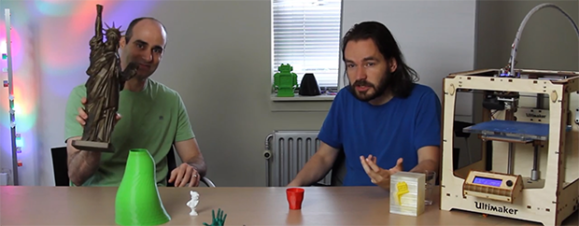
After interviewing the creator of Slic3r and the folks at Shapeways, [Andrew] is back again with his adventures in 3D printer videography and an interview with [David Braam] of Ultimaker

About a year ago, [David] looked at the state of the art in 3D printer control and Replicator G. While Replicator G, along with Pronterface and Repetier-Host both convert 3D models into G-code files as well as control the printer while its squeezing plastic out onto a bed. [David] thought the current state of these RepRap host programs were janky at best, and certainly not the best user experience for any home fabricator. This lead him to create Cura, a very slick and vastly improved piece of host software for the Ultimaker.

Cura isn’t just a fancy front end on an already existing slicer engine; [David] created his own slicing algorithm to turn .STL files into G-code that’s immensely faster than skeinforge. Where skeinforge could take an hour to slice a complex model, Cura does the same job in minutes.

There are also a bunch of cool features available in Cura: you can rotate any part before sending it to the printer, as well as pulling voxels directly from your Minecraft world and sending them to your printer. Very, very cool stuff, and if you’re running a Ultimaker or any other RepRap, you might want to check it out.

Continue reading “An Interview With [David] Of Ultimaker”

Interview: Another Kickstarter Round For The B9Creator

The Dawn of the 3D Printing Age - Art by Dennis HarrounNearly a year ago, the 3D printing scene saw a few new printers based on a technology other than squirting plastic out of a nozzle. These printers used DLP projectors underneath a vat of UV curing resin to build objects one layer at a time with incredible resolution.

Probably the most successful of these printers is the B9Creator from [Michael Joyce]. His original Kickstarter took in half a million dollars – 10 times his original goal – and still managed to deliver all the kits to backers within 2 weeks of the promised date. Now, [Michael] is running another Kickstarter before taking his printers to select distributors. We played some email tag with [Michael] for an interview discussing the perils of a hugely successful Kickstarter, and the future of the B9Creator ecosystem.

Check out our interview after the break.

Continue reading “Interview: Another Kickstarter Round For The B9Creator”

Hack A Day On Fact Or Fiction With [Veronical Belmont]

Enjoy a fun episode of “Fact or Fiction” with [Veronica Belmont], with guest [me] from Hackaday.  The show “Fact or Fiction” generally takes some popular topic and talks to experts who can shed some light on the topic. They’ve had all kinds of intelligent people on, and also me.  If you watch a few episodes you’ll see that she tends to let people talk about the science for a bit, but inevitably veers over into “can we actually make this?”, which tends to elicit an awkward and somewhat humorous response from the person being interviewed, because most of the things they’re talking about are pretty outlandish, like portal guns.  I enjoyed the one about life on mars, especially when she asks the gentleman how accurate portrayal of martians in movies are, right after he explained that we’re looking microscopic things.

On a completely unrelated note, it is a very very small world. I ran in to [Veronica] at CES a few years ago and we found that both her and her husband both worked in the same office as [Phil Torrone] when Hackaday was just beginning.

[Prusa] Interviews A Whole Bunch Of RepRappers

prusa

Any time a media outlet or conference wants an expert on 3D printing there are two people to turn to. The most famous is [Bre Pettis] of MakerBot. The other is an awesome guy named [Prusa], designer of the most popular RepRap and possibly the most popular 3D printer of all time. He’s been putting his fame to use by interviewing all the big names in 3D printing and putting them all up on his YouTube account.

First up is [Kliment], RepRap core dev and creator of the Sprinter firmware and Pronterface host.

[Ruben Lubbes], RepRap community guru, tells [Prusa] about his collection of RepRap parts from famous RepRappers. It sound like a quite interesting collection that’s probably very valuable from a historical perspective. Who knows, in a few years it could be as interesting as [Gutenberg]’s first printing press or [Tim Berners-Lee]’s NEXT cube.

Next up is [Tonokip]. He developed the original Tonokip firmware, the firmware that all major RepRap firmwares are based on.

[Prusa] also interviewed [Jordan Miller] a.k.a. [jmil] of the Philly hackerspace Hive76 and the University of Pennsylvania. He made his name in the RepRap community for 3D bio printing.

Wrapping up the most interesting people, there’s also an interview with [Sound], developer of the Slic3r firmware. We’ve seen an interview of [Sound] before, and this interview continues the earlier one by talking about multiple extruders and how awesome the RepRap community is.

Lastly, and unfortunately, is a short video of [Prusa] interviewing me at the world Maker Faire last September[Prusa] is a huge fan of Hackaday, so this interview is just two guys being star struck at each other.

Actually, the 2012 World Maker Faire had the largest number of current and former Hackaday alumni in one place ever. A group interview of  [Ian] (now of Dangerous Prototypes), [Phillip Torrone] (Adafruit), [Phil Burgess] (Adafruit), current Hackaday boss man [Caleb] and myself would have been awesome. We’ll try harder next year.

You can check out the good videos after the break.

An Interview With The Creator Of Slic3r

[youtube=https://www.youtube.com/watch?v=vA6jmg_zcQo&w=580]

When in Rome, most people visit great works of art, see masterpieces of architecture, or simply try to convince random tourists that a modern recreation of naval battles in the Colosseum would be really cool and somebody should really get on that. [Andrew] had a different idea, though. He thought meeting up with Slic3r developer [Alessandro Ranellucci] would be just as educational and entertaining as visiting a basilica and thoughtfully decided to film his interview for all to see.

Whenever a file of a 3D object is sent to a 3D printer, the object must first be converted into GCode – the language of lines, circles, and computer aided design that all 3D printers speak. To convert 3D objects to GCode, every piece of 3D printer software from Pronterface, ReplicatorG, and Repetier must first ‘slice’ the file up so the object can be printed one layer at a time.

As the lead dev for Slic3r, [Alessandro], a.k.a. [Sound] goes over the current happenings of his STL to GCode converter – he’s even getting a little support from the very cool people at LulzBot – and the future of Slic3r. There’s still a lot of work to be done optimizing the current software, improving the user interface, and getting rid of all those nasty edge-case bugs.

For as much as we at Hackaday focus on the hardware half of 3D printers, it must be said the current state of the art in desktop manufacturing wouldn’t be where it is without [Alessandro] and other software devs. There’s still a lot of room for improvement – try printing a single wall thickness cylinder without a seam, for example – but without software projects like Slic3r, 3D printing wouldn’t be where it is today.

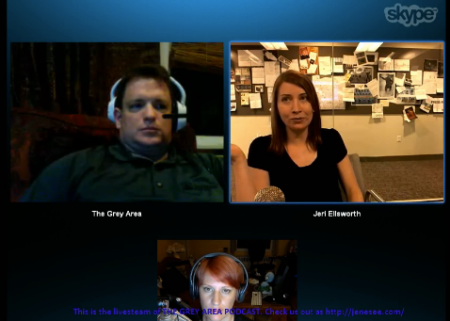
An In Depth Interview With [Jeri Ellsworth] About Everything

Here’s an interesting interview with [Jeri Ellsworth] over at the Jenessee Network. Usually the interviews I see popup with people are fairly short and sweet but this one really delves into many subjects and takes its time to explore. They start off talking about how [Jeri] began with hacking, which was literally smashing toys “with rocks” to see what was inside. They move on to discuss her adventures in building a race car, and then racing it as a teen… as an act of defiance.

In case you didn’t know, [Jeri] has been full time at Valve for about a year. Much of the discussion focuses on this from about 20 minutes in. She doesn’t hold back on information about what her daily life is like at valve as well as her experience during the hiring process. An interesting fact is that she didn’t initially recognize the name “Valve” and ignored them for a while. She does admit that if they had mentioned portal she would have paid a little more attention.

I was unaware that she had a side job putting the overflow of pinball machines she aquires into bars. When she moved to valve, she shut down that business, but she’s been flooding the halls with pinball machines, much to the enjoyment of the older folks.