LED Bicycle Hack Makes Sure You’re Seen At Night

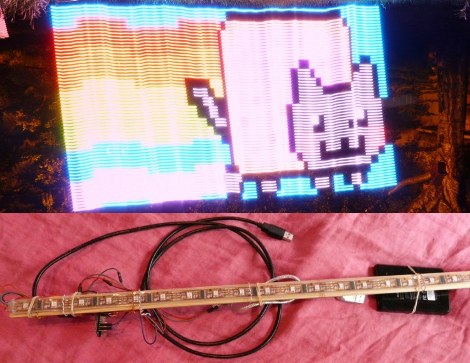
The bicycle tail and head lights that we’re accustomed to are small add-on modules. This take on the idea uses strips of LEDs to protect you from behind. They’re very bright, matching the pair of LED headlights that are attache to the handlebars.

Apparently [A.Davis12] had some LED strips laying around. There’s not what we’re used to seeing, but they have a similar footprint so you should be able to substitute the kind that come on a spool and may be cut to length. The majority of the build time was spent integrating the lights and their control wires with the frame of the bike. The frame already has holes in it for feeding the control wires for brakes and gear shifting inside the tubing. It sounds like it was a pain, but eventually he managed to get all of the routing done. Two red strips are zip-tied to the back of the seat stays. They are powered by a lithium battery inside the project box which mounts under the back of the saddle. A flip switch on the case lets you turn them on without stopping.

[Thanks Arpad]

A Wedding Cake Made Out Of LEDs

[Andrew] wanted to do something special for his wedding. Since he and his fiance [Missy] decided on a cupcake wedding cake, [Andrew] decided to wow his guests with an RGB LED cupcake holder.

The tiers of [Andrew] and [Missy]’s cupcake holder are made of acrylic laser etched with a damask pattern. These tiers are supported by a cylinder embedded with RGB leds that provide edge lighting for the acrylic panels. The effect is a series of permutating lights that illuminate the cupcake holder with every imaginable color. On the top of the cupcake cake, there’s a great cake topper made of frosted and laser cut acrylic that has the same color fade effect as the cupcake holder.

On the electrical side of things, the cupcake holder has 44 LEDs on all it’s levels. FETs driven by a 40-pin PIC18F control all the LEDs and the whole piece is powered by a computer power supply.

It’s an awesome build, especially considering it was finished just days before the wedding. After the break, you can check out a few more videos showing off the beauty of [Andrew] and [Missy]’s wedding cake.

Continue reading “A Wedding Cake Made Out Of LEDs”

Hipster Chandelier

This chandelier is something we’d expect to see on sale in the local gallery store. [Starkec] made it a couple of years back and we just love the look. The materials are pretty common, and you can throw it together in an afternoon.

The diffuser are made from clear glass soda bottles. After removing the labels and giving them a good cleaning, they were each set upside down and sprayed with some glass frosting spray. A four-conductor telephone wire serves both as the support for the bottle and electrical path for the RGB LED inside of each. The original screw cap for the bottles makes it a twist to install them after the soldering is done. There are two common color buses so that alternating colors can be shown at the same time. After seeing the video we think you’ll agree that the wiring scheme makes for some great animated effects.

Continue reading “Hipster Chandelier”

Lighting Up A Runway Into The Garage

[Timo] didn’t want to look like every other lighted driveway but using solar path lights. Instead he decided to light it up as if it were a runway. It’s easy to look at the result as cute and move on to the next hack. But look again. If you were going to do this yourself how would you implement it considering a car will drive over it, and it’s outdoors?

The first issue of protecting this from traffic is actually not too tough in this case. [Timo’s] driveway is made of pavers and is not a solid sheet of asphalt or concrete. He drilled out some of the intersections to make just enough room for each of the PCBs he etched to house the LEDs and host the driver. These boards are inserted horizontally into the sand between the pavers like a fin, with the surface mount LED positioned along the edge. Power and control wires run along each line of lights. They are serial controlled which cuts down on the number of conductors needed. [Timo] didn’t mention weather proofing but we’d suggest casting them in crystal clear resin just like this headphone amplifier.

Hacking Color And Battery Life On A Solar Powered Garden Light

Give your garden lights a little bit more life by changing out the LEDs. In the process, you can also choose a different color if you like. It really is as simple as cracking it open and replacing the stock LED, but a bit of a change may also prolong the stored charge.

These garden lights consist of a small solar cell and an LED, both controlled by a small PCB powered from a NiMH rechargeable battery. Sure, you could try to put in a battery that has more potential, but if you replace the single LED with two of them in series, it drops the current consumption and increase the battery life. Just make sure to use super bright LEDs and the intensity change will not be all that noticeable. That comes partly from the fact that our eyes don’t detect intensity changes as well when a light is already very bright. And since it’s two LEDs, mixing colors is an option as we see above.

[Thanks Ken]

Keeping An Old 8mm Projector Alive With High-power LEDs

There’s a certain mystique about old home movies and 8mm film; whether it’s footage from a family gathering from 40 years ago or a stop-motion animation you made when you were 12, there’s an immediacy for film that the VHS tapes from your family’s first camcorder can’t match. [Teslas Moustache] has been getting into 8mm cameras and projectors, so when he came across a 8mm/super 8 projector that needed a bulb, he knew he had a worthwhile project on his hands.

To replace the burnt-out and very expensive to replace incandescent bulb, [Teslas] sourced a very bright star LED from Jameco. This 1 Watt LED puts out more than enough light to project a frame of film onto a screen and fortunately doesn’t get as hot as the stock bulb.

To power the LED, [Teslas] used a cell phone charger powered from the 120 VAC incandescent socket to supply the requisite 5 Volts at 1 Amp (Ohm’s Law works on coffee) power for the LED. Right now, there’s still the matter of fabricating a nice enclosure to mount the LED and charger in the bulb socket, but once [Teslas] figures that out, he’ll have a very nice 8mm projector on his hands.

Power Index Window Display Turns Buildings Into LED Matrices

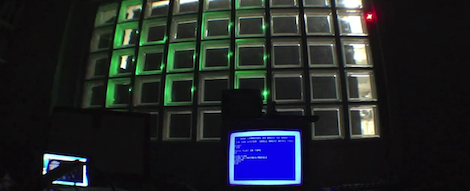
What started off as a fun project using light bulbs picked up some sponsorship and is going on tour. This project now uses LED modules controlled on the 2.4 GHz band to turn buildings into full color displays. It’s the product of students at Wrocław University of Technology in Poland. The group is something of an extra-curricular club that has been doing this sort of thing for years. But now they’ve picked up some key sponsorships which not only allowed for upgraded hardware, but sent the group on a tour of Universities around Europe. Who would’ve thought you could go on tour with something like this?

Much like the MIT project we looked at in April, this lights up the dark rooms of a grid-like building. It does go well beyond playing Tetris though. The installation sets animations to music, with a custom animation editor so that you can submit your own wares for the next show. Don’t miss the lengthy performance after the break.

Continue reading “Power Index Window Display Turns Buildings Into LED Matrices”