Insane Covert IR Illumination

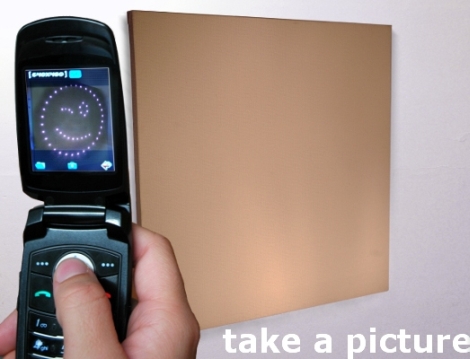
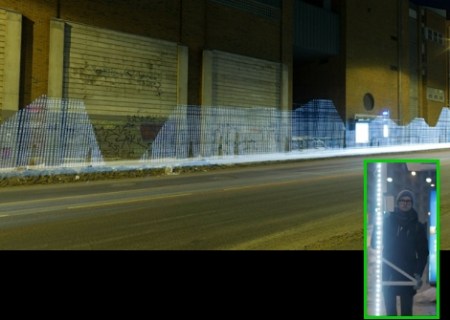
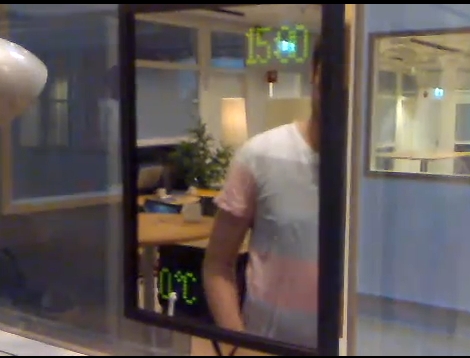
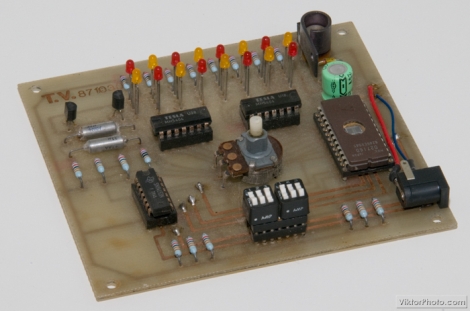
[Onironaut] over at lucidscience sent us a link to his latest project, some IR illumination panels. At first, we were mildly enticed by his usual high standard of photography and description. It was just an array of LEDs though. Still, we kept hitting the “next page” button because he goes into such great detail. Then we saw version two. Instead of simply being an array of IR LEDs mounted outside for his security camera, he has mounted 1536 IR LEDs inside an old flat panel monitor. That’s a fake monitor producing 180 watts of IR light, and we think that’s even at half power!  He replaced the screen of the display with one way mirror, so you would have no idea that it isn’t just a normal screen sitting on his desk.  Great job as usual [Onironaut].

Conways’ Wall Of Life And Whiteboard Emporium

White board beats chalk board, LED marquee beats white board, and an LED white board trumps them all.

This hybrid lets you draw on the surface with dry erase markers while Conway’s game of life plays out underneath. [Bert] sent us this tip after seeing yesterday’s office marquee. This version is quite similar in appearance but the guts are very different. Inside you’ll find a Parallax SX28 microcontroller doing the heavy lifting. The display is multiplexed but they didn’t go with a common 595 shift register, but a beefier MAX6979 LED driver. We’re not too familiar with this part but it does have a lot of nice features like constant current, and automatic shutdown if serial data stalls for more than 1 second. This is a low-side driver so transistors are used to connect voltage to the rows; the opposite from the setup we looked at yesterday. This was built several years ago and is still working happily even though its permanent home is a breadboard. Source code can be found on this page.

12 Foot LED Display Keeps Your Office Informed

Don’t reach for a sticky note when you need to leave a message for your office mates, write it down on a 12 foot LED marquee. [Kitesurfer1404] built this for his home office, but we’re sure he’ll find fun stuff to use it for. The display has 512 LEDs driven by plain old 595 shift registers for the high-side columns, with an ULN2803A Darlington Array to pull the eight rows to ground. The whole thing is controlled by an ATmega8 via a serial connection. Our compliments to the builder for accurately drilling a grid of 64×8 holes in each hardboard panel of the display. The buses for each row and column also look nice and clean. For the final look a 79% light transmittance frosted acrylic panel was added to diffuse the light.

We used the same method to build our LED pumpkin. Transistors ran the low side, and if we had needed more columns, shift registers are a popular go-to for I/O expansion. Check out that project to learn more about display multiplexing.

Scrolling Marquee Made From GE Christmas Lights

[John Riney] picked up three strands of addressable Christmas lights and used them to make a scrolling marquee. You may remember that the G-35 lights were hacked at the beginning of December, and we saw a project or two that involved these fun toys.

In order to make the display [John] modified the original packing material to hold three strands in a six by eighteen grid for a total of 108 pixels. In the video after the break he points out one interesting feature of the strand that we don’t remember from looking at the original hack; each bulb’s address is not fixed, it can be set after power-up. This works the same way as sending color data, except that you just send the address. This makes controlling a grid like this extremely easy from a microcontroller programming standpoint. Once all of the addresses have dropped down the serial bus, you’re ready to start sending color and intensity data packets.

The setup is fast, bright, and beautiful, taking just three pins of an Arduino for control. The only thing holding us back from trying this ourselves is the $150 price tag. But that was before the holiday, and we have heard some whispers about closeout deals on this product.

Continue reading “Scrolling Marquee Made From GE Christmas Lights”

OLED Displays And Small Microcontrollers

If you’ve ever thought of utilizing a small and inexpensive OLED display in your project [Rossum] has the details you need to get started. In the past we’ve seen him take a tour of available LCD screens and this is much the same, detailing his look at three different models. In the video after the break each is connected to a driver board that he made. The boards have two important components, the first is a boost driver for the 12-16V input the screens need, the second is an octal buffer necessary if you are using a 5V microcontroller. These take care of the hardware considerations, making it simple to drive them with a chip of your choosing.

Continue reading “OLED Displays And Small Microcontrollers”

Creating Art From An Old Christmas Tree

So you manged to get a great deal on a fake tree during the after Christmas sales, but what should you do with your old one? If it was lighted with fiber optics you can reuse the strands to create your own star map. [Mr Trick] shows how to disassemble one of these trees, grouping the fibers by length. He built a wood frame, then covered it with a layer of cardboard and another of black fabric. From there the painstaking process of routing the fibers in a way to looks convincing starts.[Mr Trick’s] final product uses multiple LED light sources and even includes RF control.

Think this project is large and time-consuming? Check out the same idea built into a bedroom ceiling.

Rovio Headlight Hack Looks Stock

Even the most thorough inspection may not raise the alarm that this Rovio has been hacked to include LED headlights. [Adam Outler’s] super clean work puts the two light sources on either side of the camera for maximum effect. It may not provide as many Lumens as our external headlight hack, but we were never all that excited about the black project box that housed it. [Adam] built the circuit on a scrap of perfboard, using a transistor to connect the LED pair to the battery, with the original LED power wire going to the base in order to switch the transistor.