Recover Acer Aspire One From “failed To Initialize HAL” Error

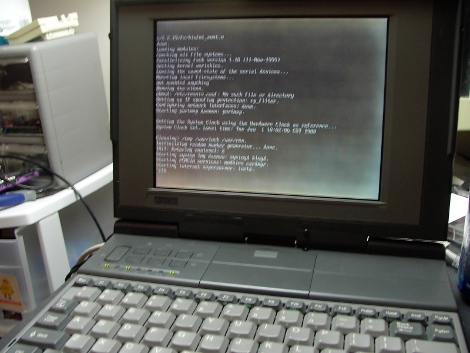
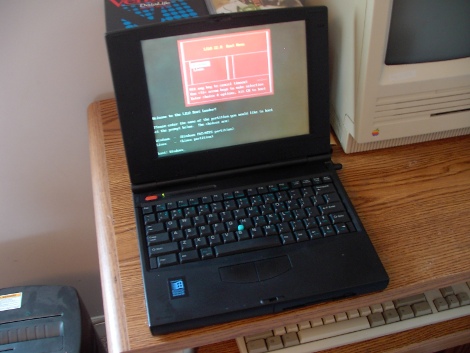
The Acer Aspire One is a netbook that often ships with a Linux OS preinstalled. This is great for fans of open source as market share is calculated based on units shipped, not what users install after they buy the hardware. Unfortunately there is a pretty major flaw that can cause a “failed to initialize HAL” error as seen above. [Michael Crummy] came up with a set of steps you can use to recover from this error.

So what is this error? HAL stands for Hardware Abstraction Layer and it’s what allows one user interface to communicate with many different types of hardware. If you’re the proud owner of an Aspire One and are struck with this error you will suddenly find that you can no longer use the USB ports, card readers, wired or wireless network connectors, or the sound card. So you can’t connect to the Internet, and you can’t get any files on or off of the device using the currently installed operating system. For an OS that [Neal Stephenson] once described as “like the M1 tanks of the U.S. Army, made of space-age materials and jammed with sophisticated technology” this is a very big problem.

We know what you’re thinking… boot into a live session on a thumb drive and get what you need from the hard disk. Well that’s all fine and dandy, but you shouldn’t ever be forced to clean install Linux to fix a problem. So check out [Michael’s] method and make sure you turn off the Acer live update server which was mostly likely the cause of the problem in the first place.

Earthquake Alert System


[Roteno’s] submission for the 555 timer design contest is an Internet connected earthquake alert system. It monitors the USGS website for earthquake data and plays a tune when an earthquake occurs. The data is available as a feed in the form of a TXT file which is pretty easy to parse using cURL. He chose an LPCXpresso board (which is an ARM development platform that can run a Linux kernel) along with an XPORT module to handle the Ethernet traffic.

So where does the 555 timer see some action? It is responsible for playing the tone when an earthquake is detected. But playing just one pitch isn’t much fun. Instead, [Roteno] built the circuit above which creates a resistor network switched by a series of transistors. This way he can use GPIO from the microcontroller to choose different pitches. Check out the video after the break to hear the results. At power-up all eight pitches are played as a test, and the alert sound varies in pitch and tempo based on the magnitude of the earthquake.

Continue reading “Earthquake Alert System”

Walking Motion Analysis Using Wii Remotes

WiiGait is not a political scandal, it’s a project that records motion data while walking. [Bilal Chishti] and [Zassa Kavuma] are strapping a Wii remote onto each leg and recording the sensor data while making video of the walker at the same time. The two are using an Ubuntu box to pull the sensor data from the Bluetooth-enabled devices and utilizing its built-in webcam for the video. They graph the data for each axis and we’re sure that syncing up data anomalies with the video is just a matter of matching timestamps.

So what good is this? The creators are keeping us in the dark about an end-goal for collected data; this may just be for the experience of using the hardware. But we could see it having uses in making distance runners more efficient, or teaching that bipedal robot how to balance.

Continue reading “Walking Motion Analysis Using Wii Remotes”

RF Control From Just About Any Device

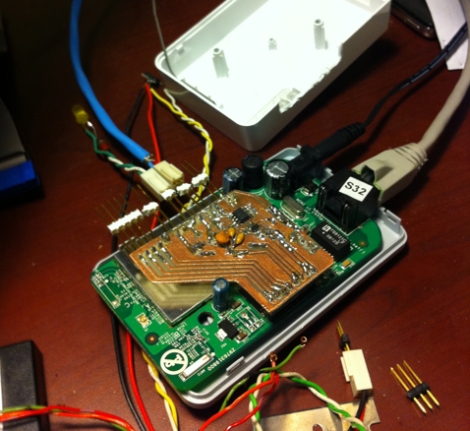
[Mirko] is working on a library that will allow you to add RF control to just about any device. The only requirement is that the device be capable of running a Linux kernel, and that it have a few GPIO pins available. One example is fairly straight forward, a Netgear router. Many, if not most routers run a Linux kernel natively and most have solder points on the board for unused IO pins so patching into the hardware is very straight forward. Less obvious and much more impressive is the hack seen in the image above. [Mirko] built an SD card adapter cable and uses the contacts in the card reader to bit bang four-wire SPI to communicate with that RF module.

Inexpensive Robot Platform Combines Mass-produced Parts

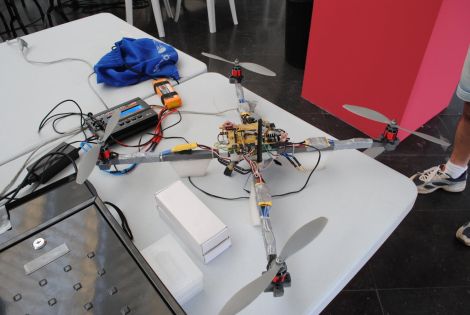
Meet Bilibot, a modular robot that aims to lower the cost of entry for robotic tinkerers. It combines the Kinect, the iRobot Create, and an Ubuntu box running ROS using some laser cut mounting brackets. These are relatively inexpensive components but the most exciting thing is that there’s already a slew of example out there that use this hardware. For instance, we looked in on ROS body tracking in January that can be directly plucked and used with this hardware. You’ll recognize the base as the iRobot create which was used in video chat robot from last week. The brains of the operation come in a choice of three Linux boxes – two headless and one laptop – which have ROS pre-installed. Watch the open-source autonomy as it tools around the office in the video after the break.

Continue reading “Inexpensive Robot Platform Combines Mass-produced Parts”

STK200 Pocket Change Programmer

A common complaints of beginners to microcontroller programming is the availability of DIY tools that do not require a parallel port.  Using not much more than a couple of 74xx series chips and some protoboard, [Rue] was able to create an AVR programmer for less than the cost of some chips it can program – giving parallel programmers a run for thier money. [Rue] used Linux treat the ubiquitous PATA/IDE port as a parallel port. By having avrdude treat the programmer as an Atmel STK200, [Rue] was able to upload a blinky program to his AVR microcontroller through ISP. If anybody can think of an even lower cost unconventional solution give us a shout.

Have A Face For Radio?

The help of fellow members of the Austrian technology collective/hackerspace [Otelo] allowed [Georg] to develop a networked audio streaming board, with less than $20 worth of components. Dubbed the OggStreamer for obvious reason, it’s designed to relay audio from a mixing board to an Icecast server (an open source implementation of SHOUTcast) in real-time. The board is based on the STM8 Discovery kit and the Xport Pro. It features stereo input, an onboard OGG Vorbis encoder, and (to top it off) is running uClinux. We think it’s very well thought out – but don’t take our word for it… the OggStreamer won second place last year in the Lantronix XPort Pro Design Contest, and [Georg] has documented it extensively (pdf).