Building An Artificial Heart With Ferrofluids

Here’s something we thought we’d never see on Hackaday. [Chris Suprock] is developing an artificial heart he calls Steel Heart. It’s an artificial heart powered by electromagnets and ferrofluids.

The idea behind [Chris]’ artificial heart is ingenious in its simplicity. An elastic membrane is stretched across a frame and a magnetic liquid (or ferrofluid, if you prefer) is poured across the membrane. An electromagnet is activated and the membrane stretches out, simulating the beating of a heart. Put a few of these together and you’ve got a compact, biologically inert pump that’s perfect for replacing an aging ticker.

[Chris]’ plan to use ferrofluids and electromagnets as an artificial heart give us pause to actually think about what he’s done here. Previously, artificial hearts used either pneumatics or motors to pump blood throughout the body. Pneumatic pumps required plastic tubes coming out of the body – not a satisfactory long-term solution. Motor-driven pumps can rupture red blood cells leading to hemolysis. Using ferrofluids and an elastic membrane allows for the best of both worlds – undamaged blood cells and transdermal induction charging.

Not only is [Chris] designing a freaking artificial heart, he also came up with a useful application of ferrofluids. We were nearly ready to write off magnetic particles suspended in a liquid as a cool science toy or artistic inspiration. You can check out [Chris]’ indiegogo video with a demo of the ferrofluid pump in action after the break.

Continue reading “Building An Artificial Heart With Ferrofluids”

Automated Squinting Instead Of Glasses, Contacts, Or Lasik

[Lee] is nearsighted and has had it with contacts and glasses. When trying to figure out an alternative, he looked at the core of the problem. The eye is not shaped correctly and therefore cannot focus adequately. The solution is to change the shape of the lens. This is exactly what lasik (laser eye surgery) does, but instead of going under the incredibly bright knife [Lee] built some headgear that pulls on your face to reshape your eye.

The hardware is from an old portable CD player. The sled that moved the laser lens has been repurposed to pull a thread taped to the skin at the corner of his eye. He built a control system that lets him adjust the tension by moving his fingers. Basically when the skin is pulled tight it causes him to squint and possibly reshapes the cornea just a bit. We’re not sold on the idea, but we can’t poo-poo the experiment; who knows what discovery this could lead to? We’re just glad he didn’t use electrical impulses to hack his peepers.

You can find some test video embedded after the break.

Continue reading “Automated Squinting Instead Of Glasses, Contacts, Or Lasik”

See In The Dark With This Bracelet Build

Even though she’s only in 8th grade, [Hannah Prutchi] is turning into a very respectable builder. She designed SharkVision, a wearable distance sensor that is meant to help the blind find objects they might bump into.

The SharkVision gets its name from shark’s ability to ‘see’ prey in their surroundings by sensing the local magnetic field. Instead of building her own Ampullae of Lorenzini, [Hannah] decided to take the easy route and use a few infrared sensors mounted to a bracelet. Whenever something is picked up by the proximity sensor, a voltage is applied to a pager motor telling the wearer they’re about to run into something.

[Hannah] and her classmates have successfully tested the SharkVision bracelet by walking around their classroom with eyes closed. They didn’t bump into anything, a fact [Hannah] attributes to neuroplasticity. We think it’s a neat build, but we’re wondering if this could be given to a population of blind people.

Replacing A Phantom Limb With A Kinect

Nearly everyone has heard of phantom limb syndrome. It occurs sometimes after a limb is amputated, but the mind of the patient still thinks that the limb is attached. Generally regarded as a mix-up in the wiring of the damaged nerves, a phantom limb can be very painful. [Ben] has been working on a way to alleviate some of the pain and frustration associated with a phantom limb and fortunately for us he went for a Kinect, VR goggles, and gyroscope build.

Today, most therapies for phantom limb syndrome use a Ramachandran Mirror Box. The theory behind the mirror box is pretty simple – if someone recently lost a hand, just insert one hand in one side of the box and the arm stump on the other side. Looking into the box from the side with the good hand will trick the patient’s brain into thinking the amputated hand is still there. It’s a good therapy that has been very successful, but [Ben] thought he could do something that is a little more immersive.

[Ben]’s project uses a Kinect and VR goggles to put the patient in a virtual environment. With the help of a few gyroscopes, the patient gets a virtual representation of their whole self projected into their goggles. The technique isn’t terribly different from VR phobia treatment, although there’s much more electronics and math involved in [Ben]’s build. The first test subject said his pain was going down, so it looks like he might have a success on his hand (no pun intended).

Check out the demos of [Ben]’s treatment plan after the break.

Continue reading “Replacing A Phantom Limb With A Kinect”

Reusing An Old Pacemaker As A Flash Timer

pacemaker-flash-timer

Most people use pacemakers to, you know, keep their heart pumping at a steady rhythm. [David Prutchi] on the other hand has found a pretty novel use for some of the old pacemakers he has in his collection.

We really had no idea that pacemakers had uses outside the world of medicine, but [David] has taken advantage of their reliability in one of his favorite hobbies – high speed photography. In a darkened room, he set up an infrared barrier which feeds its signal to the atrium input of an old pacemaker. The signal is relayed through the ventricular output, which then fires his camera’s flash.

The pacemaker allows [David] to set an “AV” delay, which is the interval between when the atrium input receives an electrical impulse and when that signal is repeated from the ventricular output. This allows him to finely tune how much time elapses from when a drop of milk breaks the IR barrier to when his flash actuates.

We think this is a pretty cool way to reuse an old pacemaker, but check out the shots he has captured and judge for yourself.

See Through Everything With A Home Made X-ray

[Grenadier] built his very own x-ray machine. He’s no stranger to high voltage – we’ve seen his Jacob’s Ladders and Marx generators. Surely he can handle himself with high voltage and dangerous equipment. With this portable x-ray machine, [Grenadier] has begun overloading Geiger counters. We’re just happy he knows what he’s doing.

The key component of [Grenadier]’s portable x-ray machine is the Coolidge tube, a simple vacuum tube that produces x-rays with the help of 75 kilovolts of power. The finished build looks awesome. Two meters display the milliamps and kilovolts going to the x-ray tube, and a trio of nixies display the exposure time.

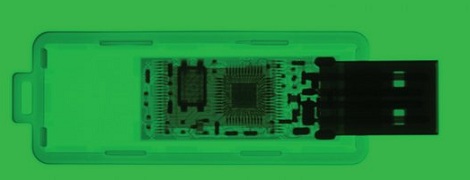
Even though [Grenadier] doesn’t have x-ray film, he can see through things with a scintillation screen that fluoresces when exposed to ionizing radiation. There are two pictures of the x-ray in action – one showing the inside of a pen and the guts of a hard drive (as shown in the title pic).

The output of the x-ray was measured with a Geiger counter. [Grenadier] was able to get a hit every second or so at 50 yards, and very loud white noise at 1 foot. Check out the video of [Grenadier]’s Buildlounge laser cutter contest submission after the break.

via Buildlounge

Continue reading “See Through Everything With A Home Made X-ray”