OpenCV Knows Where You’re Looking With Eye Tracking

[John] has been working on a video-based eye tracking solution using OpenCV, and we’re loving the progress. [John]’s pupil tracking software can tell anyone exactly where you’re looking and allows for free head movement.

The basic idea behind this build is simple; when looking straight ahead a pupil is perfectly circular. When an eye looks off to one side, a pupil looks more and more like an ellipse to a screen-mounted video camera. By measuring the dimensions of this ellipse, [John]’s software can make a very good guess where the eye is looking. If you want the extremely technical breakdown, here’s an ACM paper going over the technique.

Like the EyeWriter project this build was based on, [John]’s build uses IR LEDs around the edge of a monitor to increase the contrast between the pupil and the iris.

After the break are two videos showing the eyetracker in action. Watching [John]’s project at work is a little creepy, but the good news is a proper eye tracking setup doesn’t require the user to stare at their eye.

Continue reading “OpenCV Knows Where You’re Looking With Eye Tracking”

Building An X-ray Machine And Letting Everything Go To Your Head

It’s not every day one of the builds on Hackaday gets picked up by a big-name publication, and it’s even rarer to see a Hackaday contributor grace the pages of an actual print magazine. Such is the case with [Adam Munich] and his home-built x-ray machine.

We first saw [Adam]’s x-ray machine at the beginning of this year as an entry for the Buildlounge/Full Spectrum laser cutter contest. [Adam] won the contest, landed himself a new laser cutter, and started writing for Hackaday. Now that [Adam] is gracing the pages of Popular Science, we’re reminded of the story of Icarus, flying too close to the sun.

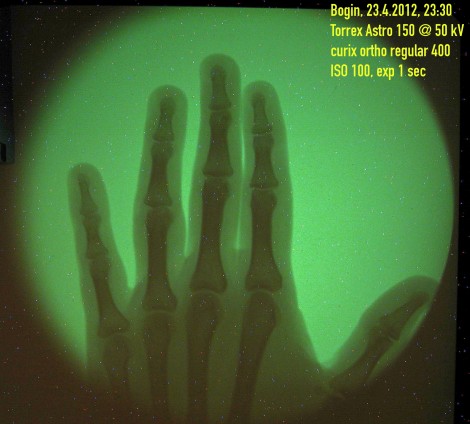
[Adam]’s x-ray machine is built around a Coolidge tube, the same type of vacuum tube found in dental x-ray machines. The device is housed in two suitcases – one used as a control panel and graced with beautiful dials and Nixies, the other housing the Coolidge tube and power supply. Proper x-ray images can be taken by pointing a camera at the scintillation screen, allowing [Adam] to see inside hard drives and other inanimate objects.

Sure, it’s a build we’ve seen before but it’s still very cool to see one of Hackaday’s own get some big name recognition.

Making A Miniature X-Ray Tube From Scratch

We know that most of you will have no reason to ever make a miniature X-ray tube. However, we also know that many of you will find this video mesmerizing like we did. [Glasslinger] does a fantastic job of explaining the entire process of creating the mini x-ray tube from, procuring the uranium glass and tungsten stem, creating the filament from scratch, all the glass work, and the testing.

Admittedly, most of us here at hackaday won’t go any further than admiring the craftsmanship, though we’re curious to see what [Adam Munich] has to say when he sees this story.

If you enjoyed the tube construction in the video, be sure to check out [Glasslinger’s] other videos. He makes all kinds of tubes in his shop and usually shares so much information along the process that each one has useful information beyond that particular project. Another crazy part is that he has made most of his own tools, including his glass lathe.

We really shouldn’t have to point out that X-Rays are dangerous. Don’t mess with them unless you have researched how to do it safely.

Monitor Your Heartbeat With A Webcam And A Flashlight

After seeing some heart rate monitor apps for Android which use the camera and flashlight features of the phones, [Tyson] took on the challenge of coding this for himself. But he’s not using a smart phone, instead he grabbed a headlamp and webcam for his heat rate monitor.

To start out he recorded a test video with his smart phone to see what it looks like to cover both the flash LED and camera module with his thumb. The picture is mainly pink, but there’s quite obviously a color gradient that pulses with each gush of blood through his skin. The next task was to write some filtering software that could make use of this type of image coming from a webcam. He used C# to write a GUI which shows the live feed, as well as a scrolling graph of the processed data. He took several tries at it, we’ve embedded one of the earlier efforts after the break.

Continue reading “Monitor Your Heartbeat With A Webcam And A Flashlight”

Digital Stethoscope Can Record, Playback, And Analyzer Heart Sounds

It’s somewhat amazing how these rather inexpensive electronics can augment the functionality of a common stethoscope. This digital stethoscope is using audio processing to add the features. A standard chest piece feeds a condenser microphone which is fed through a pretty standard OpAmp circuit which supplies the ADC of an ATmega644. After being digitized, the heart sound can be recorded in ten second increments to a 1 Mb flash memory chip. The data can also be fed to MATLAB via a USB cable in real-time. There it is displayed as a waveform and the heart rate is calculated on the fly. Check  out the video after the break for a great demo of the system.

The picture above shows a set of ear buds used as output. But this is a standard headphone jack, so the heart sounds can be played on speakers which we think would come in handy for teaching purposes. There’s also the option to hook it to a computer input which could be the audio used for a Skype session if a doctor is not close at hand. There is lots of potential here at a fairly low cost and we love that!

Continue reading “Digital Stethoscope Can Record, Playback, And Analyzer Heart Sounds”

Building A Prosthetic Leg From Scratch

[Radek] from Poland sent in a neat video of a bionic prosthetic leg he made for one of his patients. Even though [Radek] says it’s a ‘prototype of a prototype,’ we’d have to agree with him that it’s a very neat build that could provide inexpensive motorized prosthetic legs to amputees in the future.

[Radek] has been working on his project for about two years now, after building the motor and electronics by hand. The leg is powered by 1.5 kilogram battery pack – no details on the chemistry of the batteries, but [Radek] says it will last 12 hours on one charge. There are also small vibration sensors in the leg for a bit of feedback, and a few switches so the knee joint can be operated by the stump.

If you’re wondering where [Radek] got the proper tools and materials to make a carbon fiber prosthesis, he works for Carbon Prosthetics where builds simple prosthetic devices. His bionic leg creation looks really cool, and he says the final product will be much less expensive than the very high-end bionic prosthetic legs.

[Radek] was kind enough to share some more videos and a few pictures of his robotic prosthetic leg; you can check those out after the break.

Continue reading “Building A Prosthetic Leg From Scratch”

Tearing Down A Colonoscopy Pill Camera

Normally, colonoscopies are rather invasive affairs. Swallowing a small pill with a camera is much more amenable to a patient’s dignity and are seeing increasing usage in colon cancer screening. [Mike] acquired a pillcam from a relative who underwent the procedure and did a teardown to figure out how it works.

To get the video signal out of the body, the pillcam has two contacts that conduct the video signal through the body to stick-on contacts; It’s a more power efficient way of doing things versus a radio transmitter. After opening the plastic and metal capsule, [Mike] found three batteries and an impressively small circuit that contained an array of LEDs, a camera, and what might be a small MCU.

Taking a scope to the electronics in the pill, [Mike] found an impressively complex waveform that sends uncompressed image data to the receiver every few seconds. Although the camera was somewhat destroyed in the teardown, we’re pretty confident [Mike] could decode the image data if he had another… ‘sample.’

[Mike] says if you can ‘retrieve’ another one of these pill cameras, he’ll gladly accept any donations and look into the differences between different makes and models. Just make sure you sanitize it first. After the break you can see [Mike]’s teardown and the inevitable poop jokes in the comments. One last thing – if you’re over 50, doctors should be looking at your colon every 5 or 10 years. Get screened.

Continue reading “Tearing Down A Colonoscopy Pill Camera”