Tiny Chess Playing Computer

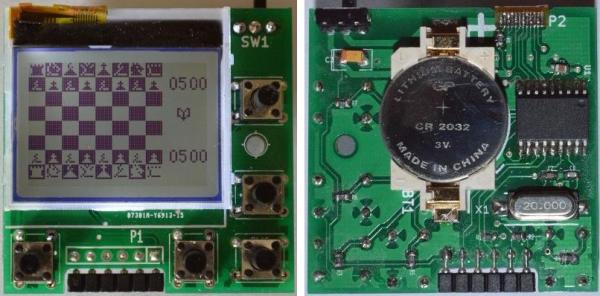
We have covered many chess computers in the past, but we think this might just be the smallest. Enter the PIC Blitz: A tiny low-cost low-power computer that can play lightning chess.

It’s based on a PIC16F628A microcontroller, which only has 3.5kbytes of flash and a mere 224 bytes of RAM. For comparison, Boris (one of the first consumer chess computers), utilized an 8-bit microprocessor with 2.5 kbytes of ROM and 256 bytes of RAM.

PIC Blitz has a full fledged chess library: it knows all the moves, all the basic openings and even changes its evaluation function weights as the game progresses to keep the game interesting. The creator [Mark Owen] quips about some of the additional techniques he utilized to make up for the limited processing power; including “pondering time”, a difficult and slow user interface, and of course, a barely-comprehensible LCD.

If you’re interested he has released the files under Creative Commons, and has a link to the PCB layout on the project page – we won’t link it directly though, since it goes straight to a download.

[Thanks Martin!]
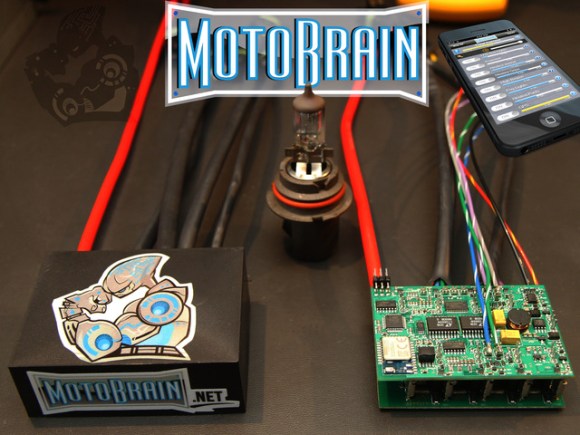
Motobrain: A Bluetooth Controlled PDU

motobrain

If you’ve ever considered modding your vehicle’s electrical system, [Josh Oster-Morris’s] Motobrain PDU (power distribution unit) might make life easier by providing precision control and protection for auxiliary 12V outputs in your car, bike, boat, etc. Once the Motobrain is paired to a phone over Bluetooth, a companion app displays real-time telemetry and lets you program up to 8 output channels.

Each of these 8 outputs can be directly controlled in the app, but the real power lies in the 4 programmable inputs. Here you can tie systems together and dictate exactly how one should respond to the other, e.g. detecting high-beams and disabling the auxiliary light bar you added. There’s even a “delayed on” option. Programming also has PWM capabilities, so flipping a switch could raise the brightness of some lights over 4 levels of intensity. If those lights are LEDs, the Motobrain can also provide constant current to specification. Each circuit can supposedly handle 15A continuous current and has a programmable circuit breaker, which would make fuses optional.

You can watch an overview video after the break to get a better idea of how it all works, but stop by [Josh’s] project blog to see all the features explained across multiple videos and blog posts as they are developed and tested.

Continue reading “Motobrain: A Bluetooth Controlled PDU”

Homemade LED Helmet

LEDHelmet

We’ve all seen Daft Punk helmet builds, but [George’s] project is a homemade LED helmet that takes no shortcuts and packs the visor full of hundreds of individual lights. He started with a prototype that uses a PIC 18F4580 microcontroller connected to a MAX7221 LED driver, which gave him control over some dot matrix displays to test the wiring and sample script. He then used this prototype setup to develop a scrolling text function.

With testing complete, [George] wired hundreds of LEDs into 8×8 block sections, using a cardboard jig to keep everything straight. He could have stopped there, but [George] took the build further, adding an LCD display and a 7-segment clock module to the inside of the helmet, in view of the wearer. The clock displays the helmet’s current beats per minute rate, while the LCD shows the content being displayed (pattern, text / Pacman, stripes). It’s possible to see out between the bottom of the display and the chin of the helmet. If you need better visibility we’d recommend a bike helmet matrix that isn’t as dense.

You can watch a video of the helmet running different patterns below. (Warning: music). When you’re done with that, why not LED all the things: from Infinity Mirrors to LED Sneakers.

Continue reading “Homemade LED Helmet”

Antares: One Bare Metal Build System To Rule All Microcontrollers

antares-build-system

[Andrew Andrianov] has the same itch we do when it comes to the variety of inexpensive dev boards out there. They put hardware in your hands but when it comes to the IDE it tends to be a very mixed bag. Some offer hobbled copies of proprietary software, but in most cases you’re on your own for any kind of open source development environment support. He and a couple of friends are working to change that. What they’ve come up with is Antares: a single build system which can compile code for multiple microcontrollers.

The idea is to make the coding environment agnostic from the compile/burn process. This serves a few purposes; it lets you use the IDE you’re most comfortable with, be it Eclipse or emacs. It also seeks to ease the pain of writing libraries that will work with multiple different chips. So far the package supports several of the usual suspects: AVR, msp430, STM32 ARM chips, as well as AT89,and STC variants of 8051. Other chips can be added as more hands make light work (in other words, roll up your sleeves and help these guys out!). Right now development targets Linux dev platforms but OS X has been shown to work with some patches.

The link above is a rather daunting readme from the Github repo. If you need a better overview before diving in hit up the RC1 announcement on [Andrew’s] blog.

A Really, Really Tiny Microcontroller Board

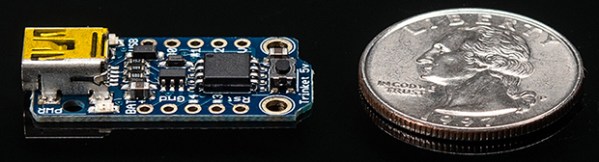
Here’s something very cool from the wonderful world of Adafruit: The Trinket, an Arduino compatible microcontroller platform that’s not only small enough to fit in your pocket, it’s small enough to lose in your pocket.

Like the similarly specced Digispark, the Trinket features an ATTiny85 microcontroller with 5 IO pins. Unlike the Digispark, the Trinket is a bit more substantial, featuring 3.3 and 5 Volt regulators along with a real USB port and mounting holes. As this is based on the ‘tiny85, it’s possible to connect this up to I2C and SPI sensors and peripherals

One thing to note about the Trinket is the fact that it’s so cheap. Either version of the Trinket goes for about $8, inexpensive enough to simply leave in a project when you’re done with it. Given the cool stuff we’ve already seen created with the Digispark, including a homebrew stepper motor and an Internet meme and lame pun assessment tool, we can’t wait to see what’s made with the Trinket,

Custom Car Keypad Entry

jeepKeyless

[EdsJunk] loves the outdoors and using his Jeep Wrangler to get him there, but hiding a key just to go for a swim makes him nervous. After a friend showed him how convenient it was to have keypad entry to his vehicle, [EdsJunk] decided it was time he built his own.

The build uses a spare waterproof keypad attached to an Arduino Micro. [EdsJunk] simplified things by cannibalizing his extra keyless entry keyfob; if the ‘duino receives the right code from the keypad, it presses the unlock button on the keyfob to grant access. [EdsJunk] admits that the Wrangler’s soft top is easy enough to get into, but explains that the goal of this project is to keep the alarm activated, which would presumably go off if someone tried to break in through the soft top. You can watch a video demo of the keypad access below. This is another great addition to the multitude of hacks he’s performed on one vehicle.

We do, however, hope that there’s some kind of lockout built into the code to prevent brute forcing: it should be easy enough to activate the car’s panic button after a set number of failed attempts. Car hacks are popular this summer: check out the Real Car Remote Control if you missed it.

Continue reading “Custom Car Keypad Entry”

The JavaScript Of Things

Espruino

There are a ton of people out there that can program in JavaScript, but give them an embedded device, and they’re up the creek without a paddle. Not anymore, that is, thanks to [Gordon]’s wonderful Espruino, a JavaScript interpreter for ARM microcontrollers. Oh, it’s also a very capable dev board that has more than enough power to turn just about any project you can imagine into reality.

On board the Espruino is an ARM Cortex M3 in the form of an STM32 chip, 256kB Flash, 48kB of RAM, and a ton of PWM and ADC pins to go along with 2 SPI ports, 2 I2C ports, and 2 DACs. It’s a very capable piece of hardware, and if you’re looking to build anything, it would be hard to pick a better general purpose dev board.

[Gordon] has put his board up on Kickstarter, and since it’s already been successfully funded, he’ll be releasing the hardware and software sources under an Open Source license. If you’ve ever wanted to run JavaScript on an ARM board, it looks like Espruino is just the ticket.