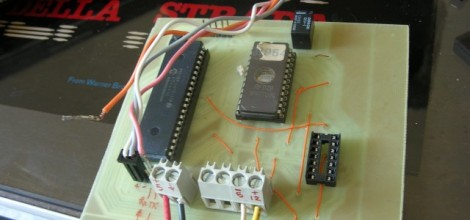
2708 EPROM Dumper

[Andrea “Mancausoft” Milazzo] has been restoring old equipment which often contain EPROM chips. He thought he was all set with an EPROM reader which easily dumped the data from 2716 chips and a few others. But he found that the hardware was unable to read 2708 and 2704 chips. His solution was to build a PIC-based EPROM dumper.

You may remember from some of our recent features that these chips are something of a ticking clock. They store program code and other information vital to the functioning of old hardware. Since they’re erased with UV light, years of exposure to ambient light can zap some of the data.

The specs needed to read a chip of this type are rather rudimentary. There are ten address pins and eight data pins. [Andrea] also needed a way to get data from the microcontroller to a computer for backup. He uses two more pins for this purpose, bringing the I/O count to 20. He went with  PIC 18F4610 and built the rest of the reader around it.
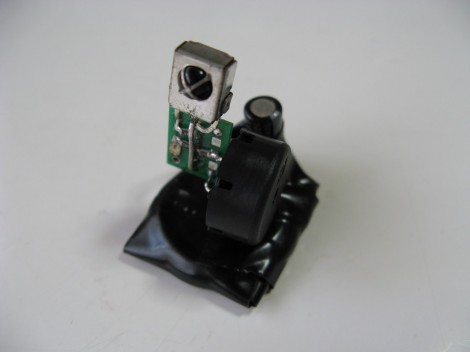
Rickrolling Remote Control Prank

This device is a prank or gag that [Eric Heisler] came up with. It will intercept IR remote control codes and play them back after a bit of a delay. The example he shows in the video (embedded after the break) catches the television power signal from a remote, then sends it again after about thirty seconds. This shuts off the TV and would be extremely annoying if you were unable to find the device. Fortunately (for the victim), [Eric] included a piezo buzzer that Rickrolls after sending each code. Just follow that tune to find the offending hardware.

He chose to use an ATtiny10 microcontroller. It looks like it’s realizing its full potential as the six-pin package use all available I/O to control the IR receiver module, an IR led, and the buzzer. It runs from a coin cell without regulation and the circuit was free-formed on a tiny surface mount breakout board which hosts the microprocessor.

Frequency Analyzer Built From The New Stellaris Launchpad

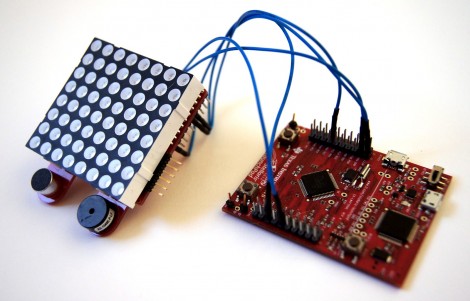
Here’s the first project we’ve seen for the new Stellaris Launchpad. It’s a frequency analyzer which displays a graph on an 8×8 LED module. What’s that you say? You haven’t received your new Launchpad board yet? Neither have we since they don’t start shipping until the end of the month. But [EuphonistiHack] works as a software dev for TI and snagged one of the early development units.

Hardware is rather simple. He uses an OpAmp to feed audio from his laptop to the ARM processor. The 8×8 LED module is an MSP430 booster pack that is addressed via SPI. On the software side of things he’s really taking advantage of hardware peripherals to simplify his work. A timer triggers each ADC reading which in turn writes the values using uDMA. Digital Signal Processing (available as a CMSIS library for many ARM chips) is then used to translate the ADC value to one that can be displayed on the LEDs. Check out the video after the break to see the final version.

The Hackaday writers are looking for an easier name for this hardware than “Stellaris Launchpad”. It doesn’t seem to lend itself to a shorter name, like RPi or Raspi does for the Raspberry Pi. If you’ve got a catchy nick name for the new board please share it in the comments.

Building A Classic Coin-op Game In An FPGA

This game of Bomb Jack is the same as the original arcade version. The difference is that this hardware was built in an FPGA using schematics found on the Internet.

We’re a little shocked by the complexity of such a project. We’ve been impressed before by the use of FPGAs to implement classic CRT vector graphics. But that project used a library that had already implemented the original game. For this effort, [Alex] wanted to find a game that hadn’t ever been translated to an FPGA, and used stock parts. Bomb Jack is a 1984 platformer which ran on a Z80 processor, AY-3-8192 sound generators, and common TTL logic chips. This meant he didn’t have to write the cores himself, but rather use already existing versions of the chips and code together the hardware.

You can read about his experience at the page linked at the top, or just jump after the break to see video of the final project. You can see the monitor is on its side, and the game sounds great and runs flawlessly.

Continue reading “Building A Classic Coin-op Game In An FPGA”

Adding Features To A DX6i Transmitter

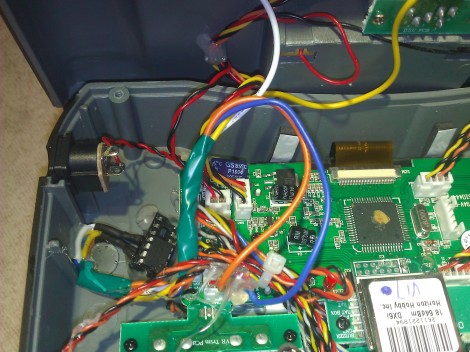
About thirty cents and some wire are all it takes to start hacking extra features into this DX6i transmitter. The DX6i is a six-channel, two-mode transmitter used to control hobby airplanes and helicopters. There are several built-in features but [Ligius] found an easy way to add a few more. In the upper left portion of the case you can see the eight-pin microcontroller he brought to the project.

It’s a PIC 10F222 mounted in a DIP socket so that it may be removed for reprogramming. The hardware page of the wiki shows the connections he made. By reading from the throttle, and tapping into the trainer wire, he is able to add features without any apparent alterations to the controller (no extra buttons, etc). You can see in the clip after the break that the throttle position when power is switched on selects between different modes. This can be the delay for turning off the LCD backlight, or presets for helicopter or airplane modes. [Ligius] thinks there’s a lot more potential here, even the possibility of fixing a bug in this particular model of transmitter.

Continue reading “Adding Features To A DX6i Transmitter”

Preorder TI’s ARM Cortex-M4 Launchpad For $5 Delivered

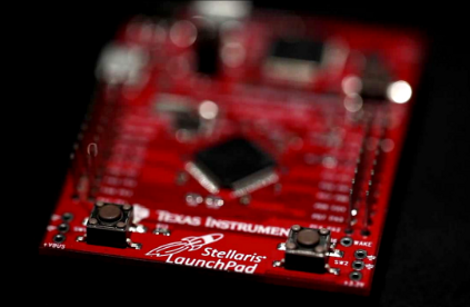
Texas Instruments just open preorders for the new Stellaris LaunchPad. The boards won’t ship until the end of September, but if you don’t mind the wait you can get one for $4.99 including delivery (we’d wager non-U.S. addresses have to pay for delivery, but leave a comment if you know for sure several readers have reported that international shipping is free).

We routinely pay more in shipping for parts orders so we already jumped at the opportunity and put in our own order. Earlier in the month we heard the first murmurs about the device. We’re glad to see they hit the $4.99 target price, but the TI website mentions that this is a promotional price that will be available for a limited time only. The board boasts an ARM Cortex-M4 processor, the Stellaris LM4F120H5QR. It includes 256 KB of flash memory, 32 KB of SRAM, and more peripherals than you can shake a stick at. To get you up and running quickly they’ve included two user buttons and an RGB LED. As with the 16-bit Launchpad, the board acts as its own programmer. It has a microUSB jack, but they’ve included a micro B to USB A cable in the kit to make sure you don’t need to also put in a cable order.

We’ll give a follow-up post once we finally get our hands on the board. We hope this will be easy to get working with a Linux box!

[Thanks Chris]

Building Touch Sensors From Digital Barometer Chips

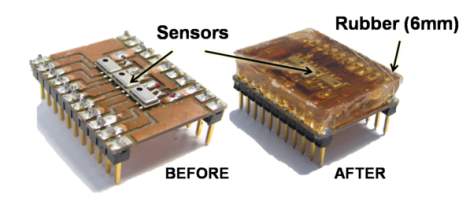
A couple of Harvard researchers have developed a method of using digital barometers as a touch sensor. The good news for us is that they’ve open sourced the project, including Eagle board files, firmware, and details about the materials they used.

The digital barometers were chosen for their characteristics, availability, and low-cost. The sensor uses an array of Freescale MPL115A2 chips, a MEMS Barometer designed for use in altimeters. The mass production makes them cheap (Octopart found some in single quantities for $1.71 at the time of writing). The chips are soldered onto a board which is then cast in rubber. This distributes the force while protecting the sensors. The video after the break shows them standing up to rubber hammer blows and supporting a 25 pound weight.

There are a few tricks to reading the array. The first is that the devices are designed to be used one-to-a-project so they have a fixed i2 address. A separate chip must be used to address them individually. But one it’s up and running you should be able to use it as feedback for the fingertips of that robot arm you’ve been building.

Continue reading “Building Touch Sensors From Digital Barometer Chips”