ATtiny Hacks: Reading From A Motorcycle’s J1850 Data Bus

ATtiny Hacks Theme Banner

[TZ] has been using ATtiny microcontrollers to read and pass along data from his Harley Davidson motorcycle. The image you see above is using an ATtiny 4313 to read data from the J1850 bus.

The J1850 protocol is an older standard which may not be available in newer vehicles. But if your vehicle has it, you may be able to tap into the bus through an ODB-II connector. [TZ] is decoding the data with the 4313, then using an inexpensive Bluetooth module to send the information to an Android tablet. Fortunately, someone has already written a nice GUI to display the speed and tachometer.

This isn’t the only approach to data harvesting with an ATtiny chip that he’s explored. There’s a second video after the break that shows a much more complicated setup. It still harvests the J1850 data in the same way, but also uses additional I2C sensors and an embedded ARM board to gather GPS data. Everything is pushed to his smart phone, which displays current gear, RPM, speed, engine temperature, fuel level, and GPS information via a WiFi connection.

Continue reading “ATtiny Hacks: Reading From A Motorcycle’s J1850 Data Bus” →

Karate Chop Is Simon Without All The Touching

[Alan Parekh] and his daughter [Alexis] just premiered their entry in the Avnet Dog Days of Summer contest. It’s a game called Karate Chop that is basically an electronic Simon Says. The video after the break shows a demonstration of the device. When switched on it’ll play a little tune and start cycling the LEDs on the front of the case. Players interact by breaking the infrared beams in the two cutouts on either side of the case. You need to keep your hand flat to do this, which is where the name comes from. There are four different game modes which are selected at the start of the game. There are two difficulty levels of a Simon Says game which shows the player a pattern in light and sound, then watches for the user to repeat that pattern back. The other mode that [Alexis] demonstrates is a reflex game which requires the player to quickly react to randomly illuminated LEDs.

The circuit is built on a breadboard hiding behind the front bezel and uses a PIC 16F1827 microcontroller to drive the game. The case itself is made from laser cut MDF and plywood. We’re not sure how much time [Alan] spent on the case, but we think it looks wonderful. If you’re planning to participate in the contest you better get rolling, the entry deadline is tomorrow.

Continue reading “Karate Chop Is Simon Without All The Touching” →

Microchip Puts Up Two $1000 Prizes For USB And TCP/IP Stacks!

microchip_call_for_open_source

A couple of weeks ago we put up a post titled Addressing Microchip’s open source problem where we talked about some of their shortcomings as far as open source code goes, specifically the TCP/IP stack and the USB stack. The comments were predictably fairly negative. The interesting part here is that Microchip actually listened. If you read through all of the comments, you will get a bit of an inside look at what is going on internally at Microchip. At the very end, [Marc] from Microchip left a couple of comments outlining a pair of prizes for independently ported stacks for TCP/IP and USB. Microchip can’t fully open the ones that they have because of legal reasons so they need the help of the development community and they are putting up $1000 for each one to prove that they are serious. If you follow this link you will arrive at a page outlining the rules for the contest.

The gauntlet has been dropped! Do you have chops to pull this off and earn yourself a cool $1000?

ATtiny Hacks: Look Ma, No Batteries!

ATtiny Hacks Theme Banner

[Gadre] built his own ATtiny project without using any batteries. It’s an electronic Dice (or die if you’re being critical) which uses induction to charge a storage capacitor to act as the power source. The voltage generator is made from a tube of Perspex which houses a set of rare-earth magnets. At the enter of the tube [Gadre] machined a channel wich accepts about 1500 windings of 30 AWG magnet wire. When someone shakes the tube back and forth the magnet passes the wire, inducing a current.  The product is stored in a 4700 uF capacitor, which feeds a boost converter to power the rest of the circuit.

The ATtiny13V that controls the circuit is running its internal RC oscillator at 128 kHz, the lowest setting possible in order to minimize power consumption. After a good shake the user can press a button to roll the die, which is then displayed for several seconds on a group of seven LEDs. See for yourself in the video after the break.

Continue reading “ATtiny Hacks: Look Ma, No Batteries!” →

Spinning UV Light Writer

uv_light_writer_ring

[David] has always wanted use UV LEDs to write on a phosphorescent surface ever since saw an article about it on Make. He accidentally purchased UV LEDs when he meant to buy purple ones, so he figured that his mistake was all the reason he needed to give UV light writing a try.

He built a PIC16F628 UV POV board using the LEDs, and while manually swiping the writer across various glow in the dark surfaces was cool, he wanted to keep the POV board stationary, moving the writing medium instead. He bought some phosphorescent vinyl, but found that it wasn’t too flexible, meaning he could not use a conveyor belt approach for his display. One day it dawned on him that a vinyl ring might work pretty well, and using a motor from an old cassette player, he constructed the UV writer you see above.

It seems to work pretty well despite a small flaw in the UV ring, and while [David] is happy with the results, he already has plenty of ideas in mind for the second revision.

Check out the video of his UV light ring in action after the jump.

[Thanks, Riley]

Continue reading “Spinning UV Light Writer” →

Google ADK On An EvalBot

evalbot_google_adk

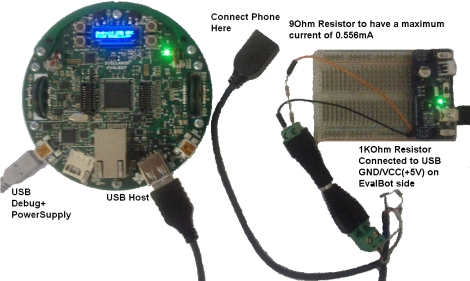
After learning that Google’s ADK relied on using an Arduino-compatible board, [Benjamin] was disappointed that other microcontroller platforms weren’t invited to the party. Rather than switch camps, he took it upon himself to get the ADK working with his EvalBot. In fact, his modifications should allow the ADK to work with nearly any Stellaris ARM kit.

The hack is composed of two parts. The first, and most important bit is the USB host driver he developed to work with the ADK. The code borrows some bits from Texas Instruments, and will be published on GitHub once he gets a chance to clean up the source a bit. To get his phone working with the EvalBot, he also had tweak the external USB power supply in order to provide the current required to operate properly with other USB-connected hardware.

It’s always nice to have more options when working with Google’s ADK, and [Benjamin’s] work is likely a welcome addition to any Stellaris developers toolkit.

Continue reading to see a quick video of his EvalBot ADK demo.

Continue reading “Google ADK On An EvalBot” →

Virtual Machine For Microcontrollers Lets You Run Python On AVR Chips

[Clifford Wolf] wrote in to let us know about a project he recently completed called EmbedVM. It’s a virtual machine for AVR microcontrollers. The package has a relatively small overhead, taking up about 3kB of program memory. The VM can execute 74,000 instructions per second, and runs asynchronously from the microcontroller. As [Clifford] demonstrates in the videos after the break, this can be handy for preloading commands to prevent slowdown during heavy VM processor loads.

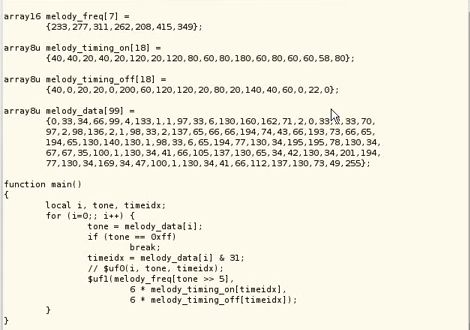
The snippet in the image above is an example program written in the C-like VM code which will play some [Rick Astley] on a speaker. This code can be run from RAM, EEPROM, or even external storage like an SD card. Recently there was a supplemental compiler project that even takes Python code and compiles it into VM byte-code. What a nice abstraction tool for making inexpensive microcontroller-based designs easily programmable for those that have a bit of Python experience.

If you don’t recognize the name, [Clifford Wolf] is also the author of OpenSCAD, a tool that is quite popular with 3D printing.

Continue reading “Virtual Machine For Microcontrollers Lets You Run Python On AVR Chips” →