Beginner Concepts: All About AVR Interrupts

Microcontroller interrupts are one of the big tools in our embedded programming arsenal. They make the chip listen for particular events, and once detected they stop what they’re doing and run a separate set of code called and Interrupt Service Routine. We’ve come across two fairly new tutorials on the subject that you should check out if you’re not yet a master on the topic. One is a ProtoShack tutorial on ATmega168 external interrupts, and the other is a Newbie’s Guide to AVR Interrupts by [Dean Camera] (we’ve been a fan of his tutorials for some time). Both cover a range of topics from what interrupts are, to avoiding the common problems of volatile data types and the compiler optimization caveats.

What can you do with interrupts? External interrupts can be used to wake up a project like this LED menorah from sleep mode. Interrupts can be used to monitor a timer for a certain value or an overflow for use in generating a pulse-width modulation signal. The TI Launchpad uses an interval timer interrupt for button debouncing in projects like this code which was ported from an AVR chip. The source for both is available if you wanted to compare how the two differ.

Interrupts are powerful. Learn them, love them, use them.
USB Adapter Options

[Ladyada] takes some time out of her day to explain the common options available for connecting projects through USB. You may be thinking that you already do this with an Arduino. Well, yes and no. The Arduino uses one of these options, an FTDI chip that handles the USB on one side and spits out microcontroller-friendly voltage signals on the other. This chip can be used with your projects, a topic that [Phil Burgess] covered in great detail.

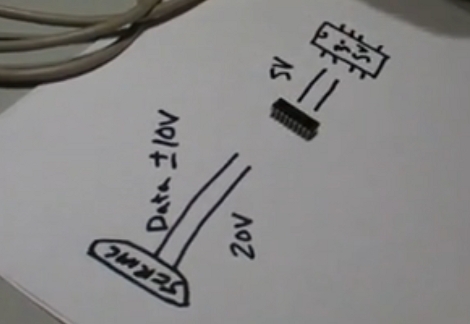
In the video after the break you’ll also hear about USB to serial converters which connect to the Universal Serial Bus and output the traditional 12-20V serial signals (with the exception of cheap knockoff cables like the one from last week). These need to be stepped down to 5 volts or less using a MAX232 chip to work with your project.

Finally there’s the option of using a microcontroller running the V-USB firmware package. This is how the USBtinyISP works and I’ve used it in my own projects to build a LIRC compatible IR receiver.

Continue reading “USB Adapter Options” →

Cheap Cable Reused To Add USB To Your Project

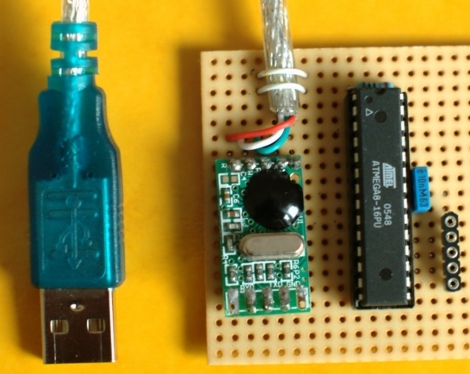
You get what you pay for. [Jkx] wanted to see how a USB to RS232 cable could be sold for just $1.70 and found out that it’s not actually RS232 compliant. The cable communicated as TTL levels, not the 12V expected of RS232 (although it can handle 12V incoming). He didn’t really want to use them for their intended purpose anyway. By betting rid of the DB9 plug and reusing the enclosed circuit board he now has a really cheap way to interface a microcontroller with the Universal Serial Bus. He worked out a couple of short subroutines that take care of receiving and sending data over the connection.

BeagleBoard Cluster

What do you do after you make a BeagleBoard graphing calculator? [Matt] over at Liquidware Antipasto made a BeagleBoard Elastic R Cluster that fits in a briefcase. Ten BeagleBoards, are connected to each other though USB to ethernet adapters and a pair of ethernet switches connected to a wireless router. The cost for this cluster comes in around $2000 and while consuming less than 40 watts of power, out-paces a $4500 laptop. How might you use this cluster? What improvements would you make? Continue reading “BeagleBoard Cluster” →

Binary Calculator

oooh, love those blue LEDs

[Syst3mX] emailed us about his Binary Calculator earlier this week and it almost slipped into the depths of our inbox. Luckily We noticed it in there today and thought we’d share.

He wanted to be able to calculate binary values without having to jump through hoops or boot up his computer, so he built his own binary calculator. For the brains, he chose an ATTiny2313. He can do basic operations like NOT, AND, OR, XOR, addition, subtraction, multiplication, division and modulo. It isn’t too bad looking either. You can catch a video of it in action after the break.

Continue reading “Binary Calculator” →

Pressure Mapping Sensor Mat

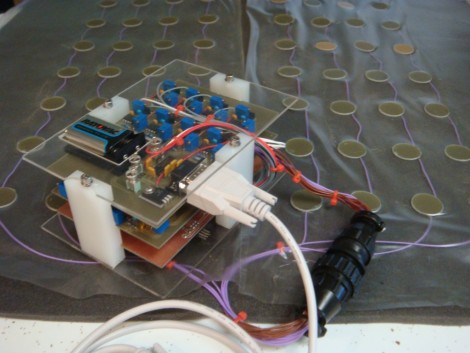
[imsolidstate] built his own pressure sensitive mat. It utilizes two discs of copper clad board with a piece of foam in between for each of 64 sensors. As the foam gets compressed, the capacitance between the two pieces of copper changes, a measurement that is fairly easy to make with an analog to digital converter. The mat is being used to measure how well a horse saddle fits the animal. Data is read in through a serial port and then mapped using Excel. This prototype proves that the concept works but [imsolidstate] mentions that there’s room to improve the sensitivity and that there could be more noise filtering incorporated into the design.

Burglar Alarm In A Zippo Lighter

surprisingly awesome

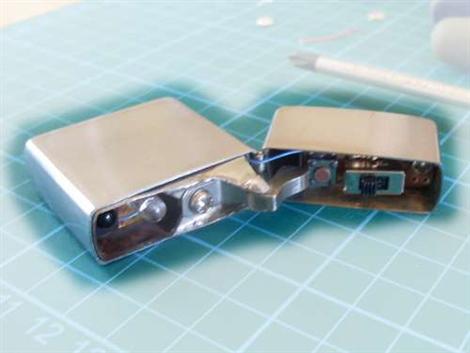
[Madmanmoe64] has really done a fantastic job with this burglar alarm built into a zippo.  He crammed a picaxe microcontroller, some IR LEDs, an IR sensor, a battery and various switches in there quite well. It almost closes perfectly, something we think he could remedy if it really bugged him that much.

It has several modes, all initiated by a different sequence of button presses. There is the proximity alarm, which sounds when something moves very close. The reverse proximity alarm which sounds when you remove something from its immediate vicinity.  A doorbell mode, and a silent alarm mode. Check out the video after the break to see it in action.

Continue reading “Burglar Alarm In A Zippo Lighter” →