ATtiny2313 Prime Number Generator

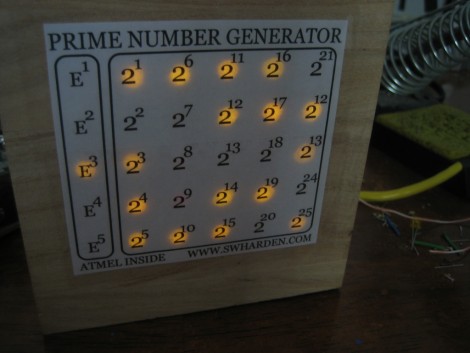
[Scott Harden’s] prime number generator exhibits a great way to use an LED matrix to present readable information. The project resides in a hinged wooden box with a grid of holes on the lid for the LEDs. [Scott] has overlaid the matrix with a printout showing powers of two that represent different prime numbers. Inside you’ll find an ATtiny2313 microcontroller that handles the column scanning and prime number testing. We’ve embedded a video the break where [Scott] explains the project in great detail, but you should also check out his prototyping and construction pages.
Continue reading “ATtiny2313 Prime Number Generator” →

Lee Hart’s “Memebership Card”

[youtube=http://www.youtube.com/watch?v=hbsPddZsmVI]

In an act of retro revival, [Lee Hart] has created this “Membership Card“, an altoid tin sized tribute to the 1802 CMOS chip. Made popular in the late 70s in the RCA COSMAC ELF computer, the 1802 stole many a hackers heart. There’s tons of information available if you explore the site, from history to kit building experiences.

[via Retro Thing)

GameBoy Analog Meter

Boring game.

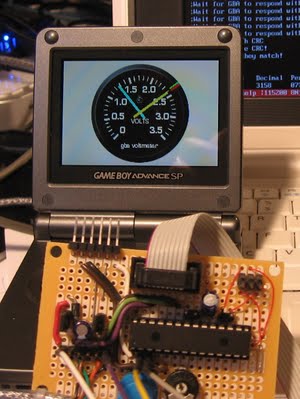
Here’s an interesting setup using a GameBoy Advance as an interface and power supply for a PIC microprocessor. He’s got the PIC connected to the serial port of the GameBoy Advance and is able to pass and retrieve data for display on the screen. You can see above that he is showing two analog values from the pic. You can download the schematic and source code and see a few more pictures, but that’s about it.

[via HackedGadgets]

Porting Code To MSP430

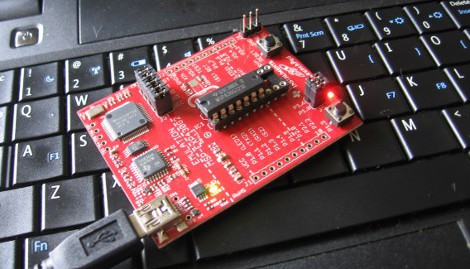
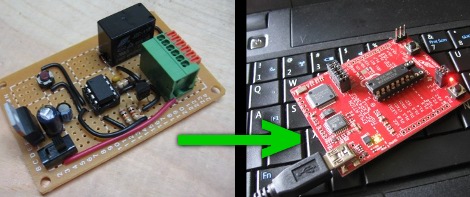
I took a little time to look into porting code written for AVR in order to run it on the MSP430 architecture. It’s easier than you think, being mostly small differences like an extra step to enable pull-up resistors. But there is a lot to be learned in order to transition away from using EEPROM.

Since the TI chips don’t have EEPROM you need to use the Info Flash, a topic which I detail in the article linked at the top. This flash memory must be erased before writing because a write operation can only change high bits to low, not the other way around. And an erase operation clears an entire 64 kB segment, not just the bytes you want to write to. It’s different but manageable.

Oh, and if you were wondering, I ported the code I wrote for the garage door coded entry project.

How-to: Launchpad Programming With Linux

When TI released their Launchpad development board at the end of June it generated a lot of Buzz. Here’s a package that delivered a programmer, debugger, two microcontrollers, and some accessories for less than five bucks (including shipping). They even provided a choice of two software suites but only for users running Windows who don’t mind proprietary software. If you’re looking to go another way you should consider trying out the open source alternative MSPGCC. After the break we’ll take a look at getting the tool-chain up and running in a Linux environment.

Continue reading “How-to: Launchpad Programming With Linux” →

Basic Stamp Controlled Kegerator

kegerator

evan jensen sent us a link to his basic stamp kegerator.  the microcontroller monitors and regulates the temperature, and outputs status information and the name of the current beer to an lcd display.  this looks like a fun project if you are looking to get started with hacking electronics.  for our non beer drinkers, i can assure you that root beer is also best served cold and from a tap.

i’ve never used a basic stamp before, but i’ve noticed that a lot of other people are using the microprocessor to do cool things, including james the weather ballon hacker from earlier this week.  i just ordered a starter kit last evening, so if people are interested maybe i can post an introduction when i receive it.

Continue reading “Basic Stamp Controlled Kegerator” →