Homemade Capacitors Of A Mad Scientist

Once upon a time I was a real mad scientist. I was into non-conventional propulsion with the idea of somehow interacting with the quantum vacuum fluctuations, the zero point energy field. I was into it despite having only a vague understanding of what that was and without regard for how unlikely or impossible anyone said it was to interact with on a macro scale. But we all had to come from somewhere, and that was my introduction to the world of high voltages and homemade capacitors.

And along the way I made some pretty interesting, or different, capacitors which I’ll talk about here.

Large Wax Cylindrical Capacitor

As the photos show, this capacitor is fairly large, appearing like a thick chunk of paraffin wax sandwiched between two wood disks. Inside, the lead wires go to two aluminum flashing disks that are the capacitor plates spaced 2.5cm (1 inch) apart. But in between them the dielectric consists of seven more aluminum flashing disks separated by plain cotton sheets immersed in more paraffin wax. See, I told you these capacitors were different.

I won’t go into the reasoning behind the construction — it was all shot-in-the-dark ideas, backed by hope, unicorn hairs, and practically no theory. The interesting thing here was the experiment itself. It worked!

I sat the capacitor on top of a tall 4″ diameter ABS pipe which in turn sat on a digital scale on the floor. High voltage in the tens of kilovolts was put across the capacitor through thickly insulated wires. The power supply contained a flyback transformer and Cockcroft-Walton voltage multiplier at the HV side. As I dialed up the voltage, the scale showed a reducing weight. I had weight-loss!

But after a few hours of reversing polarities and flipping the capacitor the other way around and taking plenty of notes, I found the cause. The weight-loss happened only when the feed wires were oriented with the top one feeding downward as shown in the diagram, but there was no weight change when the top wire was oriented horizontally. I’d seen high voltage wires moving before and here it was again, producing what looked like weight-loss on the scale.

But that’s only one of the interesting capacitors I’ve made. After the break we get into gravitators, polysulfide and even barium titanate.

Continue reading “Homemade Capacitors Of A Mad Scientist”

Cellular Automata Explorer

Well all know cellular automata from Conway’s Game of Life which simulates cellular evolution using rules based on the state of all eight adjacent cells. [Gavin] has been having fun playing with elementary cellular automata in his spare time. Unlike Conway’s Game, elementary automata uses just the left and right neighbors of a cell to determine the next cell ahead in the row. Despite this comparative simplicity, some really complex patterns emerge, including a Turing-complete one.

[Gavin] started off doing the calculations by hand for fun. He made some nice worksheets for this. As we can easily imagine, doing the calculations by hand got boring fast. It wasn’t long before his thoughts turned to automating his cellular automata. So, he put together an automatic cellular automator. (We admit, we are having a bit of fun with this.)

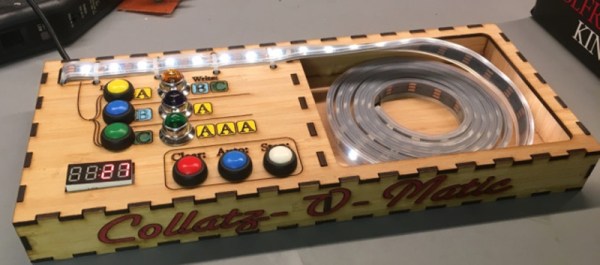
This could have been a quick software project but half the fun is seeing the simulations on a purpose-built ecosystem. The files to build the device are hosted on Thingiverse. Like other cellular automata projects, it uses LED matrices to display the data. An Arduino acts as the brain and some really cool retro switches from the world’s most ridiculously organized electronics collection finish the look of the project.

To use, enter the starting condition with the switches at the bottom. The code on the Arduino then computes and displays the pattern on the matrix. Pretty cool and way faster than doing it by hand.

Testing The Speed-of-Light Conspiracy

There are a number of ways to measure the speed of light. If you’ve got an oscilloscope and a few spare parts, you can build your own apparatus for just a few bucks. Don’t believe the “lies” that “they” tell you: measure it yourself!

OK, we’re pretty sure that conspiracy theories weren’t the motivation that got [Michael Gallant] to build his own speed-of-light measurement rig, but the result is a great writeup, and a project that includes one of our favorite circuits, the avalanche transistor pulse generator.

setupThe apparatus starts off with a very quickly pulsed IR LED, a lens, and a beam-splitter. One half of the beam takes a shortcut, and the other bounces off a mirror that is farther away. A simple op-amp circuit amplifies the resulting pulses after they are detected by a photodiode. The delay is measured on an oscilloscope, and the path difference measured with a tape measure.

If you happen to have a photomultiplier tube in your junk box, you can do away with the amplifier stage. Or if you have some really fast logic circuits, here’s another project that might interest you. But if you just want the most direct measurement we can think of that’s astoundingly accurate for something lashed up on breadboards, you can’t beat [Michael]’s lash-up.

Oh and PS: He got 299,000 (+/- 5,000) km/sec.

Ghetto Ribbon Connector

[Marcel] was trying to shoehorn a few new parts into his trusty Nexus 5 phone. If you’ve ever opened one of these little marvels up, you know that there’s not much room under the hood to work with. Pulling out some unnecessary parts (like the headphone jack) buys some space, but then how to wire it all up?

[Marcel] needed a multi-wire connector that’s as thin as possible, but he wasn’t going to go the order-Kapton-flex route. Oh no! He built one himself from masking tape and the strands from a stranded wire. Watch the video how-to if that alone isn’t enough instruction.

Continue reading “Ghetto Ribbon Connector”

All Your Displays Are Belong To Us

Artist and Hackaday reader [Blair Neal] wrote in with his incredible compendium of “alternative” displays. (Here as PDF.) From Pepper’s Ghost to POV, he’s got it all covered, with emphasis on their uses in art.

There’s an especially large focus on 3D displays. Projecting onto screens, droplets of water, spinning objects, and even plasma combustion are covered. But so are the funny physical displays: flip-dots, pin-cushions, and even servo-driven “pixels”.

Flavien Théry’s La Porte 
Flavien Théry’s La Porte

We really liked the section on LCDs with modified polarization layers — we’ve seen some cool hacks using that gimmick, but the art pieces he dredged up look even better. Makes us want to take a second look at that busted LCD screen in the basement.

We’re big fans of the bright and blinky, so it’s no surprise that [Blair] got a bunch of his examples from these very pages. And we’ve covered [Blair]’s work as well: both his Wobbulator and his “Color a Sound” projects. Hackaday: your one-stop-shop for freaky pixels.

[Blair]’s list looks pretty complete to us, but there’s always more out there. What oddball displays are missing? What’s the strangest or coolest display you’ve ever seen?

Catching Lightning With High Voltages And A Kite

Flying a kite on a stormy day is not the wisest thing to do, except, of course, you’re intentionally trying to catch a lightning bolt. The guys from [kreosan] replicated the famous experiment, with which Benjamin Franklin once set out to prove the electrical nature of lightning.

Continue reading “Catching Lightning With High Voltages And A Kite”