
You’d be hard pressed to find a public restroom that wasn’t packed full of hands free technology these days. From the toilets to the sinks and paper towel dispensers, hands free tech is everywhere in modern public restrooms.
The idea is to cut down on the spread of germs. However, as we all know too well, this technology is not perfect. We’ve all gone from sink to sink in search of one that actually worked. Most of us have waved our hands wildly in the air to get a paper towel dispenser to dispense, creating new kung-fu moves in the process. IR simply has its limitations.
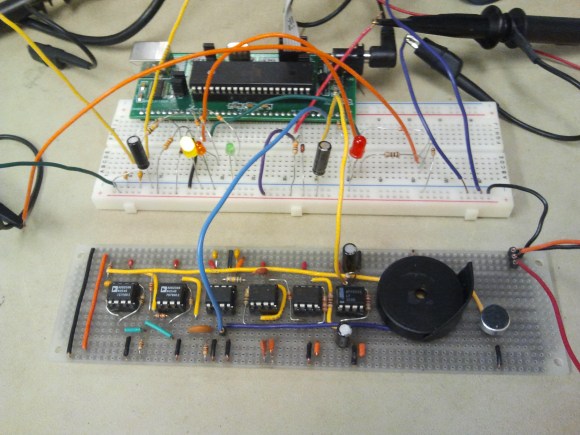
What if there was a better way? Check out [Ackerley] and [Lydia’s] work on gesture recognition using ultrasound. Such technology is cheap and could easily be implemented in countless applications where hands free control of our world is desired. Indeed, the free market has already been developing this technology for use in smart phones and tablets.
Where a video camera will use upwards of 1 watt of power to record video, an ultrasound device will use only micro watts. IR can still be used to detect gestures, as in this gesture based security lock, but lacks the resolution that can be obtained by ultrasound. So let us delve deep into the details of [Ackerley] and [Lydia’s] ultrasound version of a gesture recognizer, so that we might understand just how it all works, and you too can implement your own ultrasound gesture recognition system.

 There may be nothing new under the sun when it comes to etching PCBs with UV light, but [Heliosoph] has








