Writing A Message In Hypnotizing Style

If you’ve ever encountered a rapidly spinning split-flap displays at an airport terminal, it’s hard not to stop and marvel at them in action for a few extra seconds. Because of this same fascination, [M1k3y] began restoring an old one-hundred and twenty character sign, which he outlines the process of on his blog.

Finding documentation on this old relic turned out to be an impossibility; the producers of the model themselves didn’t even keep it off-hand any longer. In spite of that, [M1k3y] was able to determine the function of the small amount of circuitry driving the sign through process of elimination by studying the components. After nearly a year of poking at it, he happened across a video by the Trollhöhle Compute Club, demonstrating the successful use of the same display model. Luckily, they were kind enough to share their working source code. By reverse engineering the serial protocol in their example, he was able to write his own software to get the sign moving at last.

Once up and running, [M1k3y] learned that only eighty of the sign’s characters were still operable, but that is plenty to make a mesmerizing statement! Here is a video of the cycling letters in action:
Continue reading “Writing A Message In Hypnotizing Style”

Ghost Gunner Machines Your AR-15

Defense Distributed and founder [Cody Wilson] have released Ghost Gunner. Defense Distributed entered the public eye a couple of years ago with The Liberator, the world’s first 3D printed gun. Since anyone with a 3D printer can print a Liberator, it is effectively untraceable. This raised a lot of questions in the media and public eye.

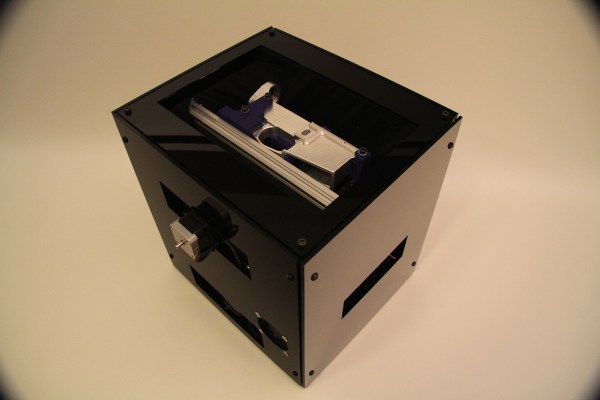
Ghost Gunner is a variation on the untraceable theme. Essentially, Ghost Gunner is a CNC designed for one purpose: final drilling and milling steps for AR-15 lower receivers. The reason for this has to do with federal gun laws in the United States. According to US law, the lower receiver is the actual firearm, and is regulated. But when does a block of aluminum become a lower receiver? Here, US law states that the metal becomes a regulated receiver when the machining operations are more than 80% complete.

ghostgunnergunAnyone can legally buy a barrel, trigger, stock, upper receiver, and various other parts to build an AR-15. To complete the weapon, they only need to buy an 80% lower receiver and perform the last 20% of the metal work. This work can be performed with everything from a drill press to a milling machine to hand tools. Ghost Gunner partially automates this process, making it easier and faster to complete lower receivers and build weapons.

Defense Distributed calls Ghost Gunner an open source hardware project, though we were unable to find the files available for download at this time. It appears that the slides are made up of MakerSlide or a similar aluminum extrusion. The steppers appear to be standard Nema 17 size.

Defense Distributed says that they’ve been having a hard time keeping up with the Ghost Gunner pre-orders. At $1300 each though, we think a general purpose mill or small CNC would be a better deal.

Continue reading “Ghost Gunner Machines Your AR-15”

Art From Brainwaves, Antifreeze, And Ferrofluid

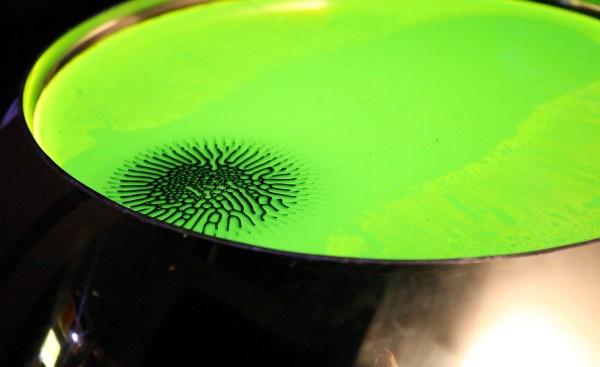
Moscow artist [Dmitry Morozov] makes phenomenal geek-art. (That’s not disrespect — rather the highest praise.) And with Solaris, he’s done it again.

The piece itself looks like something out of a sci-fi or horror movie. Organic black forms coalesce and fade away underneath a glowing pool of green fluid. (Is it antifreeze?) On deeper inspection, the blob is moving in correspondence with a spectator’s brain activity. Cool.

You should definitely check out the videos. We love to watch ferrofluid just on its own — watching it bubble up out of a pool of contrasting toxic-green ooze is icing on the cake. Our only wish is that the camera spent more time on the piece itself.

Two minutes into the first video we get a little peek behind the curtain, and of course it’s done with an Arduino, a couple of motors, and a large permanent magnet. Move the motor around with input from an Epoc brain-activity sensor and you’re done. As with all good art, though, the result is significantly greater than the sum of its parts.

[Dmitry’s] work has been covered many, many times already on Hackaday, but he keeps turning out the gems. We could watch this one for hours.

Share Your Hackaday Story As We Celebrate 10 Great Years

Tomorrow we mark 10 wonderful years of reading Hackaday. Share your experience by recording a 1-2 minute video about how you discovered Hackaday and your favorite hack from all the greats that have hit the front page. Tweet the link to your video to @Hackaday with the hashtag #10years and we’ll add it to the playlist.

It doesn’t need to be anything special (but go nuts if you wish). I recorded a one-shot talking-head format as an example.

If you are lucky enough to be in the LA area, get a free ticket for Saturday’s event. In addition to all the clinicians and speakers, there’s a small collection of the Hackaday crew in town.

Transformer Inductive Coupling Simulation Is SFW

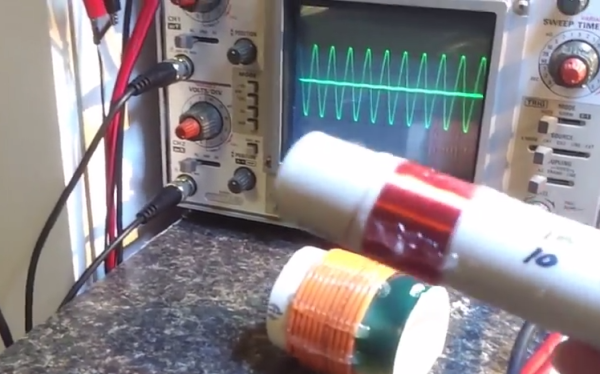
[James] has a friend who teaches at the local community college. When this friend asked him to build a transformer coupling simulation, he was more than happy to oblige. Fortunately for us, he also made a video that explains what is happening while  showing the output on a ‘scope.

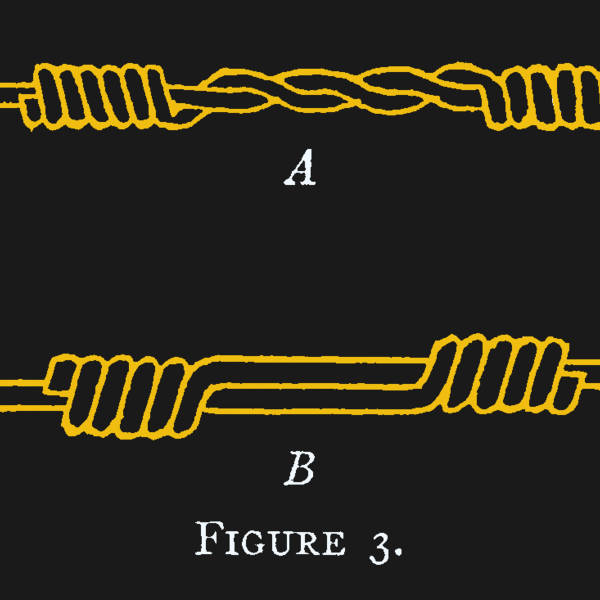
For the simulation, [James] built primary and secondary coils using PVC pipe. The primary coil consists of 11 turns of 14AWG stranded wire with 4V running through it applied. The first secondary he demonstrates is similarly built, but has 13 turns. As you’ll see, the first coil induces ~1.5V in the second coil. [James] first couples it with the two windings going the same way, which results in the two 2Mhz waveforms being in phase with each other. When he inserts the secondary the other way, its waveform is out of phase with the primary’s.

His second secondary has the same diameter PVC core, but was wound with ~60 turns of much thinner wire—28AWG bell wire to be exact. This match-up induces 10V on the secondary coil from the 4V he put on the primary. [James]’ demonstration includes a brief Lissajous pattern near the end. If you don’t know enough about those, here’s a good demonstration of the basics coupled with an explanation of the mechanics behind them.

Continue reading “Transformer Inductive Coupling Simulation Is SFW”

Invisibility cloaking with lenses

Invisibility Achieved With A Few Clever Focal Points

Students at the University of Rochester have developed a clever optical system which allows for limited invisibility thanks to a bit of optic sorcery physics.

Almost all invisibility technologies work by taking light and passing it around the object as if it were never there. The problem is, a lot of these methods are very expensive and not very practical — and don’t even work if you change your perspective from a head on view.

[Joseph Choi] figured out you can do the same thing with four standard achromatic lenses with two different focal lengths. The basic concept is each lens causes the light to converge to a tiny point  in between itself and the next lens — at which point it begins to diverge again, filling the following lens. This means the cloaked area is effectively doughnut shaped around the tightest focal point — if you block the center point of the lens, it won’t work. But everything around the center point of the lens? Effectively invisible. Take a look at the following setup using lasers to show the various focal points and “invisibility zones”.

Continue reading “Invisibility Achieved With A Few Clever Focal Points”

Mining Bitcoins With Pencil And Paper

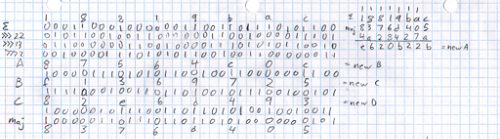
Right now there are thousands of computers connected to the Internet, dutifully calculating SHA-256 hashes and sending their results to other peers on the Bitcoin network. There’s a tremendous amount of computing power in this network, but [Ken] is doing it with a pencil and paper. Doing the math by hand isn’t exactly hard, but it does take an extraordinary amount of time; [Ken] can calculate about two-thirds of a hash per day.

The SHA-256 hash function used for Bitcoin isn’t really that hard to work out by hand. The problem, though, is that it takes a 64 byte value, sends it through an algorithm, and repeats that sixty-four times. There are a few 32-bit additions, but the rest of the work is just choosing the majority value in a set of three bits, rotating bits, and performing a mod 2.

Completing one round of a SHA-256 hash took [Ken] sixteen minutes and forty-five seconds. There are sixty-four steps in calculating the hash, this means a single hash would take about 18 hours to complete. Since Bitcoin uses a double SHA-256 algorithm, doing the calculations on a complete bitcoin block and submitting them to the network manually would take the better part of two days. If you’re only doing this as your daily 9-5, this is an entire weeks worth of work.

Just for fun, [Ken] tried to figure out how energy-efficient the bitcoin mining rig stored in his skull is. He can’t live on electricity, but donuts are a cheap source of calories, at about $0.23 per 200 kcalories. Assuming a metabolic rate of 1500 kcal/day, this means his energy cost is about 67 quadrillion times that of an ASIC miner.

Video below.

Continue reading “Mining Bitcoins With Pencil And Paper”