Building A Wavetable Synth

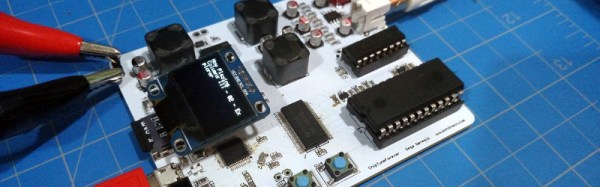
Every semester at one of [Bruce Land]’s electronics labs at Cornell, students team up, and pitch a few ideas on what they’d like to build for the final project. Invariably, the students will pick what they think is cool. The only thing we know about [Ian], [Joval] and [Balazs] is that one of them is a synth head. How do we know this? They built a programmable, sequenced, wavetable synthesizer for their final project in ECE4760.

First things first — what’s a wavetable synthesizer? It’s not adding, subtracting, and modulating sine, triangle, and square waves. That, we assume, is the domain of the analog senior lab. A wavetable synth isn’t a deep application of a weird reverse FFT — that’s FM synthesis. Wavetable synthesis is simply playing a single waveform — one arbitrary wave — at different speeds. It was popular in the 80s and 90s, so it makes for a great application of modern microcontrollers.

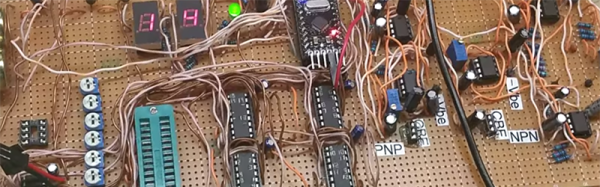
The difficult part of the build was, of course, getting waveforms out of a microcontroller, mixing them, and modulating them. This is a lab course, so a few of the techniques learned earlier in the semester when playing with DTMF tones came in very useful. The microcontroller used in the project is a PIC32, and does all the arithmetic in 32-bit fixed point. Even though the final audio output is at 12-bit resolution, the difference between doing the math at 16-bit and 32-bit was obvious.

A synthesizer isn’t useful unless it has a user interface of some kind, and for this the guys turned to a small TFT display, a few pots, and a couple of buttons. This is a complete GUI to set all the parameters, waveforms, tempo, and notes played by the sequencer. From the video of the project (below), this thing sounds pretty good for a machine that generates bleeps and bloops.

Continue reading “Building A Wavetable Synth”

Two Guitars, Two Amps, And Three Pole Dual Throw

[Alexbergsland] plays electric guitar. More accurately, he plays two electric guitars, through two amps. Not wanting to plug and unplug guitars from amps and amps from guitars, he designed an AB/XY pedal to select between two different guitars or two different amps with the press of a button.

The usual way of sending a guitar signal to one amp or another is with an A/B pedal that takes one input and switches the output to one jack or another. Similarly, to switch between two inputs, a guitarist would use an A/B pedal. For [Alex]’ application, that’s two pedals that usually sell for $50, and would consequently take up far too much room on a pedalboard. This problem can be solved with a pair of 3PDT footswitches that sell for about $4 each. Add in a few jacks, LEDs, and a nice aluminum enclosure, and [Alex] has something very cool on his hands.

The circuit for this switcher is fairly simple, so long as you can wrap your head around how these footswitches are wired internally. The only other special addition to this build are a trio of LEDs to indicate which output is selected and if both inputs are on. These LEDs are powered by a 9V adapter embedded in the pedalboard, but they’re not really necessary for complete operation of this input and output switcher. The LEDs in this project can be omitted, making this a completely passive pedal to direct signals around guitars and amps.

Bantam-sized Jukebox Reproduction Tops The Fabrication Charts

Restoring a genuine vintage jukebox is a fun project, but finding suitable candidates can be a difficult proposition. Not only can a full-size machine take a huge bite out of your wallet, it can take up a lot of room, too. So a replica miniature jukebox might be just the thing.

We have to admit, at first glance [Allan_D_Murray]’s project seemed like just another juke upgrade. It was only after diving into his very detailed build log that we realized this classic-looking juke is only about 30″ (80 cm) tall. It’s not exactly diminutive, but certainly more compact than the original Wurlitzer 1015 from which it draws its inspiration. But it sure looks like the real thing. Everything is custom made, from the round-top case to the 3D-printed trim pieces, which are painted to look like chrome-plated castings. The guts of the juke are pretty much what you’d expect these days — a PC playing MP3s. But an LCD monitor occupies the place where vinyl records would have lived in the original and displays playlists of the albums available. There’s an original-looking control panel on the front, and there are even bubblers in the lighted pilasters and arches.

Hats off to [Allan] for such a detailed and authentic tribute to a mid-century classic. But if a reproduction just won’t cut it for you, check out this full-size juke with the original electronics.

Continue reading “Bantam-sized Jukebox Reproduction Tops The Fabrication Charts”

Acoustic Accordion Becomes MIDI; Oh The Complexity!

Everyone knows accordions are cool — they look fly, make neat noises, and get your romantic interests all hot and bothered. What isn’t cool is being relegated to acoustics only. How are you going to play a packed stadium or lay down a crystal clear track like that? You could go out and buy an electric accordion, but even low-end models carry a hefty price tag. But, this is Hackaday, and you know we’re going to be telling you about someone who found a better way.

That better way, shown in a build by [Brendan Vavra], was to take an acoustic accordion and convert it to MIDI. The base for his build was a decent full-size acoustic accordion purchased on eBay for just $150. Overall, it was in good mechanical condition, but some of the reeds were out of tune or not working at all. Luckily, that didn’t matter, since he wouldn’t be using them anyway. Don’t be fooled in the demo video below; it sounds like he’s playing the acoustic according but notice he’s not pumping those bellows! However, the bellows isn’t useless either since it can feed data back as a MIDI input.

[Brendan’s] build plan called for an Arduino Mega to be tied to a series of photo-interrupters that would detect button pushes and fire MIDI signals. But, first he had to take the thing apart — no small task, given the complexity of the instrument. The accordion has 120 buttons, and they’re not interchangeable, which means he had to carefully keep track of them as they were disassembled.

Continue reading “Acoustic Accordion Becomes MIDI; Oh The Complexity!”

Annoy Your Neighbors With MIDI Musical Siren

[Yannick], aka [Gigawipf] brings us this (mostly) musical delicacy: a 3D-printed siren that’s driven by a brushless quadcopter motor, and capable of playing (mostly) any music that you’ve got the MIDI score for. This is a fantastic quickie project for any of you out there with a busted quad, or even some spare parts, and a 3D printer. Despite the apparent level of difficulty, this would actually be a great quickie weekend build.

Continue reading “Annoy Your Neighbors With MIDI Musical Siren”

Robo-Flute Whistles MIDI

We aren’t sure this technically qualifies as music synthesis, but what else do you call a computer playing music? In this case, the computer is a Teensy, and the music comes from a common classroom instrument: a plastic recorder. The mistaken “flute” label comes from the original project. The contraption uses solenoids to operate 3D printed “fingers” and an air pump — this is much easier with a recorder since (unlike a flute) it just needs reasonable air pressure to generate sound.

automated-recorder-solenoid-driverA Teensy 3.2 programmed using the Teensyduino IDE drives the solenoids. The board reads MIDI command sent over USB from a PC and translates them into the commands for this excellent driver board. It connects TIP31C transistors, along with flyback diodes, to the solenoids via a terminal strip.

On the PC, a program called Ableton sends the MIDI messages to the Teensy. MIDI message have three parts: one sets the message type and channel, another sets the velocity, and one sets the pitch. The code here only looks at the pitch.

This is one of those projects that would be a lot harder without a 3D printer. There are other ways to actuate the finger holes, but being able to make an exact-fitting bracket is very useful. Alas, we couldn’t find a video demo. If you know of one, please drop the link in the comments below.

We have seen bagpipe robots (in fact, we’ve seen several). We’ve also seen hammering shotguns into flutes, which is certainly more melodious than plowshares.

A Violin Bow Lightsaber

[Bithead942]’s ten-year-old niece is a huge Star Wars fan, and also a violinist. Which of course has led her to learn to play some of the music from the film franchise, and then to ask her uncle to make her violin bow light up like a lightsaber.

His solution might seem fairly straightforward at first sight, simply attach a strip of DotStar addressable LEDs to a bow and drive them from an Arduino Pro Mini to gain the required animation of a saber power-up. But of course, there’s another dimension to this project. Not only does the bow have to do its lightsaber trick, it also has to be a playable bow. The electronics must not impede the musician by being too heavy or intrusive, but the result must have enough power in reserve to keep the lights burning for the duration of a performance.

After experimentation with AAA cells and CR2032s the power requirement was satisfied by a tiny Li-po cell attached to the top of the end of the bow with industrial Velcro, and the LED strip was glued and further secured using tiny rubber bands of the type used by orthodontists.

A short demonstration of the bow’s lightsaber action is shown below the break, we’re sure it’ll impress the young violinist’s audience.

Continue reading “A Violin Bow Lightsaber”