Push Buttons, Create Music With A MIDI Fighter

Musicians have an array of electronic tools at their disposal to help make music these days. Some of these are instruments in and of themselves, and [Wai Lun] — inspired by the likes of Choke and Shawn Wasabi — built himself a midi fighter

Midi fighters are programmable instruments where each button can be either a note, sound byte, effect, or anything else which can be triggered by a button. [Lun]’s is controlled by an ATmega32u4 running Arduino libraries — flashed to be recognized as a Leonardo — and is compatible with a number of music production programs. He opted for anodized aluminum PCBs to eliminate flex when plugging away and give the device a more refined look. Check it out in action after the break!

Continue reading “Push Buttons, Create Music With A MIDI Fighter”

Wind Chimes And Dry Ice Make An Unusual Musical Instrument

When it comes to making music, there are really only a few ways to create the tones needed — pluck something, blow into something, or hit something. But where does that leave this dry-ice powered organ that recreates tunes with wind chimes and blocks of solid CO2?

It turns out this is firmly in the “hit something” camp, as [Leah Edwards] explains of her project. When the metal wind chime tubes come in contact with dry ice, the temperature difference sublimates the solid CO2. The puff of gas lifts the tube slightly, letting it fall back against the brick of dry ice and making a tone. The process is repeated rapidly, providing a vibrato effect while the tube is down. [Leah] used solenoids to lift the tubes and, having recently completed a stint at National Instruments, a bunch of NI gear to control them. The videos below show a few popular tunes and a little bit about the organ build. But what — no songs from Frozen?

We can easily imagine this same build using an Arduino or some other microcontroller. In fact, it puts us in mind of a recent reed organ MIDI project that has a few ideas to offer, like ways to quiet those solenoids.  Continue reading “Wind Chimes And Dry Ice Make An Unusual Musical Instrument”

Music Box Plays “Still Alive” Thanks To Automated Hole Puncher

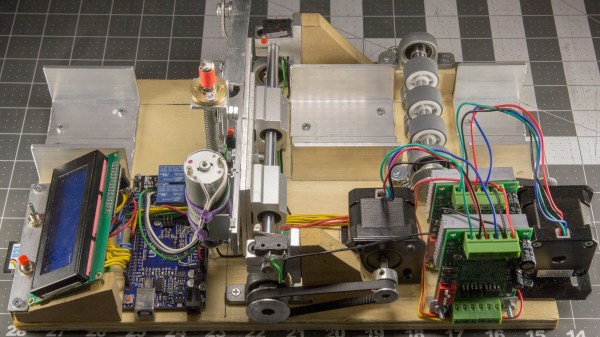
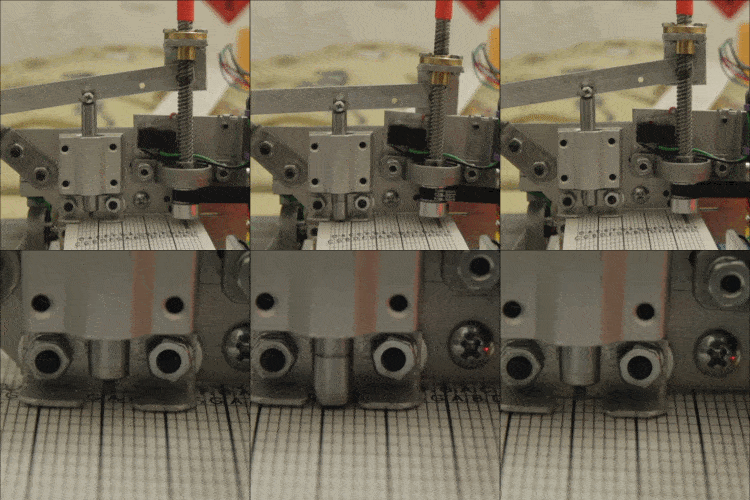
Custom hole punch and feed system

Most projects have one or two significant aspects in which custom work or clever execution is showcased, but this Music Box Hole Punching Machine by [Josh Sheldon] and his roommate [Matt] is a delight on many levels. Not only was custom hardware made to automate punching holes in long spools of paper for feeding through a music box, but a software front end to process MIDI files means that in a way, this project is really a MIDI-to-hand-cranked-music-box converter. What a time to be alive.

The hole punch is an entirely custom-made assembly, and as [Josh] observes, making a reliable hole punch turns out to be extremely challenging. Plenty of trial and error was involved, and the project’s documentation as well as an overview video go into plenty of detail. Don’t miss the music box version of “Still Alive”, either. Both are embedded below.

Continue reading “Music Box Plays “Still Alive” Thanks To Automated Hole Puncher”

Remote Controlled Streaming Speakers

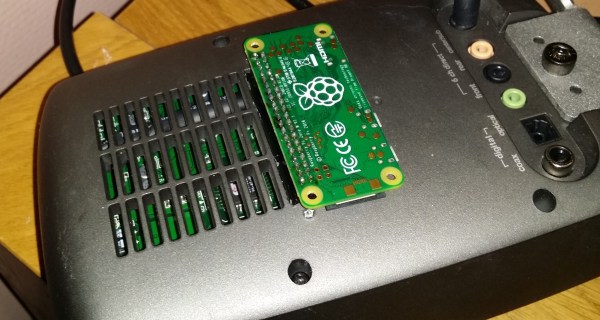
For want of a better use of a spare Raspberry Pi Zero W and a set of LogitechZ-680 surround sound speakers, [Andre van Kammen] hacked them together to make them stream music playing from his phone.

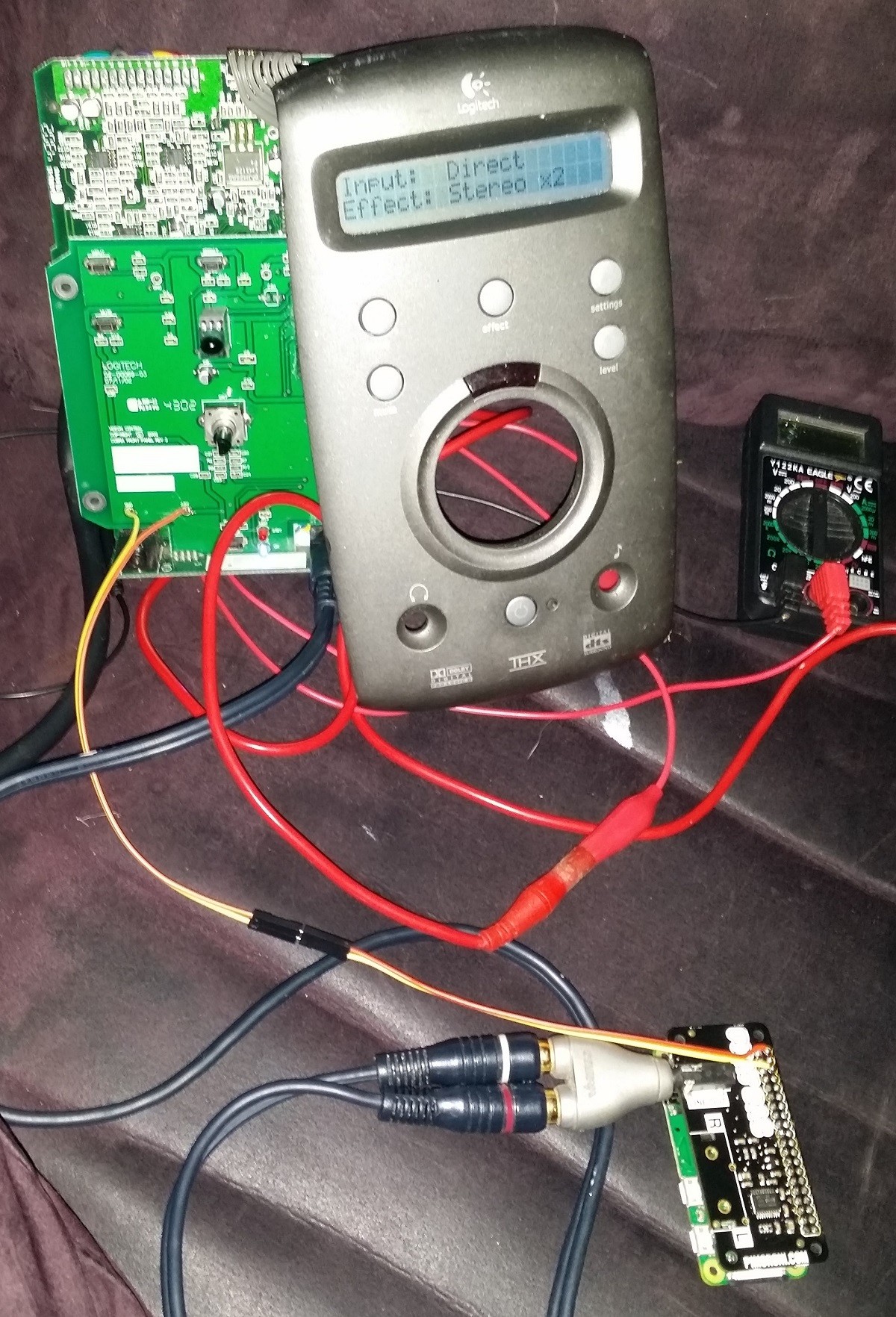
It was stumbling across the Pi Music Box distribution that really got the ball rolling, and the purchase of a pHAT DAC laid the foundation. Cracking open the speakers’ controller case, [Kammen] was able to get 5V of power off some terminals even when the speakers were on standby — awesome! — which the Pi could use. Power and volume are controlled via the Pi’s GPIO pins with a diode to drop the voltage and prevent shorts.

Now, how to tell whether the speakers are on or off? Well, a pin on the display connector changes to 4.3V when it’s on, so wiring a 10k resistor and a diode to said pin is a hackable solution. Finishing off the wired connections, it proved possible to cram the pHAT DAC inside the controller case with the GPIO header sticking out the back to mount the Pi upon with no other external wires — double awesome!

Continue reading “Remote Controlled Streaming Speakers”

Reed Organ MIDI Conversion Tickles All 88 Keys

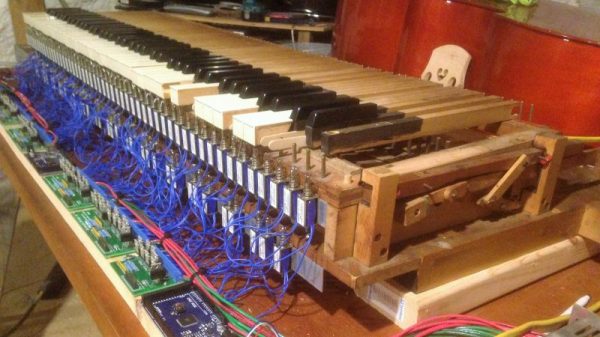
What did you do in high school? Chances are it wasn’t anywhere near as cool as turning a reed organ into a MIDI device. And even if you managed to pull something like that off, did you do it by mechanically controlling all 88 keys? Didn’t think so.

A reed organ is a keyboard instrument that channels moving air over sets of tuned brass reeds to produce notes. Most are fairly complex affairs with multiple keyboards and extra controls, but the one that [Willem Hillier] scored for free looks almost the same as a piano. Even with the free instrument [Willem] is about $500 into this project. Almost half of the budget went to the solenoids and driver MOSFETs — there’s a solenoid for each key, after all. And each one required minor surgery to reduce the clicking and clacking sounds that don’t exactly contribute to the musical experience. [Willem] designed custom driver boards for the MOSFETs with 16 channels per board, and added in a couple of power supplies to feed all those hungry solenoids and the three Arduinos needed to run the show. The video below shows the organ being stress-tested with the peppy “Flight of the Bumblebee”; there’s nothing wrong with a little showing off.

[Willem]’s build adds yet another instrument to the MIDI fold. We’ve covered plenty before, from accordions to harmonicas and even a really annoying siren.

Continue reading “Reed Organ MIDI Conversion Tickles All 88 Keys”

Theremin In Detail

[Keystone Science] recently posted a video about building a theremin — you know, the instrument that makes those strange whistles when you move your hands around it. The circuit is pretty simple (and borrowed) but we liked the way the video explains the theory and even dives into some of the math behind resonant frequencies.

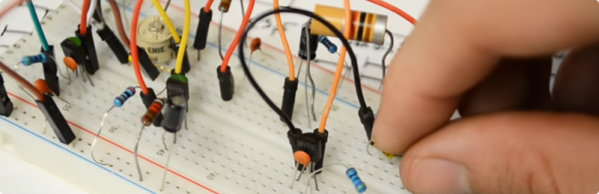
The circuit uses two FETs for the oscillators. An LM386 amplifier (a Hackaday favorite) drives a speaker so you can use the instrument without external equipment. The initial build is on a breadboard, but the final build is on a PCB and has a case.

Continue reading “Theremin In Detail”

Raspberry Pi AI Plays Piano

[Zack] watched a video of [Dan Tepfer] using a computer with a MIDI keyboard to do some automatic fills when playing. He decided he wanted to do better and set out to create an AI that would learn–in real time–how to insert style-appropriate tunes in the gap between the human performance.

If you want the code, you can find it on GitHub. However, the really interesting part is the log of his experiences, successes, and failures. If you want to see the result, check out the video below where he riffs for about 30 seconds and the AI starts taking over for the melody when the performer stops.

Continue reading “Raspberry Pi AI Plays Piano”