Turning An Old Keyboard Into A Work Of Art


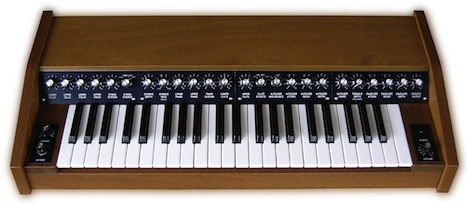
The 1970s were the glory days for analog synthesizers, and for [Stefan] listening to huge modular Moogs and ARPs resulted in a wondrous seething jealousy. In 2009, wanting to relive just a little bit of his childhood, [Stefan] picked up a PAiA Stringz’n’Things from eBay. It’s a great little keyboard, but [Stefan] his new purchase to look little classier than a tolex-covered flight case. After getting rid of the old tolex case, [Stefan] made a new enclosure and added some extra circuitry to expand the capabilities of this classic synth.

After replacing the electrolytic capacitors and fixing a voltage regulator issue, [Stefan] made a new enclosure for his keyboard out of beautifully lacquered mahogany. A new key bed stolen from an old Yamaha organ was brought in, and new control panels above the keys provide a more sensible organization than the keyboard’s previous incarnation.

The original Stringz’n’Things was laid out more like an organ than a synthesizer, a reflection of its polyphonic nature. This meant there wasn’t a very diverse tonal palette, but [Stefan] remedied that with a wave folder to generate extra harmonics, a tremolo, and an envelope generator to provide attack and decay for each note.

Now [Stefan] has a lovely polyphonic synth that has found its place on top of an old Hammond organ. As a bonus, the synth sounds really good. Not bad for an instrument generally regarded as being very limited.


Refurbing An Old Piano With Carbon Fiber

[Chris] picked up a baby grand. Of course for a complex mechanical device made out of wood, it wasn’t in the best shape. He’s doing his best to refurbish this $350 piano and turn it into something that plays and sounds like a $200,000 concert grand

The 1941 Kimball baby grand piano [Chris] picked up for $350 was a complete mess when it arrived in his house. After cleaning up the wood and replacing some felt the piano looked much better, but [Chris] wanted to make it play better.

After picking up a set of hammers from a 1909 Steinway, [Chris] tore apart the action on his Kimball. The Steinway hammers were removed from their shanks, carbon fiber shanks glued into place, and the entire assembly put back into the piano.

With new felt, new hammers, and light weight shanks on every key, [Chris] has a remarkable piano that is most likely better than new. Not a bad result for a $350 piano.

You can check out [Chris]’ build video after the break along with a little [Mozart] (we think) after the break.

Continue reading “Refurbing An Old Piano With Carbon Fiber”

Two Hard Disks And One DJ Get Down With No Delay

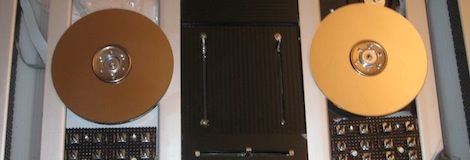
Mixmaster [robelix] built a MIDI controller for DJs that uses two hard drives for scratching and cutting some wicked beats.

[robelix]’s project is called Hard DJ and was inspired by this earlier build capable of producing a droning appreciated chiptune music using the motor inside a hard drive. Instead of reading the out of phase sine waves produced when a hard drive platter is manually rotated, [robelix] used custom laser cut encoder wheels and an IR detector from old computer mice. This gives [robelix] far more resolution than would be possible by reading the drives stepper motors and allows him to scratch and cut to whatever his MC desires.

The electronics portion of the build are a little rough at this stage – just an Arduino Mega, a few buttons, and a trio of faders. [robelix] will be building a proper enclosure for his controller soon, something we can’t wait to see.

If you’d like to clone this DJ controller, all the files are up on the Git. Check out the video after the break.

Continue reading “Two Hard Disks And One DJ Get Down With No Delay”

Cutting A Record… On A CD

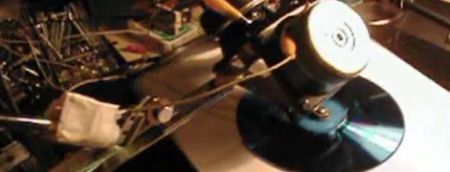
Vinyl records are an amazingly simple technology, but surprisingly we haven’t seen many builds to capitalize on the ease of recording music onto a vinyl disk. [Seringson] made his own vinyl polycarbonate cutter to record his own records at home. The impressive thing is he did this with parts just lying around.

Just like the professional and obsolete record cutters of yore, [Seringson]’s build uses two speaker drivers mounted at a 45° angle to reproduce a stereo audio track. Each of these drivers reproduce the left and right audio track by carving them into the polycarbonate of a CD with an extremely sharp needle. From the video, the audio quality of [Seringson]’s record cutter is pretty good – more than enough to recreate the sound of a 1940’s 78 RPM record, but not quite up to the task of reproducing something produced and mastered recently.

We’re extremely impressed that [Seringson] was able to a record cutter out of scraps he had lying around. Now we’ll wait patiently until a combination record/CD is released.

Tip ‘o the billycock to [Gervais] for sending this one in.

Continue reading “Cutting A Record… On A CD”

Reverse Engineering A Stylophone

The Stylophone – a musical toy from the 60s – is a surprisingly simple piece of engineering. With a simple metallic keyboard played with a stylus and just a handful of transistors, the Stylophone was able to produce a few marvelous for their time sounds, and is the equivalent of a pre-[Stradivarius] violin for the electronic music scene. [Simon] tore apart an original Stylophone, and did a complete teardown of the circuit, going over the ins and outs of why this ancient noise box is so cool.

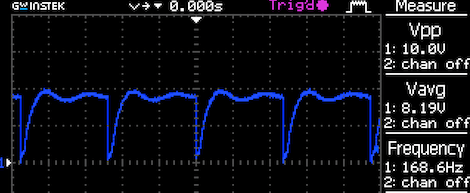
There have been quite a few DIY Stylophone clones, but all of them suffered from the same raspy sound made by a 555 timer chip slightly misguided makers used instead of the relaxation oscillator (in the pic seen above) used in the original. Aside from the oscillator connect to the RC circuit of the metallic keyboard, [Simon] also looked into the vibrato circuit. This is just a simple oscillator producing an 8 Hz sine-ish wave. The keyboard, of course, is connected to the circuit with an array of resistors which [Simon] happily provided the values for.

[Simon] put up a schematic of his reverse engineered Stylophone, allowing you to clone this ancient electronic instrument. If you can source the transistors, that is.

MIDI Swiss Army Knife Built From An MSP430

[youtube=http://www.youtube.com/watch?v=0hvQUXcXlEg&w=470]

Hot off the heels of his web server for the TI MSP430, [Rob] shared a MIDI booster pack for the MSP430 LaunchPad, an exceedingly inexpensive and ever more capable microcontroller that is getting somewhat of a cult following.

[Rob]’s MIDI booster pack contains a MIDI in and out port as well as just about whatever MIDI manipulation apps his mind can dream up. So far, [Rob] has a MIDI arpeggiator, a harmonizer, an echo, filter, s MIDI monitor that displays incoming messages on a Nokia LCD, and a controller that interfaces with a light sensor or joystick to manipulate MIDI variables.

Back in the 80s (and 90s, and even into the aughts), a dedicated MIDI arp or harmonizer was a crazy expensive piece of kit, especially considering how simple the device is. Those dedicated rackmount boxes can now be replaced with a TI LaunchPad and [Rob]’s booster pack.

You can check out the arp and harmonizer in action after the break.

Continue reading “MIDI Swiss Army Knife Built From An MSP430”

apoll013

A Replica DJ Controller To Rule Them All

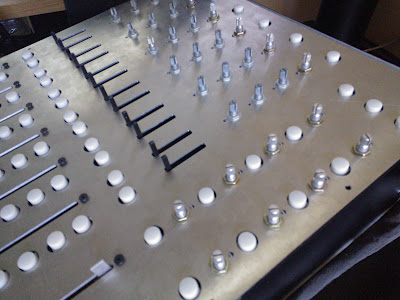
So like many followers of Hackaday, maybe you’re into electronic music. We’d dare to say though that few of you have the dedication of [adamdzak] as he decided to replicate [Sasha]‘s custom controller for the [Abelton Live] software package. Apparently it’s more difficult than taking apart your DJ Hero controller and hacking it to interface songs on your computer.

The “new” controller is named Apollo, and is meant to be a replica of Sasha’s Maven controller. The build process is well laid out in his post, and the results so far look quite incredible. What’s particularly interesting is the effort taken to reverse engineer this device without ever having been able to use it. Both from a mechanical standpoint and trying to figure out how the buttons are used to control the software must have been quite a challenge. Check out the video after the break to see this new controller in action. Continue reading “A Replica DJ Controller To Rule Them All”