Controlling Samplers And Sequencers With Multitouch

When we see artists like Daft Punk or Madeon working their magic in a live setting, we’re always impressed with their controllers. Sample-based artist use controllers like the Monome and Kaoss Pad a lot, but these devices are fairly expensive. Thankfully, we live in an age of multitouch displays, so [Graham Comerford] came up with his own multitouch controller that does just about anything.

The build is based on the Kivy framework and includes a Monome emulator, MIDI drum pads, mixer, and a whole bunch of other sliders and buttons. There’s no word on how [Graham]’s multitouch display was constructed, but if you’re looking to build your own gigantic audio control setup there’s a lot of info on building Microsoft Surface clones, adapting computer monitors, and spherical multitouch rigs.

We’re not sure if [Graham]’s virtual drum kit is velocity sensitive but even if it’s not, it’s an interesting bit of kit. Check out an earlier version of his setup after the break.

Continue reading “Controlling Samplers And Sequencers With Multitouch”

Insects Turned Into Orchestra; Not Harmed But Terribly Inconvenienced

[Jochem] has always been fascinated by chaos in nature, whether it’s a swarm of ants or evolution in action in a petri dish. His insect orchestra takes the chaos in the natural world and changes it into something completely artificial. In this case, MIDI.

For the build, a light sensor was placed at the bottom of a test tube. A cricket (or grasshopper, or locust) is then put into the test tube. The test tube is then closed up with a cap that houses a LED. An Arduino reads the light sensors and then transmits the data over MIDI. The MIDI commands are picked up in Abelton Live which converts everything to audio.

[Jochem] rigged up Abelton to have the insects perform in four different modes – instrument, synthesis, samples, and drums. Definitely an improvement over the humble Mexican Jumping bean.

You can check out the insect orchestra in action after the break.

Continue reading “Insects Turned Into Orchestra; Not Harmed But Terribly Inconvenienced”

Guitar Pickup Winding Workstation

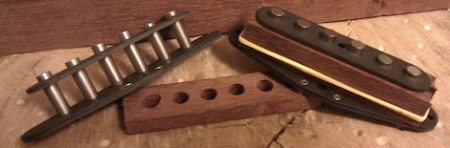
After a bit of inspiration, [Pete] decided to build a solid body electric guitar for himself. Instead of assembling a conglomeration of off-the-shelf parts, he plans on building just about everything from scratch. This includes the guitar pickups, so he built himself a pickup winder that has measures RPM, ETA until done, and auto stop for when the pickup is complete.

Electric guitar pickups are simple devices – just a magnet for each string wrapped in thousands of turns of wire about as thin as a human hair. [Pete] began his build with a cheap sewing machine and added a tachometer and pickup mount. As an added bonus, [Pete] threw in an ohmmeter to measure the coil resistance and a Gauss meter to measure the magnetic flux and polarity of the pole pieces. It’s a very nice build that’s designed to be as functional as commercial pickup winders.

[Pete] was originally inspired to build a pickup winder by the Les Paul Google doodle, and he plans on continuing Les Paul’s tradition of guitar innovation by building his own solid body guitar. The wood has been cut already, and we can’t wait to see the final product.

Check out a video of [Pete]’s coil winder in action after the break.

Continue reading “Guitar Pickup Winding Workstation”

High Voltage Hacks: A 1000 Watt Tube Amp

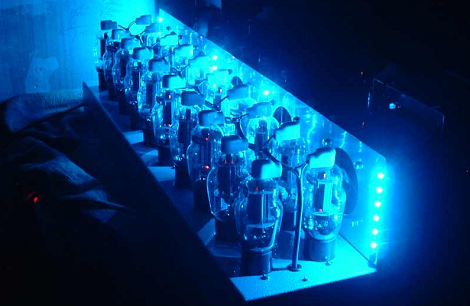
Normally when we hear of a Champ guitar amp, we think of a sweet-sounding rig that puts out 6 Watts through an 8-inch speaker. [John Chambers] of Champ Electronics wanted to build a true champion for the field of battle and came up with The Champ 1000 Watt Tube Amp, an amplifier that probably puts out enough heat to keep an igloo warm.

The amp is based on 807 valves. With some clever engineering [John] managed to coax 100 watts out of a pair of 807s, so the entire amp “only” requires 20 power tubes. The build log shows some pretty impressive examples of electrical prowess. We can’t recall the last time we featured a build with point-to-point wiring on tagboard, and [John]’s work is some of the best we’ve ever seen.

[John] has been working on this amp off and on for a few years now, but he should be wrapping up the build sometime soon. We haven’t seen this amp in action, but we imagine it would look something like this 36×10 monstrosity. Send us a message or post a comment if you can find a video and we’ll put it up.

Water-powered Multi-channel Audio

[Niklas Roy] is rolling out some water-powered music for Berlin’s Museum night. It seems that this water-wheel is attached to the side of the Museum. It’s got a stream flowing past it and the wheel is constantly turning. The thing is, that work isn’t being used for anything. Now we’ve already seen [Niklas] making electricity from moving water, but that’s far from what he had in mind this time around. Instead he’s driving a multitude of music boxes with the motion transferred from the water.

He teamed up with another artist named [La belle Imira] to build and connect a series of pulleys to the waterwheel. The video after the break shows the rope system being strung throughout the grounds of the museum. After passing around the output drum of the water wheel, the rope snakes through each pulley. Many of the pulleys have the mechanism from a music box attached to their axles, so whenever the water is flowing, music plays. They don’t all play the same tune, so you get a variety of selections as you walk around. We could swear that one of them is playing ‘My Way’.

Continue reading “Water-powered Multi-channel Audio”

Building A Contact Mic Using Homemade Piezo Crystals

homemade_piezo_contact_mic

[Leafcutter] is big in to making music and has put together all sorts of musical instruments and tools over the years. Recently, he was inspired to make his own piezo crystals, and wrote in to share the results of his experiments with us.

[Leafcutter] is no stranger to messing around with piezo elements, and after seeing [Collin’s] tutorial on making your own piezo crystals at home, he knew he had to give it a try. He stopped by the grocery store to fetch all of the ingredients, then followed [Collin’s] instructions to the letter…well, almost. It seems that he might have cooled the solution too quickly, so he found himself with a jar full of tiny, barely usable piezo crystals instead of larger ones like [Collin] was able to produce.

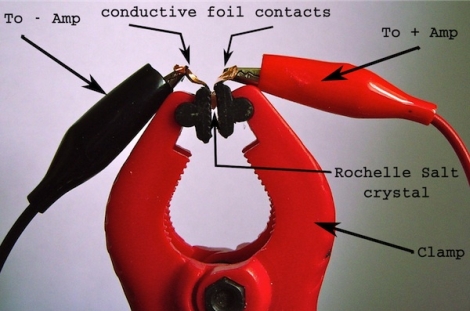
Undeterred, he decided to see if the stuff was any good, and rigged up a makeshift contact microphone using some conductive foil and a clamp. He piped the output to his amplifier, and wouldn’t you know it…it worked!

He has a small sound clip of what the mic sounded like on his site, and it worked pretty darn well despite the crystal’s tiny size. He is going to give the whole process another go, so we hope to see more experiments with bigger crystals in the near future.

Adding Wireless Controls To Vintage Stereo Equipment

marantz_wifi_remote_control

[Jean] was shopping around for a vintage stereo receiver, and happened upon a broken, but repairable Marantz 4240. After getting things back to working order, he thought it would be great if he could use his iPhone to remotely control the unit (PDF Writeup, Schematics and Code).

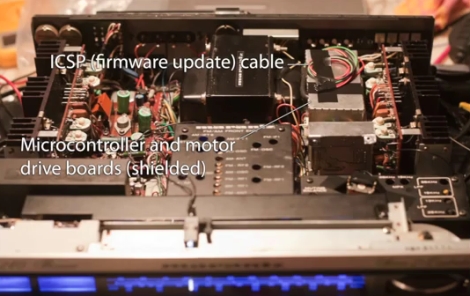
He scrounged around for parts, and after locating a PIC and a handful of parts from old copiers and printers, he got down to business. He etched some custom boards to house electronic bits, then strapped motors to the volume and source selection knobs. He also rigged up the push button power switch on the receiver, using a small servo and a bit of string.

Now, he can control everything using his iPhone, which communicates with the stereo over WiFi. While the power, volume knob, and input selector can be triggered remotely, he still has the ability to tweak any of these items manually if desired.

We think that this is a great way to add modern amenities to vintage electronics, without ruining the aesthetics of the components. Don’t take our word for it though, check out the video demonstrations [Jean] but together after the jump.

Continue reading “Adding Wireless Controls To Vintage Stereo Equipment”