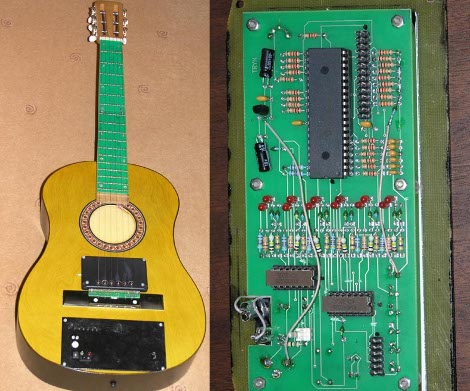
Fully Fretted Guitar MIDI Controller

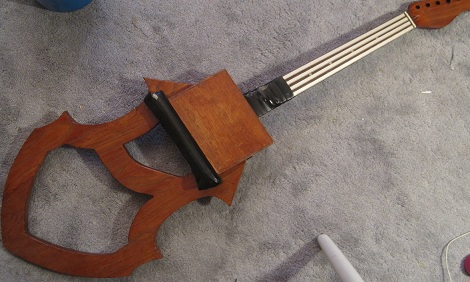
[Andy] came across this guitar midi controller project from way back and decided to send us a tip about it. The English version, translated from the original Russian, is easy to follow and documents the build process from first prototypes to the version you see above. It can connect via a standard MIDI cable and then be used to control anything you want. The only thing missing is the ability to transmit velocity data, but that’s certainly not a deal breaker.

The device has two sensory parts. The first is a set of pickups that can be seen underneath the strings near the bridge. These work like standard magnetic pickups but instead of extrapolating fret data from the pitch picked up on the string, there is a second sensor mechanism for every fret of each string. Since the strings are made of metal, it’s possible to detect which fret is depressed based on continuity sensing. Of course this means you need a conductor between every fret, and that’s why the fingerboard has been replaced with one made of printed circuit boards. All of this data is gathered, then sent to the MIDI device via a PIC 16F74 microcontroller.

If this leaves you wanting for more guitar hacks, don’t miss this one that adds addressable LEDs in between each fret.

CV Sequencer With A TV Out

[gijs] sent in the control voltage sequencer he’s been working on that uses the TVout Arduino library to provide a graphical interface.

The sequencer doesn’t produce any sound on its own. Instead, it outputs a Control Voltage so other synths can be sequenced with [gijs]’ TVSCV. Before MIDI came around, CV was the standard to connect synthesizers and drum machines together. Even today, a lot of boutique synths have at least one jack for CV. [gijs]’ build is really interesting because of the user interface – the TVout Arduino library was used in conjunction with a tiny CRT to change values, timing and speed of the CV output. The TVSCV is able to sequence two different channels of CV at 10 bit resolution with 16 steps per bank.

From the video after the break, the TVSCV sounds like it can produce what would be the trippiest soundtrack ever conceived for an Atari or NES game. It’s a great bit of kit, especially when connected to an Atari punk console or a TR-808 and a glitch delay.

Continue reading “CV Sequencer With A TV Out”

Why Wasn’t This Magnetic Cello Made In The 70’s?

[magnetovore] made himself an electronic cello. Instead of pulling a few cello samples off of an SD card, he did it the old school analog way. The finished build is really impressive and leaves us wondering why we haven’t seen anything like this before.

[magnetovore] uses a permanent magnet to play each ‘string’. A lot of details are in this post and [magnetovore]’s provisional patent (PDF warning). From what we can gather, each string is a resistive ribbon sensor connected to a voltage controlled oscillator. The output of the VCO is sent to a variable gain amplifier that is controlled by a coil of wire and the magnetic ‘bow’.

From the video (after the break), [magnetovore] already has an amazing reproduction of the cello sound. It’s a bit electronic on the lowest parts of the C string, but with a little bit of processing it could definitely pass for an acoustic instrument. We’re left wondering why we haven’t seen anything like this cello before. VCOs and VGAs were the bread and butter of the old Moogs and even the ancient ondes martenot. Ribbon controllers were being attached to electronic instruments back in the 50’s, so we’re really at a loss on why a magnetic cello is new to us. If any Hack A Day readers have seen anything like this before, leave a message in the comments.

Continue reading “Why Wasn’t This Magnetic Cello Made In The 70’s?”

Roland 808 Synced To MIDI

Reading this week’s ATtiny-themed builds, [Thomas] was reminded one of his coolest builds. His midi808 project used an ATtiny2313 to sync a vintage Roland 808 drum machine to his Logic workstation.

Even though MIDI had been around for a few years when 808s were being made, the CPU in the 808 isn’t exactly up to the task of handling MIDI. Instead, the 808 used an interface known as DIN Sync that was designed to keep 808s, 707s, and 303s in time with each other. MIDI to DIN Sync boxes do did exist, but even the auxiliary equipment to use an 808 is getting hard to find.

The build takes a MIDI signal and passes it through an opto-isolator per the MIDI spec. The microcontroller reads the MIDI signal and passes it out through the DIN Sync port. The DIN Sync protocol is only 24 pulses per quarter note output with TTL voltages, and the project code is easy enough to follow. It’s a nice build for one of the greatest drum machines ever made. Listen to a track [Thomas] made with his new setup after the break.

Continue reading “Roland 808 Synced To MIDI”

Building An Optigan-like Instrument

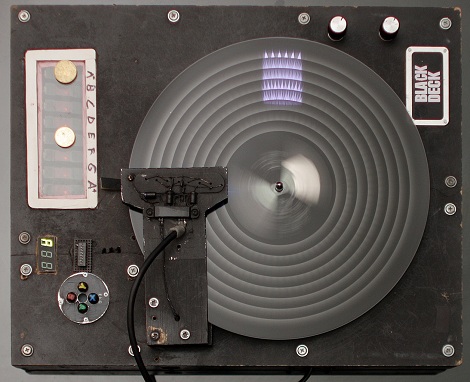
[Olli] sent in his writeup of a musical instrument he made called the Black Deck. [Olli]’s instrument was inspired [Jimi Tenor]’s photophone – a transparent disk attached to a fan and photocell.

A transparent disk is placed on the turntable [Olli] rescued during a dumpster diving expedition. A light shines though the optical disk and is picked up by phototransistors. After writing a program to generate an A minor scale onto a transparency, [Olli] connected his contraption to a stereo and heard his creation speak. To control the individual tracks (or notes) on the disk, [Olli] made a keyboard out of photoelectric switches that control which note is played.

Superficially, [Olli]’s instrument resembles an Optigan. While [Olli]’s instrument is capable of producing waveforms, the Optigan is able to reproduce sampled instruments. That being said, we think [Olli]’s Black Deck would feel comfortable next to the Optigans of Kraftwerk and Devo. Check out the YouTube demo of the Black Deck in action after the break:

Continue reading “Building An Optigan-like Instrument”

[Dino’s] JFET Guitar Preamp With Piezo Pickup

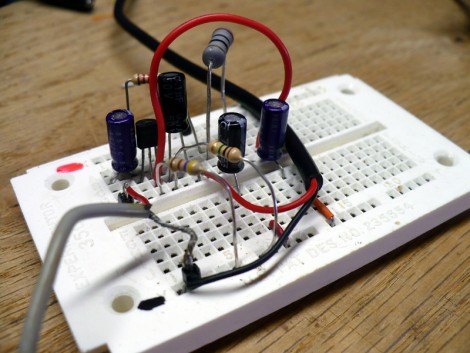
This week, with a little help from a Roomba, [Dino] built a guitar pickup and preamp that sounds marvelous. A pickup takes vibrations from the guitar and turns them into an electrical signal which can then be amplified and broadcast. He grabbed a long-dead Roomba which has slowly but surely been donating its organs for his weekly projects. After plucking out a piezo element he grabbed a bag of Junction gate Field-Effect Transistors (JFET) and built a preamp circuit around one of them.

JFETs operate in much the same way as MOSFETs (which we took a look at last week). [Dino’s] design adds a few resistors and capacitors to tune the gain and decouple the circuit from the input and power rails. He epoxied the piezo element inside the guitar and connected leads between it and a jack mounted in the body. As always, he does an excellent job of explaining the concepts behind the design and outlining the build techniques that he used. We’ve embedded his video after the break.

Continue reading “[Dino’s] JFET Guitar Preamp With Piezo Pickup”

Broken Vintage Record Player Reborn As A Portable MP3 Cabinet

old_record_player_pc_jukebox

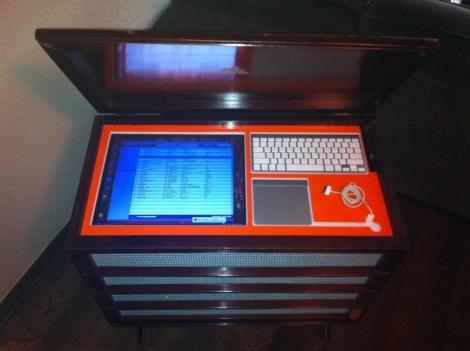
[Julian] picked up an old record player that was sitting in somebody’s trash pile, and brought it home to see if it could be restored to working order. When he got it home he discovered that it didn’t work at all, so he and his wife decided to modernize it a bit.

In an effort to simultaneously reunite himself with his music collection and piss off audiophiles/antique collectors in the process, he gutted the radio and began rebuilding it to serve as an MP3 jukebox. Once the innards were removed, his wife refinished the cabinet and gave the front grill a new cloth cover.

An old PC was installed inside the cabinet, along with a set of relatively cheap (but better than paper cone) speakers. A pair of custom cut plexi panels were used to cover the computer, while providing space for the monitor and Apple wireless keyboard + trackpad [Julian] uses to manage the jukebox.

The refurbed record player came out looking quite nice, and although it likely raises the ire of several different groups of purists, we think it’s pretty cool.