Homebrew Mp3 Player With Some Bonus Features

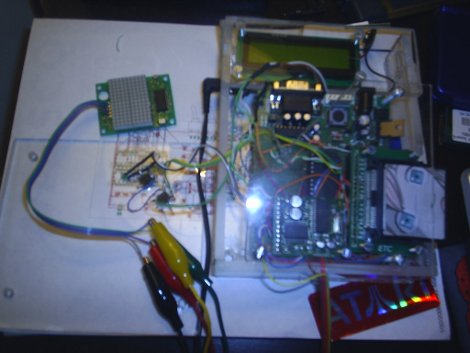
When [falldeaf] set about making his own homebrew Mp3 player, he ended up at the same place we most do while looking into the subject, the wonderful Minty Mp3. Basing the design on [Adafruit Industries] popular board, we are presented The Mp3 Garbler.

First change of the project was to replace the sometimes difficult to find ST013, or the more expensive ST015T Mp3 decoder chip, and the CS4340 digital to analog cconverter with a single vs1001k, which we have checked out before. And while yes VLSI says that the 1001 series is a discontinued product, and it may be a bit hard to find now days, they also offer an updated model on their website, which should suit the application fine.

Next up is a useful LCD display sporting a Sparkfun lcd backpack, that shows us all the important to know music info. And finally there is a 10×14 led matrix display, that can be used to display all sort of user feedback icons, and is driven by a MAX6953, which we think is a pretty spiffy chip.

While there is no schematic, there are brd files, and source code available for your PIC18F452 or similar micro controller to complete your own
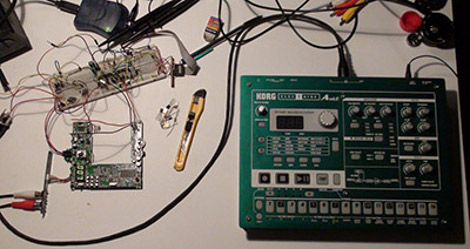
MIDI Input For The Kaossilator

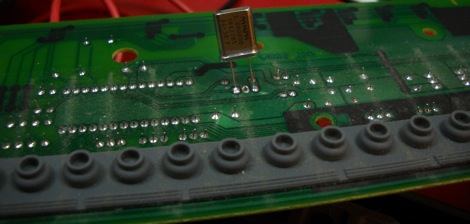
This isn’t strictly a MIDI input hack; [Furrtek] pulled off an alternate input hack for the Kaossilator that he’s currently using with a MIDI connection. In its unhacked form the Kaossilator is a small touchpad-based sound manipulation tool. [Furrtek] sniffed out how the touchpad data is read and used on the little device. He then purposed an ATtiny2313 as the core of a circuit that spoofs those signals. The microcontroller now listens for incoming MIDI data, looks up the proper signal translations in a table, then outputs them to the Kaossilator.

In the video after the break you can see that it works perfectly, with no lag or noticeable problems. As we alluded to at the top, there could be so much more done with this. Since the ATtiny2313 is merely translating MIDI into touchpad signals, the input could be anything. The first thing that comes to mind is a dance floor that changes the music based on how many people are out there tearing it up. Continue reading “MIDI Input For The Kaossilator”

LEGO Wah-wah Pedal

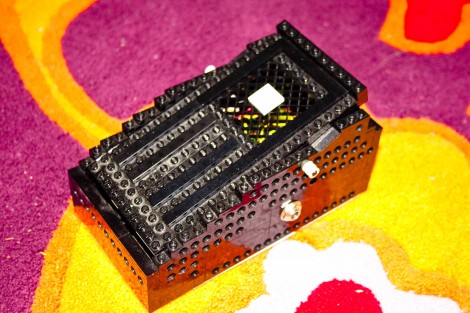
Here’s a guitar wah-wah pedal that [Christian Munk] built. Inside you’ll find a circuit board that he etched and populated based on this design but he chose to build the housing out of LEGO. The video after the break gives you an idea of what it sounds like, but for those who’ve stepped on a LEGO piece with bare feet, his pedal pounding might make you cringe!

To manipulate the sound the pedal rocks forward and backward on a center pivot shown above as a grey “nut” sticking out the side of the frame. Inside there’s a system of LEGO gears that turn a trimpot to alter the sound. This might go along nicely with that guitar amp you hacked together.

Continue reading “LEGO Wah-wah Pedal”

Guitar Tube-amp From Junk Hi-fi

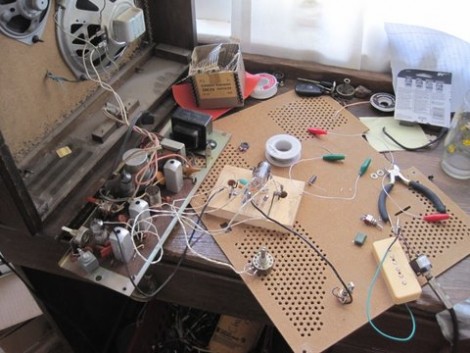
[Tristan Chambers] picked up an old speaker box some friends acquired at a yard sale. It didn’t have any inputs, and there weren’t any tuning knobs like a radio would have, so it’s a mystery what this was originally used for. [Tristan] traced out the circuit and figured out where he could input audio signals which allowed him to hook up an iPod, but it was mono and not very loud. He ended building his own vacuum tube preamp from a schematic he found on the Internet so that he could use it with an electric guitar. As the video after the break shows, the box not only puts out some pretty good sound but it’s nice and loud too.

Continue reading “Guitar Tube-amp From Junk Hi-fi”

Audio Crossover Back In Service


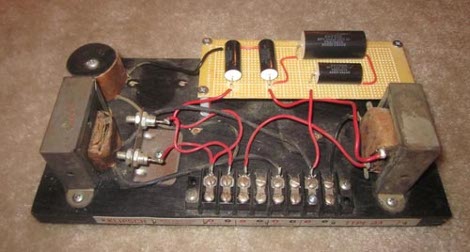
Audio Crossovers are an essential tool for any high end speaker system. Because most individual loudspeakers are unable to cover the entire spectrum of audible sound as well as multiple drivers are, it is necessary to split the input signal into low and high frequency parts. When a friend of [Anthony]’s was about to send off a classic Klipsch AA Crossover to be repaired professionally, [Anthony] insisted it was possible to save some money and do it himself.

The oil can capacitors of the Crossover had gone bad, so a new set of metalized polypropylene capacitors were ordered to pick up the task. After carefully removing the old caps, [Anthony] assembled the new set on a breadboard, and mounted the board to the old Crossover base (along with some tasteful McDonalds straw spacers). The entire process is detailed on his blog, and we are sure his friend saved a good deal by this home repair method. Capacitor issues are a common problem in repairing electronics new and old alike, and always a great place to start looking when devices start acting funny.

Quit Your Job And Build A Pipe Organ

[Raphi Giandiulio] grew tired of designing expensive things for Texas Instruments, so he quit his job and built this organ. Now there is some back story here, [Raphi’s] dad was a professional musician and [Raphi] played trumpet through college. He is a mechanical engineer by trade and that’s where a lot of the expertise for the instrument design came from. The project and the website that documents it are very large in scope, detailing the design process (including CAD drawings), the build, and a tour of his woodshop. The instrument includes 250 pipes and took about four years to finish, concluding in 2007. We weren’t surprised to learn that [Raphi] now has a new job… building organs.

Perhaps you’d be more interested in hacking an existing pipe organ?

[Thanks M]

Intro To Circuit Bending

Electronic musical instruments are a lot of fun for a hacker because, with a small palette of tools, know-how and curiosity, they are easily modified. As with any hack, there is always the chance that the subject will be ruined, so it’s not necessarily worth the risk to muck about inside your thousand-dollar pro synthesizer. Luckily for all of us, there are shovel-fulls of old electronic musical toys littering the curbs and second-hand shops of the world. These fun little devices provide ample opportunity to get familiar with audio electronics and circuit bending techniques.

A note on definitions: the term “circuit bending” can be synonymous with “hardware hacking” in the world of audio electronics, and we have seen some debate as to which term is better suited to a given project. We welcome you to share your viewpoints in the comments.

Keep reading to get started.
Continue reading “Intro To Circuit Bending”