Fueling With Ammonia

There’s a major push now to find energy sources with smaller carbon footprints. The maritime shipping industry, according to IEEE Spectrum, is going towards ammonia. Burning ammonia produces no CO2 and it isn’t hard to make. It doesn’t require special storage techniques as hydrogen does and it has ten times the energy density of a modern lithium-ion battery.

You can burn ammonia for internal combustion or use it in a fuel cell. However, there are two problems. First, no ships are currently using the fuel and second most ammonia today is made using a very carbon-intensive process. However it is possible to create “green” ammonia, and projects in Finland, Germany, and Norway are on schedule to start using ammonia-powered ships over the next couple of years.

Continue reading “Fueling With Ammonia”

World’s First EVTOL Airport Will Land This November

We have to admit that flying cars still sound pretty cool. But if we’re ever going to get this idea off the ground, there’s a truckload of harsh realities that must be faced head-on. The most obvious and pressing issue might seem to be the lack of flying cars, but that’s not really a problem. Air taxis are already in the works from companies like Airbus, Rolls-Royce, and Cadillac, who premiered theirs at CES this year.

Where we’re going, we don’t need roads. But we do need infrastructure to support this growing category of air traffic that includes shipping drones that are already in flight. Say no more, because by November 2021, the first airport built especially for flying cars is slated to be operational in England.

Image via Hyundai

British startup Urban Air Port is building their flagship eVTOL hub smack dab in the center of Coventry, UK, a city once known as Britain’s Detroit due to the dozens of automobile makers who have called it home. They’re calling this grounded flying saucer-looking thing Air One, and they are building it in partnership with Hyundai thanks to a £1.2 million ($1.65M) grant from the British government. Hyundai are developing their own eVTOL which they are planning to release in 2028. Continue reading “World’s First EVTOL Airport Will Land This November”

Wind Turbines And Ice: How They’re Tailored For Specific Climates

Wind turbines are incredible pieces of technology, able to harvest wind energy and deliver it to the power grid without carbon emissions. Their constant development since the first one came online in 1939 mean that the number of megawatts produced per turbine continues to rise as price per megawatt-hour of wind energy continues to fall. Additionally, they can operate in almost any climate to reliably generate energy almost anywhere in the world from Canada to the North Atlantic to parts beyond. While the cold snap that plowed through the American South recently might seem to contradict this fact, in reality the loss of wind power during this weather event is partially a result of tradeoffs made during the design of these specific wind farms (and, of course, the specifics of how Texas operates its power grid, but that’s outside the scope of this article) rather than a failure of the technology itself.

First, building wind turbines on the scale of megawatts isn’t a one-size-fits-all solution. Purchasing a large turbine from a company like GE, Siemens, or Vestas is a lot like buying a car. A make and model are selected first, and then options are selected for these base models. For example, low but consistent wind speeds demand a larger blade that will rotate at a lower speed whereas areas with higher average wind speeds may be able to get by with smaller and less expensive blades for the same amount of energy production. Another common option for turbines is cold weather packages, which include things like heaters for the control systems, hydraulics, and power electronics, additional insulation in certain areas, and de-icing solutions especially for the turbine blades.

In a location like Texas that rarely sees cold temperatures for very long, it’s understandable that the cold weather packages might be omitted to save money during construction (although some smaller heaters are often included in critical areas to reduce condensation or humidity) but also to save on maintenance as well: every part in a wind turbine has to be maintained. Continuing the car analogy, it’s comparable to someone purchasing a vehicle in a cold climate that didn’t come equipped with air conditioning to save money up front, but also to avoid repair costs when the air conditioning eventually breaks. However, there are other side effects beyond cost to be considered when installing equipment that’s designed to improve a turbine’s operation in cold weather.

Let’s dig into the specifics of how wind turbine equipment is selected for a given wind farm.

Continue reading “Wind Turbines And Ice: How They’re Tailored For Specific Climates”

Tim Hunkin Rides Again With The Secret Life Of Components

Long-time readers may remember one of the occasional Engineering Heroes series that focused on the British engineer, inventor and sometime TV presenter Tim Hunkin, known for his intricate creations, unusual arcade machines, and Secret Life Of Machines TV series’ from the years around 1990. It seems we’re now in for a fresh treat as he’s returning to our screens via YouTube with a new series. The Secret Life Of Components will be his attempt to pass on the accumulated knowledge of a long career that most of us would have given our eyeteeth for.

There will be eight videos in the series which launches on the 4th of March, and judging by the snippets in the preview video below the break he’ll be covering a wide range including springs, adhesives, chains, belts, switches, and much more. His entertaining style and beautifully built working models are guaranteed to make for some very good content while giving a unique view into the workshop of a true master of the craft.

As an appetiser it’s worth reading our profile of Tim Hunkin. It features a visit to his Novelty Automation arcade in London’s Holborn, which should be an essential stop for any travelling Hackaday reader finding themselves in that city.

Continue reading “Tim Hunkin Rides Again With The Secret Life Of Components”

How To Monitor Blood Pressure Without Raising It

Does anyone actually enjoy the sensation of being squeezed by a blood pressure cuff? Well, as Mom used to say, it takes all kinds. For those who find the feeling nearly faint-inducing, take heart: researchers at UC San Diego have created a non-invasive medical wearable with a suite of sensors that can measure blood pressure and monitor multiple biochemicals at the same time.

The device is a small, flexible patch that adheres to the skin. So how does it manage to measure blood pressure without causing discomfort? The blood pressure sensor consists of eight customized piezoelectric transducers that bounce ultrasonic waves off the near and far walls of the artery. Then the sensor calculates the time of flight of the resulting echoes to gauge arterial dilation and contraction, which amounts to a blood pressure reading.

This patch also has a chemical sensor that uses a drug called pilocarpine to induce the skin to sweat, and then measures the levels of lactate, caffeine, and alcohol found within. To monitor glucose levels, a mild current stimulates the release of interstitial fluid — the stuff surrounding our cells that’s rife with glucose, salt, fatty acids, and a few minerals. This is how continuous glucose monitoring for diabetes patients works today. You can check out the team’s research paper for more details on the patch and its sensors.

In the future, the engineers are hoping to add even more sensors and develop a wireless version that doesn’t require external power. Either way, it looks much more comfortable and convenient than current methods.

This Week In Security: Mysterious Mac Malware, An Elegant VMware RCE, And A JSON Mess

There’s a new malware strain targeting MacOS, Silver Sparrow, and it’s unusual for a couple reasons. First, it’s one of the few pieces of malware that targets the new M1 ARM64 processors. Just a reminder, that is Apple’s new in-house silicon design. It’s unusual for a second reason — it’s not doing anything. More precisely, while researchers have been watching, the command and control infrastructure didn’t provide a payload. Silver Sparrow has been positively found on nearly 30,000 machines.

The malware also has an intentional kill switch, where the presence of a particular file triggers a complete removal of the malware package. Researchers at Red Canary point out that this package behaves very much like a legitimate program, difficult to pick out as malware. Ars Technica got an off-the-record statement from Apple, indicating that they are tracking the situation, and have revoked the developer’s certificate used to sign the malware. It’s not entirely clear whether this prevents the malware running on already compromised machines, or just stops new infections.

So who’s behind Silver Sparrow? The observed stealth mode and other complexities suggest that this is more than a simple adware or ransomware campaign. Since it was discovered before the payload was delivered, we may never know what the purpose is. It may have been a government created campaign, targeting something specific. Continue reading “This Week In Security: Mysterious Mac Malware, An Elegant VMware RCE, And A JSON Mess”

Bad Week For Boeing: Reports Of Third Engine Failure Causes Emergency Landing In Moscow

Early Friday morning a Boeing 777 performed an emergency landing in Moscow, according to Russian media. The Interfax news agency cites an anonymous source who claims the landing was caused by an engine failure on a flight from Hong Kong to Madrid. According to the Hong Kong civil aviation department this was a cargo flight. So far no injuries have been reported.

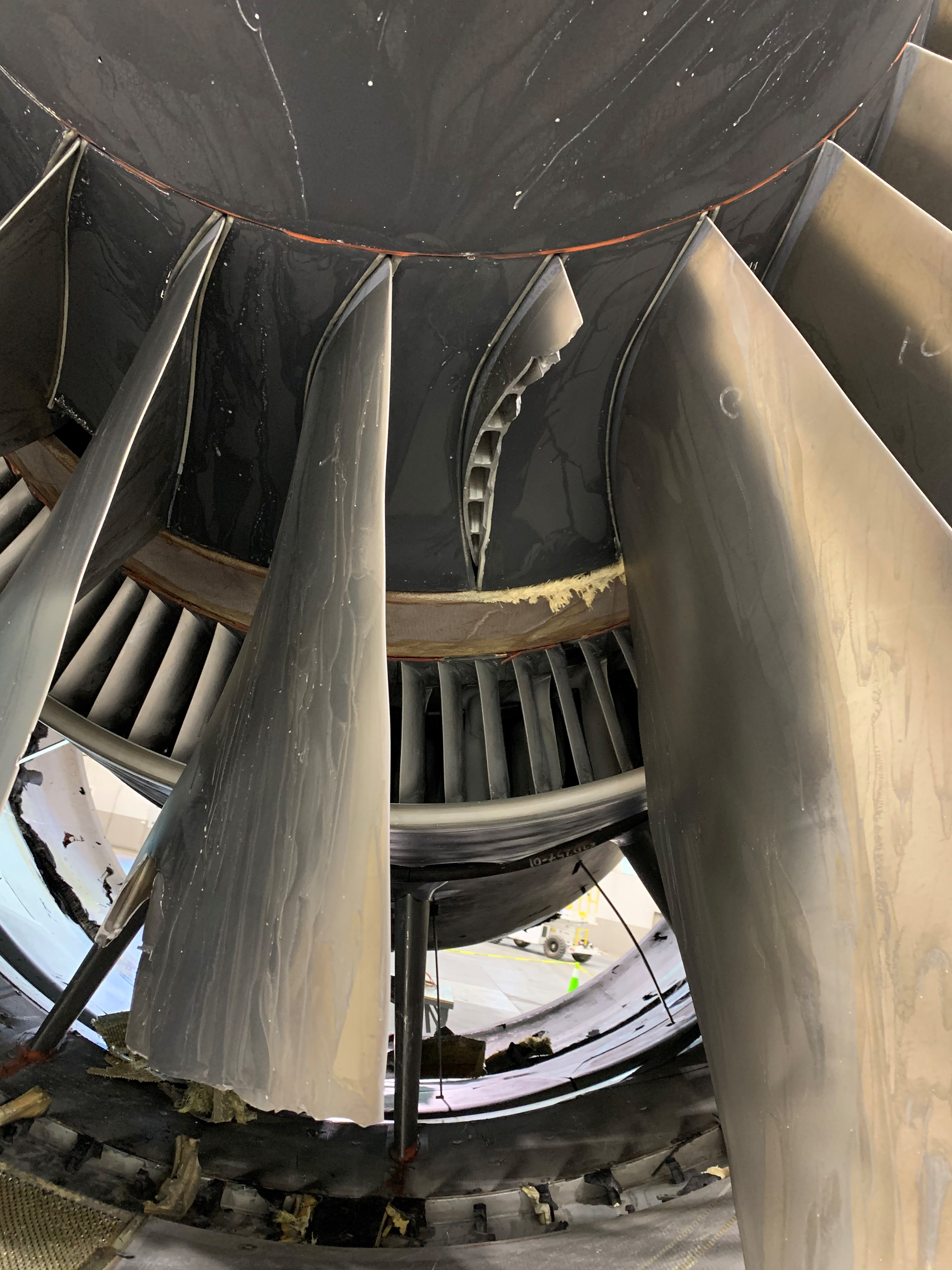
Two damaged fan blades from UA328, a Boeing 777 that returned safely to DIA shortly after takeoff

Engine failures happen, pilots train for them, and our airport infrastructure is setup to accommodate emergency landings like this. However, the timing of this reported failure is notable. This is the second engine failure on a 777 within a week, and the third to occur in a Boeing aircraft.

Shortly after takeoff on Saturday, February 20th, a United Airlines flight bound for Hawaii made an emergency landing after suffering a catastrophic failure of the right engine. The event was widely shared on social media, you likely saw the video from a passenger inside the Boeing 777-200 that shows the damaged engine on fire — if you haven’t you really should. There was also damage on the ground due to falling debris. This prompted Boeing to launch inspections of all 777-200s, and soon afterwards the NTSB published photos of the damaged engine. No injuries have been reported.

Two days later, on February 22nd, a Boeing 747-400 cargo plane operated by Longtail Aviation suffered an engine failure over the Netherlands, dropping parts that reportedly injured two people on the ground. This is a different model of aircraft but uses a Pratt & Whitney PW4000, in the same family as the Pratt & Whitney PW4070/4090 on the United 777-200.

Reports of this morning’s emergency landing in Moscow will need to be verified and investigated, and we have not seen confirmation on what type of engine the Rossiya Airlines B777-300ER used. For comparison the 777-300ERs of the United fleet and the 777-300ERs operated by Emirates both use General Electric engines rather than Pratt & Whitney models, so it is likely the Rossiya aircraft also had a GE engine.

The fact that the flights were all able to make safe landings is a testament to the redundant engineering of these aircraft. CNET did a deep dive into last Saturday’s engine failure and notes that it was an Extended-range Operations Performance Standards (ETOPS) aircraft capable of flying long distances on a single engine — necessary if an aircraft needed to make it half-way to Hawaii on one engine for an emergency landing. They also report on two other Pratt & Whitney PW-4000 engine failures in 2018 and 2000 2020, although as mentioned before, today’s incident likely didn’t involve an engine from this maker.

[Main image source: B777-300 by Maarten Visser CC-BY-SA 2.0]