Dwingeloo telescope with sun shining through

Dwingeloo To Venus: Report Of A Successful Bounce

Radio waves travel fast, and they can bounce, too. If you are able to operate a 25-meter dish, a transmitter, a solid software-defined radio, and an atomic clock, the answer is: yes, they can go all the way to Venus and back. On March 22, 2025, the Dwingeloo telescope in the Netherlands successfully pulled off an Earth-Venus-Earth (EVE) bounce, making them the second group of amateurs ever to do so. The full breakdown of this feat is available in their write-up here.

Bouncing signals off planets isn’t new. NASA has been at it since the 1960s – but amateur radio astronomers have far fewer toys to play with. Before Dwingeloo’s success, AMSAT-DL achieved the only known amateur EVE bounce back in 2009. This time, the Dwingeloo team transmitted a 278-second tone at 1299.5 MHz, with the round trip to Venus taking about 280 seconds. Stockert’s radio telescope in Germany also picked up the returning echo, stronger than Dwingeloo’s own, due to its more sensitive receiving setup.

Post-processing wasn’t easy either. Doppler shift corrections had to be applied, and the received signal was split into 1 Hz frequency bins. The resulting detections clocked in at 5.4 sigma for Dwingeloo alone, 8.5 sigma for Stockert’s recording, and 9.2 sigma when combining both datasets. A clear signal, loud and proud, straight from Venus’ surface.

The experiment was cut short when Dwingeloo’s transmitter started failing after four successful bounces. More complex signal modulations will have to wait for the next Venus conjunction in October 2026. Until then, you can read our previously published article on achievements of the Dwingeloo telescope.

ReactOS 0.4.15 Released With Major Improvements

Recently the ReactOS project released the much anticipated 0.4.15 update, making it the first major release since 2020. Despite what might seem like a minor version bump from the previous 0.4.14 release, the update introduces sweeping changes to everything from the kernel to the user interface and aspects like the audio system and driver support. Those who have used the nightly builds over the past years will likely have noticed a lot of these changes already.

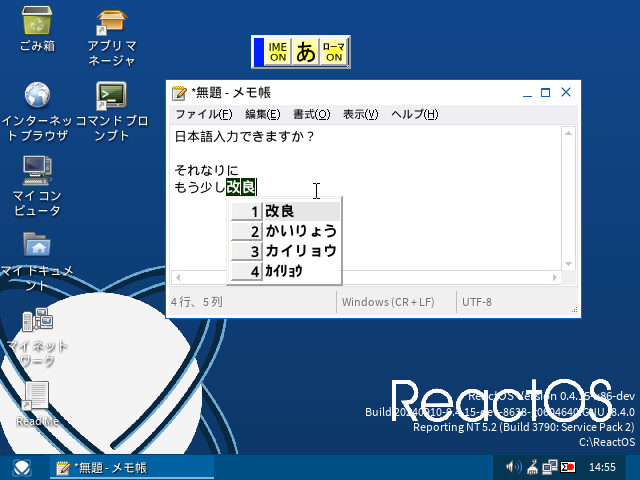
Japanese input with MZ-IME and CJK font (Credit: ReactOS project)

A notable change is to plug-and-play support which enables more third party drivers and booting from USB storage devices. The Microsoft FAT filesystem driver from the Windows Driver Kit can now be used courtesy of better compatibility, there is now registry healing, and caching and kernel access checks are implemented. The latter improvement means that many ReactOS modules can now work in Windows too.

On the UI side there is a much improved IME (input method editor) feature, along with native ZIP archive support and various graphical tweaks.

Meanwhile since 0.4.15 branched off the master branch six months ago, the latter has seen even more features added, including SMP improvements, UEFI support, a new NTFS driver and improvements to power management and application support. All of this accompanied by many bug fixes, which makes it totally worth it to regularly check out the nightly builds.

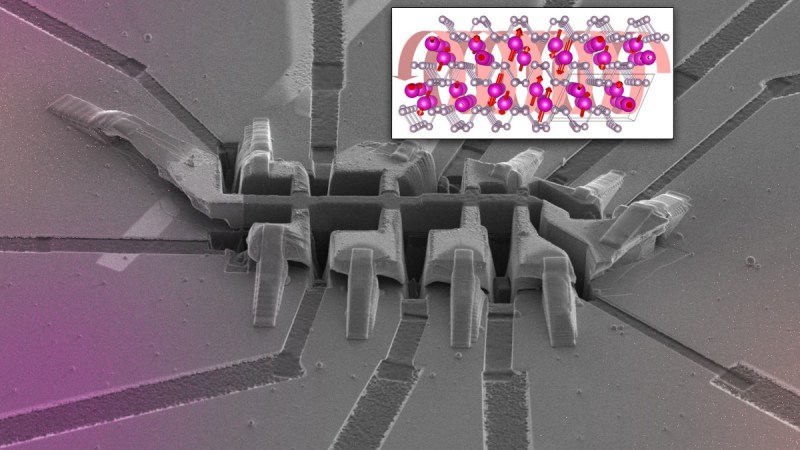
Microscopic view of chiral magnetic material

Twisting Magnetism To Control Electron Flow

If you ever wished electrons would just behave, this one’s for you. A team from Tohoku, Osaka, and Manchester Universities has cracked open an interesting phenomenon in the chiral helimagnet α-EuP3: they’ve induced one-way electron flow without bringing diodes into play. Their findings are published in the Proceedings of the National Academy of Sciences.

The twist in this is quite literal. By coaxing europium atoms into a chiral magnetic spiral, the researchers found they could generate rectification: current that prefers one direction over another. Think of it as adding a one-way street in your circuit, but based on magnetic chirality rather than semiconductors. When the material flips to an achiral (ferromagnetic) state, the one-way effect vanishes. No asymmetry, no preferential flow. They’ve essentially toggled the electron highway signs with an external magnetic field. This elegant control over band asymmetry might lead to low-power, high-speed data storage based on magnetic chirality.

If you are curious how all this ties back to quantum theory, you can trace the roots of chiral electron flow back to the early days of quantum electrodynamics – when physicists first started untangling how particles and fields really interact.

There’s a whole world of weird physics waiting for us. In the field of chemistry, chirality has been covered by Hackaday, foreshadowing the lesser favorable ways of use. Read up on the article and share with us what you think.

This Week In Security: The Github Supply Chain Attack, Ransomware Decryption, And Paragon

Last Friday Github saw a supply chain attack hidden in a popular Github Action. To understand this, we have to quickly cover Continuous Integration (CI) and Github Actions. CI essentially means automatic builds of a project. Time to make a release? CI run. A commit was pushed? CI run. For some projects, even pull requests trigger a CI run. It’s particularly handy when the project has a test suite that can be run inside the CI process.

Doing automated builds may sound straightforward, but the process includes checking out code, installing build dependencies, doing a build, determining if the build succeeded, and then uploading the results somewhere useful. Sometimes this even includes making commits to the repo itself, to increment a version number for instance. For each step there are different approaches and interesting quirks for every project. Github handles this by maintaining a marketplace of “actions”, many of which are community maintained. Those are reusable code snippets that handle many CI processes with just a few options.

One other element to understand is “secrets”. If a project release process ends with uploading to an AWS store, the process needs an access key. Github stores those secrets securely, and makes them available in Github Actions. Between the ability to make changes to the project itself, and the potential for leaking secrets, it suddenly becomes clear why it’s very important not to let untrusted code run inside the context of a Github Action.

And this brings us to what happened last Friday. One of those community maintained actions, tj-actions/changed-files, was modified to pull an obfuscated Python script and run it. That code dumps the memory of the Github runner process, looks for anything there tagged with isSecret, and writes those values out to the log. The log, that coincidentally, is world readable for public repositories, so printing secrets to the log exposes them for anyone that knows where to look.

Researchers at StepSecurity have been covering this, and have a simple search string to use: org:changeme tj-actions/changed-files Action. That just looks for any mention of the compromised action. It’s unclear whether the compromised action was embedded in any other popular actions. The recommendation is to search recent Github Action logs for any mention of changed-files, and start rotating secrets if present. Continue reading “This Week In Security: The Github Supply Chain Attack, Ransomware Decryption, And Paragon”

From The Ashes: Coal Ash May Offer Rich Source Of Rare Earth Elements

For most of history, the world got along fine without the rare earth elements. We knew they existed, we knew they weren’t really all that rare, and we really didn’t have much use for them — until we discovered just how useful they are and made ourselves absolutely dependent on them, to the point where not having them would literally grind the world to a halt.

This dependency has spurred a search for caches of rare earth elements in the strangest of places, from muddy sediments on the sea floor to asteroids. But there’s one potential source that’s much closer to home: coal ash waste. According to a study from the University of Texas Austin, the 5 gigatonnes of coal ash produced in the United States between 1950 and 2021 might contain as much as $8.4 billion worth of REEYSc — that’s the 16 lanthanide rare earth elements plus yttrium and scandium, transition metals that aren’t strictly rare earths but are geologically associated with them and useful in many of the same ways. Continue reading “From The Ashes: Coal Ash May Offer Rich Source Of Rare Earth Elements”

Long-tail pair waves

Current Mirrors Tame Common Mode Noise

If you’re the sort who finds beauty in symmetry – and I’m not talking about your latest PCB layout – then you’ll appreciate this clever take on the long-tailed pair. [Kevin]’s video on this topic explores boosting common mode rejection by swapping out the old-school tail resistor for a current mirror. Yes, the humble current mirror – long underestimated in DIY analog circles – steps up here, giving his differential amplifier a much-needed backbone.

So why does this matter? Well, in Kevin’s bench tests, this hack more than doubles the common mode rejection, leaping from a decent 35 dB to a noise-crushing 93 dB. That’s not just tweaking for tweaking’s sake; that’s taking a breadboard standard and making it ready for sensitive, low-level signal work. Instead of wrestling with mismatched transistors or praying to the gods of temperature stability, he opts for a practical approach. A couple of matched NPNs, a pair of emitter resistors, and a back-of-the-envelope resistor calculation – and boom, clean differential gain without the common mode muck.

If you want the nitty-gritty details, schematics of the demo circuits are on his project GitHub. Kevin’s explanation is equal parts history lesson and practical engineering, and it’s worth the watch. Keep tinkering, and do share your thoughts on this.

Continue reading “Current Mirrors Tame Common Mode Noise”