Diamonds Are For Data Storage

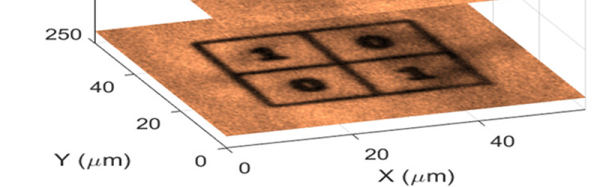
Most data storage devices we currently use are, at their core, two-dimensional. Sure, a hard drive might have multiple platters, but the data storage takes place on a flat surface. Even an optical drive is effectively a single surface that holds data. At the  City College of New York, they are experimenting with storing data in three dimensions using lab-grown diamonds and LASERs.

Usually, diamonds that have few flaws are more valuable. But in this application, the researchers exploit the flaws to store information. Optical memory that uses a volume instead of a surface isn’t exactly new. However, it is difficult to use these techniques in a way that is rewritable.

Diamonds are a crystalline structure of carbon atoms. Sometimes, though, a carbon atom is missing from the structure. That’s a vacancy. Another defect is when a nitrogen atom replaces a carbon atom. Sometimes a vacancy occurs next to a rogue nitrogen atom and that causes an NV (nitrogen vacancy) center.

Continue reading “Diamonds Are For Data Storage”

[Geohot]’s Self-Driving Car Cancelled

George [Geohot] Hotz has thrown in the towel on his “comma one” self-driving car project. According to [Geohot]’s Twitter stream, the reason is a letter from the US National Highway Traffic Safety Administration (NHTSA), which sent him what basically amounts to a warning to not release self-driving software that might endanger people’s lives.

This comes a week after a post on comma.ai’s blog changed focus from a “self-driving car” to an “advanced driver assistance system”, presumably to get around legal requirements. Apparently, that wasn’t good enough for the NHTSA.

When Robot Cars Kill, Who Gets Sued?
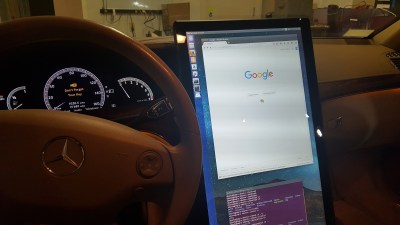
20160530_165433On one hand, we’re sorry to see the system go out like that. The idea of a quick-and-dirty, affordable, crowdsourced driving aid speaks to our hacker heart. But on the other, especially in light of the recent Tesla crash, we’re probably a little bit glad to not have these things on the road. They were not (yet) rigorously tested, and were originally oversold in their capabilities, as last week’s change of focus demonstrated.

Comma.ai’s downgrade to driver-assistance system really begs the Tesla question. Their autopilot is also just an “assistance” system, and the driver is supposed to retain full control of the car at all times. But we all know that it’s good enough that people, famously, let the car take over. And in one case, this has led to death.

Right now, Tesla is hiding behind the same fiction that the NHTSA didn’t buy with comma.ai: that an autopilot add-on won’t lull the driver into overconfidence. The deadly Tesla accident proved how that flimsy that fiction is. And so far, there’s only been one person injured by Tesla’s tech, and his family hasn’t sued. But we wouldn’t be willing to place bets against a jury concluding that Tesla’s marketing of the “autopilot” didn’t contribute to the accident. (We’re hackers, not lawyers.)

Should We Take a Step Back? Or a Leap Forward?

Stepping away from the law, is making people inattentive at the wheel, with a legal wink-and-a-nod that you’re not doing so, morally acceptable? When many states and countries will ban talking on a cell phone in the car, how is it legal to market a device that facilitates taking your hands off the steering wheel entirely? Or is this not all that much different from cruise control?

What Tesla is doing, and [Geohot] was proposing, puts a beta version of a driverless car on the road. On one hand, that’s absolutely what’s needed to push the technology forward. If you’re trying to train a neural network to drive, more data, under all sorts of conditions, is exactly what you need. Tesla uses this data to assess and improve its system all the time. Shutting them down would certainly set back the progress toward actually driverless cars. But is it fair to use the general public as opt-in Guinea pigs for their testing? And how fair is it for the NHTSA to discourage other companies from entering the field?

We’re at a very awkward adolescence of driverless car technology. And like our own adolescence, when we’re through it, it’s going to appear a miracle that we survived some of the stunts we pulled. But the metaphor breaks down with driverless cars — we can also simply wait until the systems are proven safe enough to take full control before we allow them on the streets. The current halfway state, where an autopilot system may lull the driver into a false sense of security, strikes me as particularly dangerous.

So how do we go forward? Do we let every small startup that wants to build a driverless car participate, in the hope that it gets us through the adolescent phase faster? Or do we clamp down on innovation, only letting the technology on the road once it’s proven to be safe? We’d love to hear your arguments in the comment section.

Qualcomm Buys NXP In Largest Ever Semiconductor Deal

Reuters has reported that Qualcomm will purchase NXP for $38 Billion in the largest semiconductor deal ever.

This deal was rumored last month in a deal worth about $30 Billion. Qualcomm’s name should be familiar to all Hackaday readers – they have an immense portfolio of mobile processors, automotive chips, and a ton of connectivity solutions for WiFi, Bluetooth, and every other bit of the EM spectrum. NXP should also be familiar for their hundreds of ARM devices, automotive devices, and Freescale’s entire portfolio.

The deal for $38 Billion is just a bit larger than the previous largest semiconductor deal, Avago’s purchase of Broadcom for $37 Billion.

This latest acquisition has followed acquisitions of ARM Holdings by Japan’s Softbank, On and Fairchild, Avago and Broadcom, NXP and Freescale, Microchip and Atmel, Intel and Altera, and a few dozen we’re forgetting right now. The good news is this immense industry consolidation won’t result in a single gigantic chip maker; there will probably be two or three gigantic chip companies in the future. If I may dredge up an observation from a Mergers and Acquisition post from this summer, this trend didn’t go well for Hughes, Fairchild, Convair, Douglas, McDonnell Douglas, North American, Grumman, Northrop, Northrop Grumman, Bell, Cessna, Schweizer or Sikorsky. It went very well for Lockheed, Boeing, and Textron.

Physics Or Phiction?

Do you remember Gilligan’s Island? For many people of a certain age, “The Professor” was our first impression of what a scientist was like. Even in those simpler times, though, you probably couldn’t find anyone like the professor; a jack of all trades, he sort of knew everything about everything (except, apparently, how to make a boat).

Real scientists tend to hyper-specialize. Getting grant money, publication pages, and just advancing the state of the art means that you get more and more focused on more obscure things. It is getting to the point that two scientists in the same field may not be able to really understand each other. You see the same thing in engineering to some degree. Not many digital designers can talk about the frequency dependence of Early effect in bipolar transistors, but not many device gurus can talk intelligently about reservation techniques for superscalar CPUs.

There’s now a website that lets you guess if a physics paper title is real or if it made up jibberish. The site, snarXiv, gets the real titles from arXiv, the site that contains many preprint papers. For example, we were asked to guess if “Brane Worlds with Bolts” was a real paper or if it was “Anthropic Approaches to the Flavor Problem.” (For the record, it was the one about branes.) Give it a whirl!

Botnet Recall Of Things

After a tough summer of botnet attacks by Internet-of-Things things came to a head last week and took down many popular websites for folks in the eastern US, more attention has finally been paid to what to do about this mess. We’ve wracked our brains, and the best we can come up with is that it’s the manufacturers’ responsibility to secure their devices.

Chinese DVR manufacturer Xiongmai, predictably, thinks that the end-user is to blame, but is also consenting to a recall of up to 300 million 4.3 million of their pre-2015 vintage cameras — the ones with hard-coded factory default passwords. (You can cut/paste the text into a translator and have a few laughs, or just take our word for it. The company’s name gets mis-translated frequently throughout as “male” or “masculine”, if that helps.)

Xiongmai’s claim is that their devices were never meant to be exposed to the real Internet, but rather were designed to be used exclusively behind firewalls. That’s apparently the reason for the firmware-coded administrator passwords. (Sigh!) Anyone actually making their Internet of Things thing reachable from the broader network is, according to Xiongmai, being irresponsible. They then go on to accuse a tech website of slander, and produce a friendly ruling from a local court supporting this claim.

Whatever. We understand that Xiongmai has to protect its business, and doesn’t want to admit liability. And in the end, they’re doing the right thing by recalling their devices with hard-coded passwords, so we’ll cut them some slack. Is the threat of massive economic damage from a recall of insecure hardware going to be the driver for manufacturers to be more security conscious? (We kinda hope so.)

Meanwhile, if you can’t get enough botnets, here is a trio of recent articles (one, two, and three) that are all relevant to this device recall.

Via threatpost.

Codebender Shuts Down

Codebender.cc was a cloud based IDE for Arduino development. It was made for hackers by a few fellows in Greece. Unfortunately, while they saw some serious success, they were never able to convert it all the way into a viable business.

By November 31st Codebender.cc will be completely shut down. They assure users that the site will be in read-only mode for as long as the end of the year, but longer if the traffic justifies it. Codebender made it all the way to 10,000 monthly active users, but hosting and administration overshadowed this success to the tune of 25,000 dollars a month. Not so much as far as businesses go, but without revenue it’s more than enough to shut down a site. Their business plan aimed to tailor their services for specific chip manufacturers and other companies but those deals never came together.

It’s a pity, we were excited to see if Codebender could continue to grow. They were certainly doing some really interesting stuff like remote code upload. As the comments on the site show, many users, especially educators and Chromebook users, loved Codebender — your code isn’t stuck on one computer and where there was a browser there was an IDE.

Two paid services will remain (starting at $10/month) at addresses with different TLDs. But the post does mention that the Codebender project started as Open Source. Their GitHub repo isn’t a clear path for rolling your own, but if you do manage to hack together a working Codebender implementation we’d love to hear about it.

Supercapacitor Uses No Carbon

Supercapacitors have found a myriad of uses due to their ability to rapidly charge and then deliver the power efficiently. Currently, production of supercapacitors requires materials made out of carbon which requires high temperatures and poses other manufacturing difficulties.

Researchers announced a new type of supercapacitor that uses no carbon and could have advantages over conventional technologies. The new research focuses on metal-organic frameworks, or MOFs. This material is extremely porous with a sponge-like structure. Since supercapacitors require large surface areas, that makes MOFs an interesting material for that application. However, MOFs are not very electrically conductive, which is a disadvantage.

Continue reading “Supercapacitor Uses No Carbon”