Puzzling Out An 80s Puzzle Toy

[Ido Gendel] looks back a time in the 80s when kids would learn by answering the questions to quizzes on their “TOMY Teacher,” or, “Sears Quiz-A-Tron”. There’s a bit of a conundrum with this toy. How did it know which answers were correct. Chip memory of any kind wasn’t the kind of thing you’d sweep into the dust bin if you had extras like it is now; it was expensive.

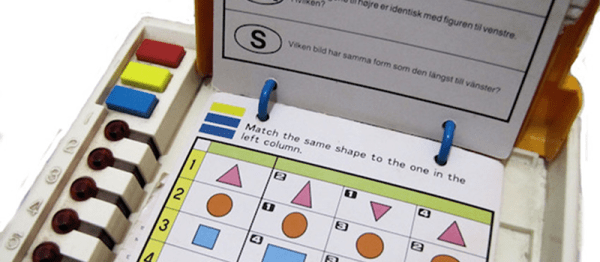
To use the toy, the child would place the notebook in the plastic frame on the device. They’d open the page with the quiz they would like to take. Printed in the upper left hand corner were three colored squares. There was a matching set of colored buttons on the device. They’d press the corresponding buttons in order from top to bottom and then the machine would magically know which answers on the quiz were correct.

[Ido] wondered how the machine handled this information. Was there an internal table for all 27 possible codes? Did it generate the answer table somehow? He sat down with a spreadsheet filled with the notebook code on the left and the corresponding correct answers on the right. Next he stared at the numbers.

He eventually determined that there was a pattern. The machine was using the colored squares as the input for a function that determined what the answers were. A table would have only taken up 68 bytes, but with one 80s chip on board, sounds to play, and lights to switch on and off, the machine needed all the free space it could get.

The EAGLE Has Landed: At Autodesk!

The selloffs continue at Farnell! We’d previously reported that the UK distributor of electronics parts was being sold to a Swiss distributor of electronics parts. Now it looks like they’re getting rid of some of their non-core businesses, and in this case that means CadSoft EAGLE, a popular free-for-limited-use PCB layout suite.

But that’s not the interesting part: they sold EAGLE to Autodesk!

Autodesk had a great portfolio of professional 3D-modeling tools, and has free versions of a good number of their products. (Free as in beer. You don’t get to see the code or change it.) By all accounts, the professional versions of their tools are very professional if you can afford them, and the trial versions are still useful. This makes EAGLE slot very nicely into their business model, filling a hole (PCB design) in their toolchain.

What does this mean for those of you out there still using EAGLE instead of open-source alternatives? (We haven’t used EAGLE since KiCAD got good a couple years back.) Beats us! Care to speculate wildly? That’s why we have a comments section. Go! In the mean time we hope to have more info for you directly from Autodesk soon so stay tuned to the front page.

The Politest Patent Discussion, OSHW V. Patents

We’ve covered [Vijay] refreshable braille display before. Reader, [zakqwy] pointed us to an interesting event that occured in the discussion of its Hackaday.io project page.

[Vijay] was inspired by the work of [Paul D’souza], who he met at Makerfaire Bangalore. [Paul] came up with a way to make a refreshable braille display using small pager motors. [Vijay] saw the light, and also felt that he could make the vibrating motor display in such a way that anyone could make it for themselves at a low cost.

Of course, [Paul], had patented his work, and in this case rightly so. As jaded as we have become with insane patent trolls, our expectation on receiving the tip was that [Paul] had sued [Vijay] out of house and home and kicked his dog while he was at it. A short google search shows that [Paul] is no patent troll, and is a leader in his field. He has done a lot to help the visually impaired with his research and inventions.

Instead we were greeted by a completely different conversation. [Paul] politely mentioned that his lawyer informed him that in order to protect his IP he needed to let [Vijay] know exactly how the information could be used. No cease and desist, in fact he encouraged [Vijay] to continue his open research as long as he made it clear that the methods described could not be used to make a marketable product without infringing on [Paul]’s patents. They’d need to get in touch with [Paul] and work something out before doing such.

[Vijay] responded very well to this information. His original goal was to produce a cheap braille display that could be made and sold by anyone. However, he did use [Paul]’s work as a basis for his variation. Since [Paul]’s commercial interests relied on his patent, there was a clear conflict, and it became obvious to [Vijay] that if he wanted to meet his goal he’d have to pick a new direction. So, he released his old designs as Creative Commons, since the CERN license he was using was invalidated by [Paul]’s patent. He made it very clear that anyone basing their work off those designs would have to get in touch with [Paul]. Undaunted by this, and still passionate about the project, [Vijay] has decided to start from scratch and see if he can invent an entirely new, unprotected mechanism.

Yes, the patent system is actually encouraging innovation by documenting prior work while protecting commercial and time investments of beneficial inventors. Well. That’s unexpected.

Kudos to [Paul] for encouraging the exploration of home hackers rather than playing the part of the evil patent owner we’ve all come to expect from these stories. Also [Vijay], for acting maturely to [Paul]’s polite request and not ceasing his work.

One lightbulb ON one OFF

Single Molecule Detects Light

Everything is getting smaller all the time. Computers used to take rooms, then desks, and now they fit in your pocket or on your wrist. Researchers that investigate light sensors have known that individual diarylethene molecules can exist in two states: one where it conducts electricity and one where it doesn’t. A visible photon causes the molecule to be electrically open and ultraviolet causes it to close. But there’s a problem.

light600Placing electrodes on the molecule interferes with the process. Depending on the kind of electrode, the switch will get stuck in the on or off position. Researchers at Peking University in Beijing determined that placing some buffering material between the molecule and the electrodes would reduce the interference enough to maintain correct operation. What’s more the switches remain operable for a year, which is unusually long for this kind of construct.

Using chemical vapor deposition and electron beam lithography, the team produced over 40 working single molecule switches. These devices could be useful in optical computing and other applications. Future work will include developing multilevel switches comprised of multiple molecules.

If you want something more macroscopic, you might try using an LED to sense light. A switch is fine, but sometimes you want to generate a signal.

150,000 Members Strong, Hackaday.io Flies Past Another Milestone

We’re growing so fast that soon your mom will be on Hackaday.io. That’s fine, everyone who loves hardware is welcome. 150,000 members have made Hackaday.io a home for their creativity — looking for inspiration in the work of others, sharing successes and temporary failures, and building their dream team to take on amazing new challenges. There is no place in the world that can come close to matching the Open Hardware ecosystem that is Hackaday.io.

What is in that one number, 150k? It is a monumental chunk of a much bigger picture: the thriving Hackaday ecosystem that spans from staking down your own workshop full of projects and skills, to following the editorial pulse of hardware used in new and creative ways. Looking over the last twelve months on all of the Hackaday sites we’ve seen about 18.5 Million visitors and registered nearly 85 Million views. Hackaday is not a passive community. We all have an insatiable hunger to delve into the next big trick, and to celebrate the accomplishments that made it happen.

Want to find a new and unique way to use the tech you find most interesting? Your leap forward needs input to pollinate the idea. Hackaday has a critical mass of hackers, designers, and engineers waiting with excitement to hear and help out in exploring and expanding the frontier. These interaction are what has packed Hackaday.io with interesting people. Most would say: I came for a specific hack or to see what a particular hacker was up to, but then I felt at home and decided to stick around and share what I’ve spent way to much time doing (but I wouldn’t have it any other way).

As we continue to knock down one membership milestone after another I want to thank you all for being involved, for valuing the free and open sharing of information and ideas, and for sharing your own time and talent. You are what moves this community of hardware hackers to dizzying heights of excellence and awesome.

This is all too good to be a secret. Talk to your hardware-loving friends, colleagues, family, and acquaintances and invite them to Hackaday.io if they’re not already with us.

FAA Finalizes Rules For Drones, UAS, And Model Aircraft

The FAA and DOT have finalized their rules for small Unmanned Aircraft Systems (UAS, or drones), and clarified rules for model aircraft. This is the end of a long process the FAA undertook last year that has included a registry system for model aircraft, and input from members of UAS and model aircraft industry including the Academy of Model Aeronautics and 3D Robotics.

Model Aircraft

Since the FAA began drafting the rules for unmanned aircraft systems, it has been necessary to point out the distinction between a UAS and a model aircraft. Thanks to the amazing advances in battery, brushless motor, and flight controller technology over the past decade, the line between a drone and a model aircraft has been fuzzed, and onboard video systems and FPV flying have only blurred the distinction.

The distinction between a UAS and model aircraft  is an important one. Thanks to the FAA Reauthorization Act of 2012, the FAA, “may not promulgate any rule or regulation regarding a model aircraft” under certain conditions. These conditions include aircraft flown strictly for hobby or recreational use, operated in accordance with a community-based set of safety guidelines (read: the safety guidelines set by the Academy of Model Aeronautics), weighs less than 55 pounds, gives way to manned aircraft, and notifies the operator of an airport when flown within five miles of a control tower.

Despite laws enacted by congress, the FAA saw it necessary to create rules and regulations for model aircraft weighing less than 55 pounds, and operated in accordance with a community-based set of safety guidelines. The FAA’s drone registration system doesn’t make sense, and there is at least one pending court case objecting to these rules.

The FAA’s final rules for UAS, drones, and model airplanes change nothing from the regulations made over the past year. If your drone weighs more than 250 grams, you must register it. For model aircraft, and unmanned aircraft systems conducting ‘hobbyist operations’, nothing has changed.

Unmanned Aerial Systems

The finalized rule introduced today concerns only unmanned aircraft systems weighing less than 55 pounds conducting non-hobbyist operations. The person flying the drone must be at least 16 years old and hold a remote pilot certificate with a small UAS rating. This remote pilot certificate may be obtained by passing an aeronautical knowledge test, or by holding a non-student Part 61 pilot certificate (the kind you would get if you’d like to fly a Cessna on the weekends)

What this means

Under the new regulations, nothing for model aircraft has changed. The guys flying foam board planes will still have to deal with a registration system of questionable legality.

For professional drone pilots – those taking aerial pictures, farmers, or pilots contracting their services out to real estate agents – the situation has vastly improved. A pilot’s license is no longer needed for these operations, and these aircraft may be operated in class G airspace without restriction. Drone use for commercial purposes is now possible without a pilot’s license. This is huge for many industries.

These rules do not cover autonomous flight. This is, by far, the greatest shortcoming of the new regulations. The most interesting applications of drones and unmanned aircraft is autonomous flight. With autonomous drones, farmers could monitor their fields. Amazon could deliver beer to your backyard. There are no regulations regarding autonomous flight from the FAA, and any business plans that hinge on pilot-less aircraft will be unrealized in the near term.

DJI Phantoms are now ‘drones’

This is a quick aside, but I must point out the FAA press release was written by someone with one of two possible attributes. Either the author of this press release paid zero attention to detail, or the FAA has a desire to call all unmanned aircraft systems ‘drones’.

The use of the word ‘drone’ in the model aircraft community has been contentious, with quadcopter enthusiasts making a plain distinction between a DJI Phantom and a Predator drone. Drones, some say, have the negative connotation of firing hellfire missiles into wedding parties and killing American citizens in foreign lands without due process, violating the 5th amendment. Others have classified ‘drones’ as having autonomous capability.

This linguistic puzzle has now been solved by the FAA. In several places in this press release, the FAA equates ‘unmanned aircraft systems’ with drones, and even invents the phrase, ‘unmanned aircraft drone’. Language is not defined by commenters on fringe tech blogs, it is defined by common parlance. Now the definition of ‘drone’ is settled: it is an unmanned, non-autonomous, remote-controlled flying machine not flown for hobby or recreational use.

Espressif Releases ESP8266-Killer!

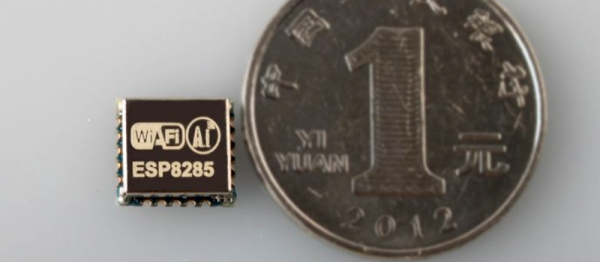
It’s no secret that we love the ESP8266 chip, and the community of hackers that have contributed to making it useful. We often joke about this or that new WiFi-enabler being an ESP8266 killer, but so far none have stepped up. Here we go again!

Espressif has released a chip that’s going to be an ESP8266 killer, and no, it’s not the ESP32. The ESP8285 went into mass production in March, and should start to appear in the usual outlets fairly soon.

What makes it an ESP8266 killer? It’s an ESP8266, but with the flash memory onboard. Nothing more, but also nothing less. What does this mean? Tiny, tiny designs are possible. And, if the street price ends up being right, there’s no reason you wouldn’t opt for built-in flash. (Unless you were planning on doing some ROM hacking.)

Continue reading “Espressif Releases ESP8266-Killer!”