“Makerspace” Trademark Application Rejected

The German Patent and Trademark Office has denied the application from UnterhehmerTUM for a trademark on the word “Makerspace”.  It wasn’t likely to be a threat to the community anyway, but now it’s entirely off the table. So Kwartzlab Makerspace, Houston Makerspace, Rochester Makerspace, Anchorage Makerspace, … you can all breathe easy!

To be fair, there was never any danger, just a misunderstanding.  We reported earlier on the trademark application and within a day or so got an official reply in the comments from Phil (“Mr. Mobile”) Handy that they weren’t looking to enforce anything, but were just essentially trying to make sure that nobody else could pull the rug out from under them.  (Thanks [Gentleman Nerd] for pushing them on this.)

The makerspace in question is an open-access offshoot of a business incubator that’s associated with Munich’s Technical University, and it looks like they pumped a couple million Euros into the deal, so there were doubtless layers of bureaucracy that wanted to make sure that their asses were legally covered.

Anyway, the Trademark Office did the right thing, denying the trademark because it wasn’t “unique”, and the makerspace looks awesome.  All’s well that ends well.
via [Make Magazine] (Germany)

Introducing The BeagleBone Blue

The BeagleBone is a board that doesn’t get a lot of attention in a world of $5 Raspberry Pis, $8 single board computers based on router chipsets, and a dizzying array of Kickstarter projects promising Android and Linux on tiny credit card-sized single board computers. That doesn’t mean the BeagleBone still isn’t evolving, as evidenced by the recent announcement of the BeagleBone Blue.

The BeagleBone Blue is the latest board in the BeagleBone family, introduced last week at CES. The Blue is the result of a collaboration between UCSD Engineering and TI, and with that comes a BeagleBone built for one specific purpose: robotics and autonomous vehicles. With a suite of sensors very useful for robotics and a supported software stack ideal for robots and drones, the BeagleBone Blue is the perfect board for all kinds of robots.

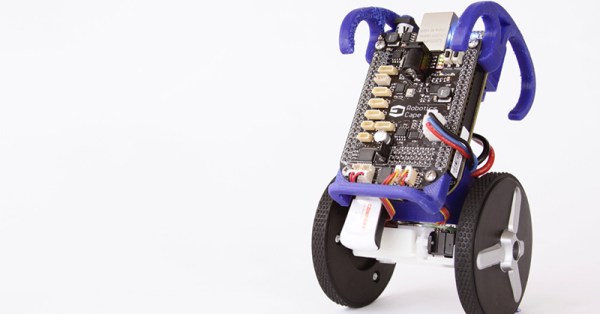
On board the BeagleBone Blue is a 2 cell LiPo charger with cell balancing and a 6-16 V charger input. The board also comes with eight 6V servo outputs, four DC motor outputs and inputs for four quadrature encoders. Sensors include a nine axis IMU and barometer. Unlike all previous BeagleBones, the BeagleBone Blue also comes with wireless networking: 802.11bgn, Bluetooth 4.0 and BLE. USB 2.0 client and host ports are also included.

Like all of the recent BeagleBoards, including the recently released BeagleBone Green, the Blue uses the same AM3358 1 GHz ARM Cortex 8 CPU, features 512 MB of DDR3 RAM, 4GB of on board Flash, and features the main selling point of the BeagleBoard, two 32-bit programmable real-time units (PRUs) running at 200 MHz. The PRUs are what give the BeagleBone the ability to blink pins and control peripherals faster than any other single board Linux computer, and are extremely useful in robotics, the Blue’s target use.

Right now, the BeagleBone Blue isn’t available, although we do know you’ll be able to buy one this summer. Information on pricing and availability – as well as a few demos – will come in February.

WingBoard: Wakeboarding Behind An Airplane

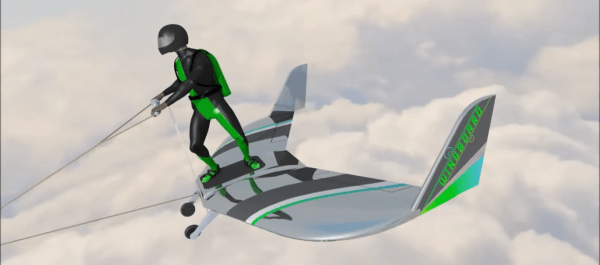
[Aaron Wypyszynski] or [Wyp] for short had a dream as a youngster about jumping out of a plane and “carving through the sky” (paraphrasing the video embedded after the break), so when he grew up [Wyp] went ahead and pursued that dream.

What that boyhood dream produced is [Wyp] offering to pull you through the sky on what looks like a proper model of a blunt nosed paper airplane glider. Seems to be a bit like wakeboarding for skydivers, cause that needed to be a thing.

Continue reading “WingBoard: Wakeboarding Behind An Airplane”

Baby Saved By Doctors Using Google Cardboard After 3D Printer Fails

It’s a parent’s worst nightmare. Doctors tell you that your baby is sick and there’s nothing they can do. Luckily though, a combination of hacks led to a happy ending for [Teegan Lexcen] and her family.

When [Cassidy and Chad Lexcen]’s twin daughters were born in August, smaller twin [Teegan] was clearly in trouble. Diagnostics at the Minnesota hospital confirmed that she had been born with only one lung and half a heart. [Teegan]’s parents went home and prepared for the inevitable, but after two months, she was still alive. [Cassidy and Chad] started looking for second opinions, and after a few false starts, [Teegan]’s scans ended up at Miami’s Nicklaus Children’s Hospital, where the cardiac team looked them over. They ordered a 3D print of the scans to help visualize possible surgical fixes, but the 3D printer broke.

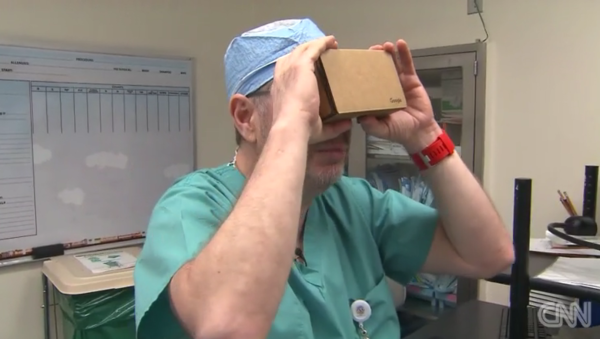
Not giving up, they threw [Teegan]’s scans into Sketchfab, slapped an iPhone into a Google Cardboard that one of the docs had been playing with in his office, and were able to see a surgical solution to [Teegan]’s problem. Not only was Cardboard able to make up for the wonky 3D printer, it was able to surpass it – the 3D print would only have been the of the heart, while the VR images showed the heart in the context of the rest of the thoracic cavity.[Dr. Redmond Burke] and his team were able to fix [Teegan]’s heart in early December, and she should be able to go home in a few weeks to join her sister [Riley] and make a complete recovery.

We love the effect that creative use of technology can have on our lives. We’ve already seen a husband using the same Sketchfab tool to find a neurologist that remove his wife’s brain tumor. Now this is a great example of doctors doing what it takes to better leverage the data at their disposal to make important decisions.

CES: Self-Flying Drone Cars

CES, the Consumer Electronics Show, is in full swing. Just for a second, let’s take a step back and assess the zeitgeist of the tech literati. Drones – or quadcopters, or UAVs, or UASes, whatever you call them – are huge. Self-driving cars are the next big thing. Flying cars have always been popular. On the technical side of things, batteries are getting really good, and China is slowly figuring out aerospace technologies. What could this possibly mean for CES? Self-flying drone cars.

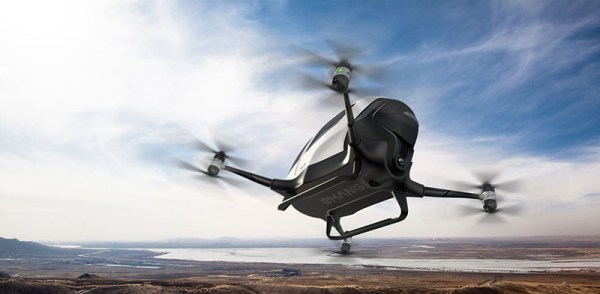
The Ehang 184 is billed as the first autonomous drone that can carry a human. The idea is a flying version of the self-driving cars that are just over the horizon: hop in a whirring deathtrap, set your destination, and soar through the air above the plebs that just aren’t as special as you.

While the Ehang 184 sounds like a horrendously ill-conceived Indiegogo campaign, the company has released some specs for their self-flying drone car. It’s an octocopter, powered by eight 106kW brushless motors. Flight time is about 23 minutes, with a range of about 10 miles. The empty weight of the aircraft is 200 kg (440 lbs), with a maximum payload of 100 kg (220 lbs). This puts the MTOW of the Ehang 184 at 660 lbs, far below the 1,320 lbs cutoff for light sport aircraft as defined by the FAA, but far more than the definition of an ultralight – 254 lbs empty weight.

In any event, it’s a purely academic matter to consider how such a vehicle would be licensed by the FAA or any other civil aviation administration. It’s already illegal to test in the US, authorities haven’t really caught up to the idea of fixed-wing aircraft powered by batteries, and the idea of a legal autonomous aircraft carrying a passenger is ludicrous.

Is the Ehang 184 a real product? There is no price, and no conceivable way any government would allow an autonomous aircraft fly with someone inside it. It is, however, a perfect embodiment of the insanity of CES.

The 3D Printers Of CES

CES, the Consumer Electronics Show, is in full swing. That means the Hackaday tip line is filled to the brim with uninteresting press releases, and notices that companies from the world over will be at CES.

3D printing has fallen off the radar of people who worship shiny new gadgets of late, and this is simply a function of 3D printing falling into the trough of disillusionment. The hype train of 3D printing is stuck on a siding, people are bored, but this is the time that will shape what 3D printing will become for the next ten years. What fascinating news from the 3D printing industry comes to us from CES?

Continue reading “The 3D Printers Of CES”

WiFi Alliance Introduces 802.11ah

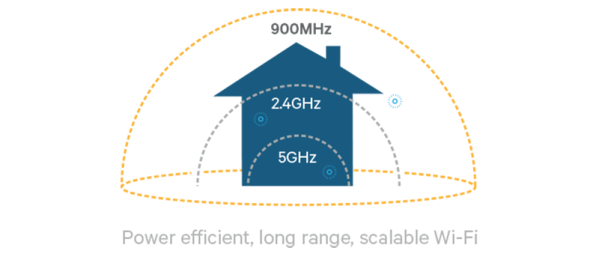
For the last decade or so, wireless networking has been entirely about short range, high speed communications. The type of networking needed by an Internet of things is fundamentally incompatible with WiFi, and the reason for this is due to the frequencies used by WiFi networking gear. 2.4 and 5 GHz are very fast, but cannot penetrate through walls as easily as lower frequencies.

This week the WiFi alliance introduced IEEE 802.11ah into the WiFi spec. It’s called WiFi HaLow (pronounced like angel’s headwear), and unlike other versions of 802.11, WiFi HaLow uses low frequencies for low bandwidth but a much larger range.

WiFi HaLow uses the 900 MHz ISM band to communicate, divided into 26 channels. The bandwidth is low – a mere 100 kbps, but the range is huge: one kilometer, or about four times the approximate range of 802.11n.

This is not the only WiFi spec aimed at the Internet of Things. In 2014, the WiFi alliance introduced 802.11af, a networking protocol operating in unused TV whitespace spectrum between 54 and 790 MHz. 802.11af has a similar range as 802.11ah – about one kilometer – but products and chips utilizing 802.11af have been rare and hard to find.