Harnessing The Electrical Power Of Clams

Yes, that is a clam. Yes researchers are using them as batteries. Yes, that quip about the matrix  and clam-Neo that is bubbling up into your temporal lobe is appropriate. While keeping a clam as “happy as a clam” might not necessitate a virtual world, they don’t really produce much electricity either. Researchers were able to siphon almost 29 millijoules over the course of an hour. This was enough to turn their electric motor one quarter of a turn.

Wether you find this kind of biological hacking ethical or not, you’ll probably agree that the following quote is, at least a tiny bit, creepy.

The researchers tried different ways to connect three clams at a time as a collective living battery. A serial circuit boosted the battery’s voltage (electric potential), whereas a parallel circuit increased the current (rate of charge flow) — but the overall electricity available often changed depending on each clam’s health.


2012 Robogames This Weekend In San Mateo California

As you may recall, many of us here at Hackaday are big fans of any activity involving robot competitions. One of the better known events that fits that description would be the Robogames, an international event where robots can compete in 50 different events. Granted, not all of them are as visually exciting as the ball of fire and twisted steel shown above, but they are interesting nonetheless. The event is happening this weekend, April 20th, in San Mateo California. Unfortunately, none of the Hackaday staff will be able to make it this year, but we’re really looking forward to seeing all the cool pictures that seem to flow out of the event.

If you happen to make it to the event, we’d love to see your pictures and videos.

Join us after the break for a short video that gives a taste of what the games are like.

Continue reading “2012 Robogames This Weekend In San Mateo California”

Preparing Sushi With The Help Of Lasers

It’s not too often that we cover food here on Hackaday, but when we saw how a laser cutter was being used to help enhance the look of sushi, we decided to share. Even if you don’t enjoy sushi, it’s hard not to argue that it can often be more like edible art than simply food. The preparation that goes into well-made sushi is extensive, and this laser cut maki certainly takes things up a notch.

In the wake of the 2011 tsunami many businesses were suffering, including Umino Seaweed whose primary product is nori – the ubiquitous green seaweed wrapper found in/on many sushi rolls. They were looking for something to attract attention to the brand, while remaining respectful to the centuries-old tradition of making sushi.

They sent their request to ad agency I&SBBDO who came up with the fancy looking nori you see above. Each sheet of seaweed is laser cut with traditional Japanese imagery, from the Sakura (cherry blossom) to the Kumikikkou (tortoise shell). We’re not sure if these sheets of nori are actually for sale or have just been put together for solely advertising, either way we think this is a novel and frivolous, but awesome use for a laser cutter. Also, we’re pretty hungry now – anyone up for grabbing some sushi?

[via Make]

A Locking Chest With A Musical Key

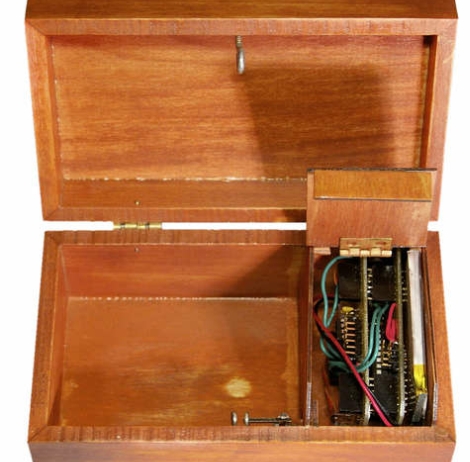
music-detecting-box

[Basil Shikin] was thinking about different types of locks, and was trying to come up with a locking solution that he had yet to see. It dawned on him that he had never come across a lock triggered by music, so he set off to construct one of his own.

He ordered a wooden chest online, then proceeded to piece together the electronics required for the locking mechanism as well as the music detecting logic. Using an Atmega328P paired with an electret mic, his system listens for a particular tune (the Prelude of Light from the Ocarina of Time) to be played , which triggers a tiny servo to undo the latch. To do this, he implemented a version of the Goertzel Algorithm on the Arduino, allowing him to accurately detect the magical tune by frequency, regardless of what instrument it is played on.

Be sure to check out the video below to see his musical lock in action.

Continue reading “A Locking Chest With A Musical Key”

Neosporin…the Retrobright For Bench Equipment?

polishing-knobs

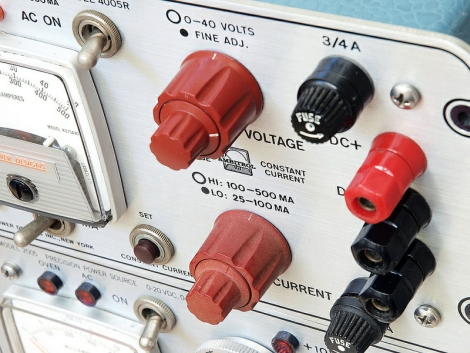
[linux-works] picked up an old power supply from eBay, and as it was built back in the 60’s or 70’s, it was in need of a little TLC. One thing that immediately caught his eye was the condition of the knobs, dials, and banana plug receptacles – they were dull and faded, showing off 40+ years of heavy usage.

He started off by simply removing the knobs from the power supply, giving them a thorough cleaning with soapy water before leaving them to air dry. They didn’t look any better afterward, so he decided to take a different approach and apply some triple antibiotic ointment to the knobs. As it turns out, letting the ointment sit for a few minutes then wiping the knobs with a soft cloth really made them shine, as you can see in the image above. [linux-works] attributes the effect to the white petrolatum base of the product rather than the antibiotics, likely making a wide array of products equally suitable for the job.

We know how well Retr0bright has worked for the vintage computer folks, so we’ll be interested to see how long the effects of the triple antibiotic treatment last. It certainly can’t hurt those readers who spend their time perusing flea markets in search of classic electronic equipment.

Motorcycle Lighting Upgrade Ensures Other Drivers Know You’re There

led-brake-lights

[Pete Mills] recently bought himself a motorcycle, and as people are known to do, they start trying to scare him with gruesome stories of cycling accidents once they hear about his purchase. While he tries to shrug them off as people simply not minding their own business, something must have resonated with him, because he started tinkering with the bike’s taillight in order to ensure he was always seen by other drivers.

He swapped out his motorcycle’s incandescent taillight for a smart LED-based lamp that he constructed using perfboard. Not only does his new brake light feature ultra bright LEDs, but the onboard ATtiny85 rapidly flashes the lights each time he hits the brakes, making his presence impossible to miss. Before everyone starts with the claims of, “Flashing red lights are illegal!”, let’s all take a deep breath and read on.

We’ve seen these sorts of lights on the back of motorcycles for years, though being a careful guy, [Pete] wrote to the state of Michigan in order to ensure that his modifications won’t get him pulled over. He has yet to hear back, but in the meantime, he merely needs to start the bike with the brakes applied to trigger the ATtiny85 to run the lights in “normal mode.”

Continue reading to see a short demo video of his brake light mod in action.

Continue reading “Motorcycle Lighting Upgrade Ensures Other Drivers Know You’re There”

Upgrading A Rockford Fosgate Punch 601s To An 801s With Just A Handful Of Parts

[Simon] had a Rockford Fosgate Punch 601s amplifier in his car, and while it was a great piece of equipment, he wanted a little more power behind his stereo system. It turns out that with just a handful of parts and a bit of soldering work, he was able to increase his amplifier’s output by 200 watts, putting it on par with a Punch 801s.

The main board in each amp is laid out identically, making the conversion a relatively easy process. A handful of MOSFETs need to be added, along with some resistors and capacitors. Most of the work can be done with a decent soldering iron, though you might want a hot air reflow station to handle the smaller resistors – it all depends on your skill set.

We’re really not sure how big the price difference is between the two amps, but we’re pretty certain that the conversion would be worth it. [Simon] sells conversion kits on his web site for under $60, but you may be able to find the parts for a bit less if you hunt around.