New JEDEC DDR5 Memory Specification: Up To 8800 MT/s, Anti-Rowhammer Features

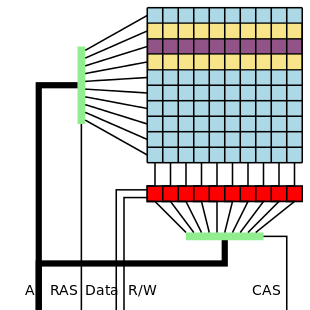
Rapid row activations (yellow rows) may change the values of bits stored in victim row (purple row).
Row hammer” by DsimicOwn work. Licensed under CC BY-SA 4.0 via Wikimedia Commons.

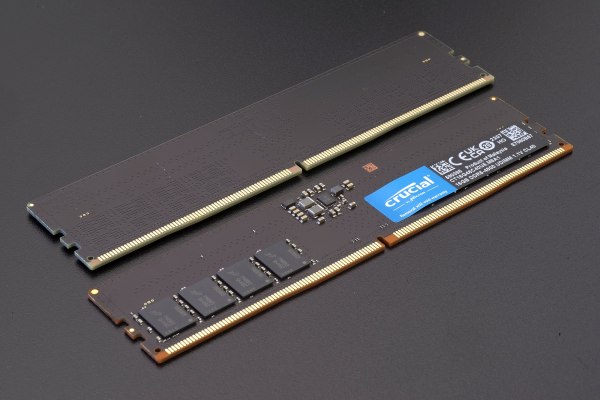
As DDR SDRAM increases in density and speed, so too do new challenges and opportunities appear. In the recent DDR5 update by JEDEC – as reported by Anandtech – we see not only a big speed increase from the previous maximum of 6800 Mbps to 8800 Mbps, but also the deprecation of Partial Array Self Refresh (PASR) due to security concerns, and the introduction of Per-Row Activation Counting (PRAC), which should help with row hammer-related (security) implications.

Increasing transfer speeds is primarily a matter of timings within the limits set by the overall design of DDR5, while the changes to features like PASR and PRAC are more fundamental. PASR is mostly a power-saving feature, but can apparently be abused for nefarious means, which is why it’s now gone. As for PRAC, this directly addresses the issue of row hammer attacks. Back in the 2014-era of DDR3, row hammer was mostly regarded as a way to corrupt data in RAM, but later it was found to be also a way to compromise security and effect exploits like privilege escalation.

The way PRAC seeks to prevent this is by keeping track of how often a row is being accessed, with a certain limit after which neighboring memory cells get a chance to recover from the bleed-over that is at the core of row hammer attacks. All of which means that theoretically new DDR5 RAM and memory controllers should be even faster and more secure, which is good news all around.

A pair of hands holds a digital camera. "NUCA" is written in the hood above the lens and a black grip is on the right hand side of the device (left side of image). The camera body is off-white 3D printed plastic. The background is a pastel yellow.

AI Camera Only Takes Nudes

One of the cringier aspects of AI as we know it today has been the proliferation of deepfake technology to make nude photos of anyone you want. What if you took away the abstraction and put the faker and subject in the same space? That’s the question the NUCA camera was designed to explore. [via 404 Media]

[Mathias Vef] and [Benedikt Groß] designed the NUCA camera “with the intention of critiquing the current trajectory of AI image generation.” The camera itself is a fairly unassuming device, a 3D-printed digital camera (19.5 × 6 × 1.5 cm) with a 37 mm lens. When the camera shutter button is pressed, a nude image is generated of the subject.

The final image is generated using a mixture of the picture taken of the subject, pose data, and facial landmarks. The photo is run through a classifier which identifies features such as age, gender, body type, etc. and then uses those to generate a text prompt for Stable Diffusion. The original face of the subject is then stitched onto the nude image and aligned with the estimated pose. Many of the sample images on the project’s website show the bias toward certain beauty ideals from AI datasets.

Looking for more ways to use AI with cameras? How about this one that uses GPS to imagine a scene instead. Prefer to keep AI out of your endeavors to invade personal space? How about building your own TSA body scanner?


End-Of-Life For Z80 CPU And Peripherals Announced

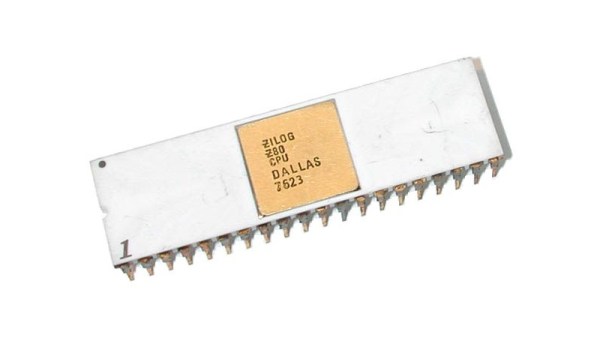
In a Product Change Notification (PCN) published on April 15, Zilog (now owned by Littelfuse) announced the End of Life for a range of Z80 products, specifically virtually all of the Z84C00 range. This also includes the peripherals, such as the Z84C10 range of MPUs. These are currently already marked as EoL on stores like Mouser, with Littelfuse noting that the last orders with them can be placed until June 14th of 2024. After that you’ll have to try your luck with shady EBay sellers and a lucky box of old-new-stock found in the back of a warehouse.

What this effectively means is that after just under 48 years since its launch in 1976, the Zilog Z80 will no longer be available for sale as discrete components, which is likely to primarily impact hobbyists and people who are trying to keep retro systems going. This does not mean that it’s the end of the road for Z80, however, as the eZ80 will be produced for the foreseeable future.

These new chips will of course not come in easy to drop in DIPs, making the challenge of breadboarding your own Z80-based microcomputer that much tougher. Yet one thing that definitely won’t happen is any of us witnessing the end of the era of the Z80, 6502 and 8051 architectures.

Thanks to [Techokami] for the tip.

This Week In Security: Putty Keys, Libarchive, And Palo Alto

It may be time to rotate some keys. The venerable PuTTY was updated to 0.81 this week, and the major fix was a change to how ecdsa-sha2-nistp521 signatures are generated. The problem was reported on the oss-security mailing list, and it’s quite serious, though thankfully with a somewhat narrow coverage.

The PuTTY page on the vulnerability has the full details. To understand what’s going on, we need to briefly cover ECDSA, nonces, and elliptic curve crypto. All cryptography depends on one-way functions. In the case of RSA, it’s multiplying large primes together. The multiplication is easy, but given just the final result, it’s extremely difficult to find the two factors. DSA uses a similar problem, the discrete logarithm problem: raising a number to a given exponent, then doing modulo division.

Yet another cryptography primitive is the elliptic curve, which uses point multiplication as the one-way function. I’ve described it as a mathematical pinball, bouncing around inside the curve. It’s reasonably easy to compute the final point, but essentially impossible to trace the path back to the origin. Formally this is the Elliptic Curve Discrete Logarithm Problem, and it’s not considered to be quantum-resistant, either.

One of the complete schemes is ECDSA, which combines the DSA scheme with Elliptic Curves. Part of this calculation uses a nonce, denoted “k”, a number that is only used once. In ECDSA, k must be kept secret, and any repetition of different messages with the same nonce can lead to rapid exposure of the secret key.

And now we get to PuTTY, which was written for Windows back before that OS had any good cryptographic randomness routines. As we’ve already mentioned, re-use of k, the nonce, is disastrous for DSA. So, PuTTY did something clever, and took the private key and the contents of the message to be signed, hashed those values together using SHA-512, then used modulo division to reduce the bit-length to what was needed for the given k value. The problem is the 521-bit ECDSA, which takes a 521-bit k. That’s even shorter than the output of a SHA-512, so the resulting k value always started with nine 0 bits. Continue reading “This Week In Security: Putty Keys, Libarchive, And Palo Alto”

Source Code To The 1999 FPS Game Descent 3 Released

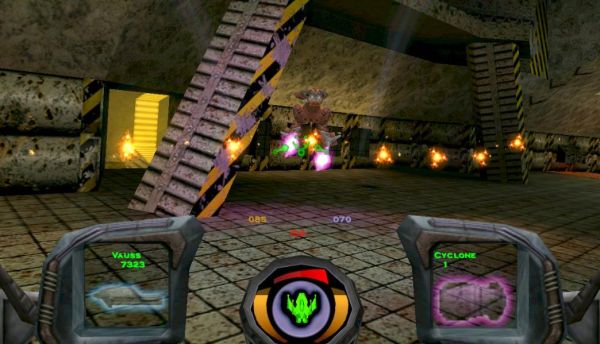
On April 16th of this year, [Kevin Bentley] released the source code to the Sci-Fi FPS game Descent 3. Originally released in 1999 for Windows, the game has you control a flying ship which you have to guide through both in- and outdoor environments, while shooting at robots that have been infected with an alien virus as you try to save the solar system. It was later also ported to Mac OS and Linux, but was considered a commercial flop due to low sales.

As one of the original developers, [Kevin] explains that one of the goals of this code release is to give the game a second life, by cleaning up the C++ code and using new APIs. Original proprietary audio and video libraries from Interplay were removed, which means that some work is required before one can build a fresh copy of the game from this code base. That said, the released code is the latest 1.5 patch level, with the Mac OS and Linux support. Even if the original Descent games weren’t your cup of tea, it’s still great to see games being preserved and updated like this.

Thanks to [Phil Ashby] for the tip.

This Go-Kart Rides On A Pallet

Many beginner woodworkers, looking to offset the introductory costs of starting a hobby, will source their wood from pallets. Generally they’re easily found and can be low or no cost, but typically require a bit of work before they’re usable in a project. [Garage Avenger] is looking to do something a little outside of the box with his pallet project, though. He’s using raw pallets as a chassis for a four-speed go-kart, partially for the challenge and excitement and also to one-up a Pinterest post.

Almost immediately, though, the other major downside of working with pallets arose which is that they’re generally built out of low-grade pine which is soft and flexible. Flexibility is generally not a good thing to have in a vehicle frame so plenty of the important parts of this build were strengthened with steel tubing including the rear axle, steering mounts, and a few longitudinal supports to strengthen the overall frame. After working out some kinks with ordering a few of the wrong parts, and mounting the steering box backwards, it was time to test out the four-speed engine (and brakes) on the the go-kart, making it nearly ready for the road.

To complete the build, some tidying of wiring and fuel lines was done, along with improving some of the non-critical parts of the build like the bucket seat. Of course, adding pallet spoilers and body kit puts the finishing touches on the build and the go-kart is finally ready to tear up the local go-kart track and the less-inspiring Pinterest projects. [Garage Avenger] is no stranger to strange vehicle builds, either. Although it’s a bit out of season for most of our northern hemisphere readers now, his jet-powered street sled is still worth a view.

Continue reading “This Go-Kart Rides On A Pallet”