Time Frog Color Is A Game Boy Color On Your Wrist

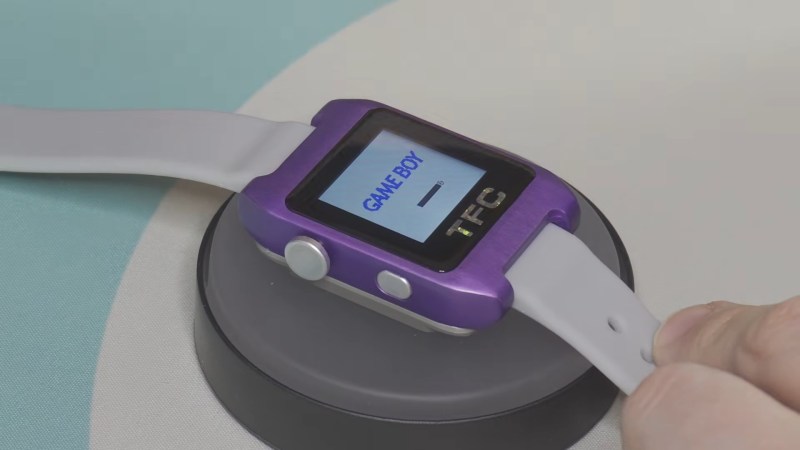
Handheld consoles are great for gaming on the go, but who wants to hold onto things all the time? Would it not be easier to strap the game to your wrist? Well, not in its current form factor, but [LeggoMyFroggo], aka [
Chris Hackmann] has you covered, because he turned the Gameboy Color into a (relatively smart) watch.

Why “relatively” smart? Well, we say that because he’s using the original Game Boy Color CPU, a Sharp SOC based on the Z80 that is far less powerful than modern smartwatch platforms. That SOC is helped out by an RP2040 that translates the chip’s parallel RGB output into something a modern watch-sized display can comprehend via its PIOs. [Chris] refers to it as a “poor man’s FPGA” which isn’t a bad way of thinking about it in this context. Yes, he could have just stuck an emulator on that chip, but what’s the fun in that?

The controls are squeezed into the sides of the watch — the four face buttons on one side, and a tiny D-pad on the other — but that’s easy enough because this thing is 15 mm thick. Since [LeggoMyFroggo] is a purist, he insists on loading the games via cartridge, which does not help thin it out. Game Boy carts are not not watch-friendly, so the cartridges are custom PCBs that plug into an M.2 slot, but with the original (or at least compatible) ROM.

If it wasn’t for the cartridge slot, maybe a battery would have fit. But it doesn’t, which leads to our favorite part of the hack: the battery is in the watch strap. This is both kind of crazy, but also brilliant. The band is cast in silicone, so he’s able to embed a flexi-PCB inside. As for the watch body, that’s CNC’d out of 6061 aluminum before being anodized to a very Nintendo-esque purple.

[Chris] evidently has a soft spot for the Game Boy Color — we featured his FrogBoy re-imagining of the handheld a few years back. The project is just up on YouTube as of this writing, but the watch will join the FrogBoy on [Chris]’s GitHub so we can all get in on the fun once he’s finished the documentation.

Continue reading “Time Frog Color Is A Game Boy Color On Your Wrist”
Real-time Shader, Running On A Game Boy Color

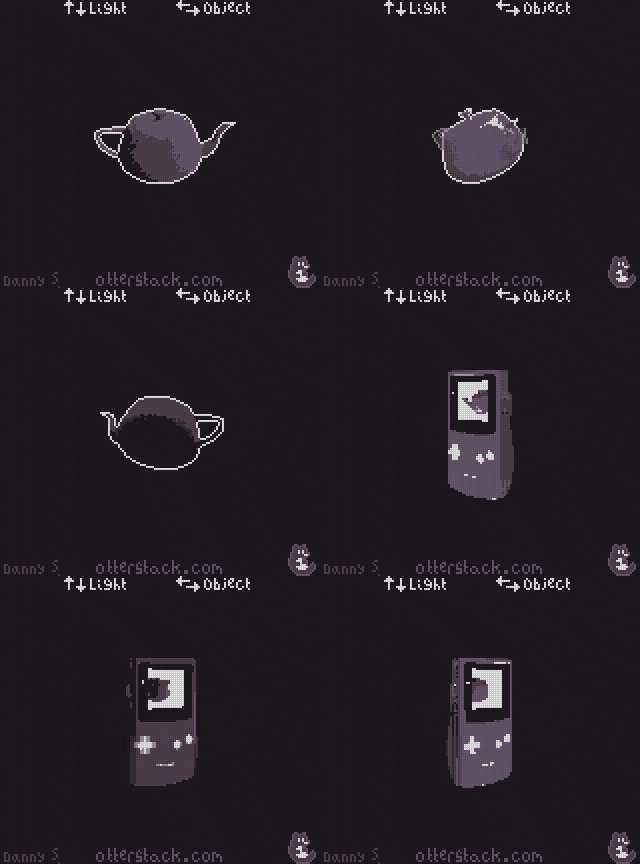
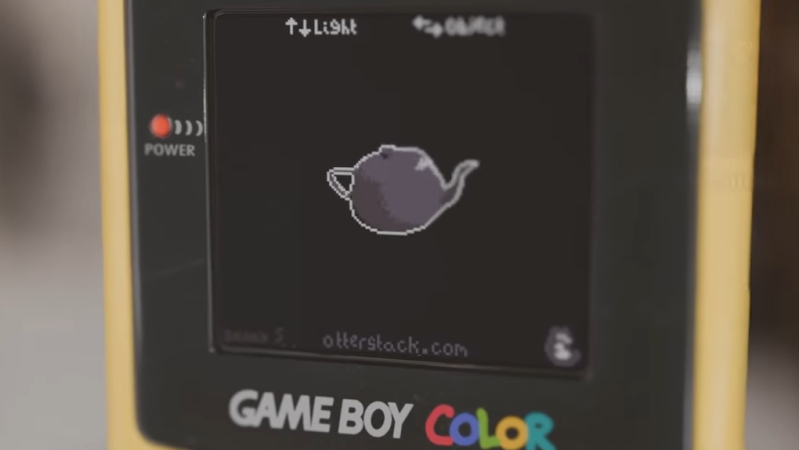
[Danny Spencer] has a brilliant graphical demo that, like all great demos, flexes a deep understanding of the underlying system: a real-time 3D shader on the Game Boy Color.

If you’re not familiar with shaders, they were originally mathematical lighting models (hence the name) and are an integral part of the modern 3D graphics pipeline. One no longer draws pixels directly to a screen to represent objects. Instead, 3D object data is sent to the Graphics Processing Unit (GPU) which handles the drawing. Shaders are what control things like an object’s lighting, textures, and more.

Implementing even a basic real-time shader in software on a Game Boy Color is pretty wild. Not only is it a pixels-and-sprites (and not 3D graphics) kind of system, but the Game Boy’s SM83 CPU doesn’t even have a multiply instruction, nor does it support floats. As [Danny] puts it: given that the entire mathematical foundation of his shader rests on multiplying non-integer numbers, he had to get creative. That makes his demo a very round peg in an extremely square hole.

In the case of [Danny]’s demo, the user can manipulate the position of, and lighting around, a classic Utah teapot in real time. He explains the workflow and shows how the process can be applied to other objects. The ROM is available on GitHub and there’s a video, embedded below.

[Danny] is no stranger to performing feats of technical prowess that are as creative as they are playful, like implementing a working adding machine in a DOOM level.

Continue reading “Real-time Shader, Running On A Game Boy Color”

A New Screen Upgrade For The GBA

The Game Boy Advance (GBA) was released in 2001 to breathe some new life into the handheld market, and it did it with remarkable success. Unfortunately, the original models had a glaring problem: their unlit LCD screens could be very difficult to see. For that reason, console modders who work on these systems tend to improve the screen first like this project which brings a few other upgrades as well.

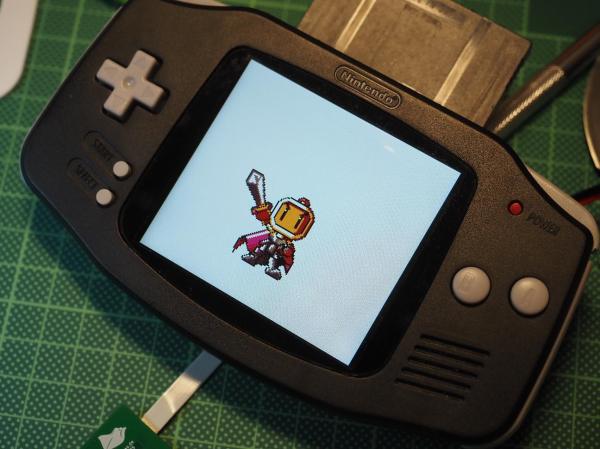
The fully open-source modification is called the Open AGB Display and brings an IPS display to the classic console. The new screen has 480×480 resolution which is slightly larger than the original resolution but handles upscaling with no noticeable artifacts and even supports adding some back in like scanlines and pixelation to keep the early 00s aesthetic. The build does require permanently modifying the case though, but for the original GBA we don’t see much downside. [Tobi] also goes through a ton of detail on how the mod works as well, for those who want to take a deep dive into the background theory.

There has been a lot of activity in the Game Boy Advance communities lately though as the hardware and software become more understood. If you don’t want to modify original hardware, want an upgraded experience, but still want to use the original game cartridges we might recommend something like the Game Bub instead.

Carry Your Grayscale Memories With This Tiny Game Boy Photo Frame

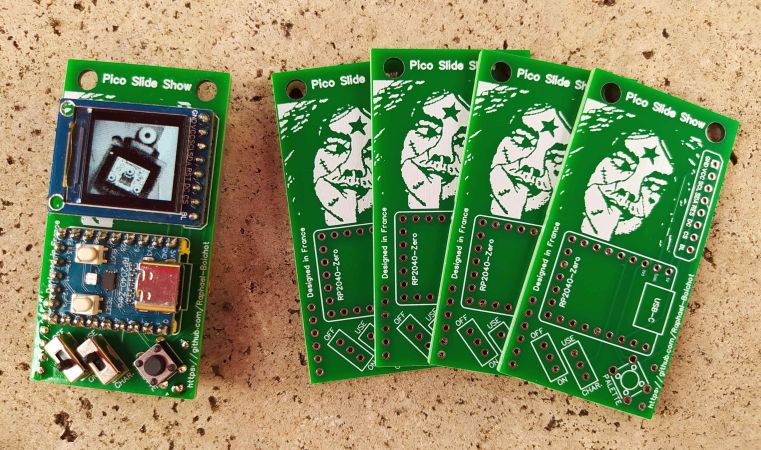
While we cannot be certain this is the world’s smallest digital photo frame, [Raphaël Boichot]’s Pico Slide Show is probably in the running. Since the 0.85″ TFT display would be wasted on multi-megapixel images, [Raphael] has dedicated this project to images from the Game Boy Camera.

It’s a good fit: the tiny square display has a resolution of 128 pixels per side, while the Game Boy Camera produces files measuring 128 x 112. That allows for pixel-perfect rendering of the grainy images from everyone’s favorite early digicam with just a little letter boxing.

While perfect for all your on-the-go Game Boy slideshow needs, an enclosure might be a good idea for hauling around that battery.

The brains of the operation are an RP2040, provided via the RP2040-zero breakout from Waveshare. Since everything is through-hole or on breakouts, this wouldn’t be a bad project for a beginner solderer.

Since it would make no sense not to have this tiny unit to be portable, power is provided with a 503035 LiPo pouch on the back. It’s only 500 mAh, but this device isn’t going to be chugging power, so we’d expect a reasonable runtime.

Alas, no link cable functionality is currently included, and files must be transferred via PC. Images are saved to the Pico’s flash memory, and [Raphaël] says any format from any Game Boy Printer emulator will work, provided it has a four-color palette. The flash memory on the chip has room for 540 images, which seems like more than enough. Regardless of the novelty of the tiny screen and retro format, nobody wants to see that many holiday snaps in one go.

The Game Boy Camera has been popular with hackers literally for decades now, and we’ve seen it everywhere from wedding photo booths to the heart of a custom DSLR, and even on Zoom calls.

The GBA Console You Never Knew You Wanted

Do you like Nintendo games? How about handhelds? Do you prefer the now-venerable Game Boy Advance (GBA) to more modern platforms, but wish your aging eyes could enjoy its content on a large CRT instead of a dinky LCD? If you answered yes to all those questions, you are exactly the type of person [GouldFish on Games] made this custom console for, and you should probably be friends.

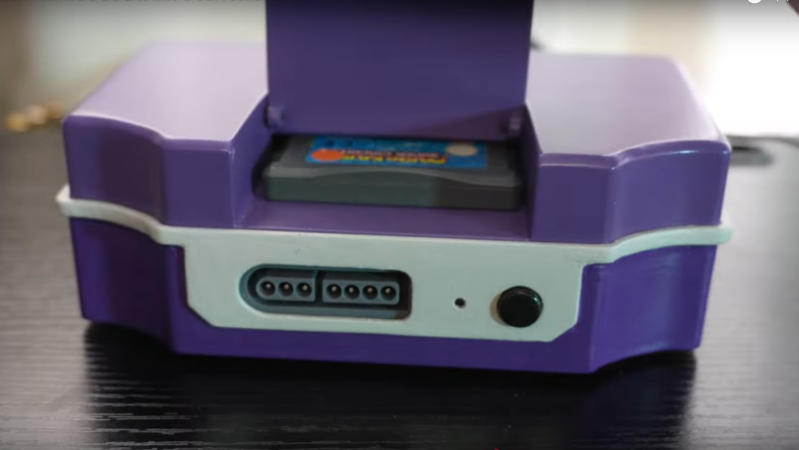
The external appearance of this hack is slick: a 3D printed console with the contours of the GBA in that iconic purple, but with a cartridge bay door like an NES and a SNES controller port. It’s the GBA console Nintendo never made, sitting next to a period-appropriate CRT. Playing GBA game on a CRT with an SNES controller is already hacky; what makes it really hacky is the guts are yet another Nintendo system — the DS Lite.

Why a DS Lite? Two reasons: one, it is cheaper to get a busted DS Lite than an old GBA mainboard. Two, as we covered before, the DS Lite can do composite-out with a relatively cheap add-on board. [GouldFish] really is hacking on the shoulders of giants, and they acknowledge it in the video. Aside from the composite-out board, he also makes use of community knowledge on how to make the DS Lite boot without screens or batteries.

Should you be interested in putting your own version of this console together, [GouldFish] was kind enough to share the STLs for the 3D printed enclosure, as well as the Gerber files for the custom PCB that interfaces with the SNES controller port.

We featured a CRT mod for an original Game Boy before, but this seems a lot more practical, if a lot less portable. [GouldFish] has no shortage of old titles and newer homebrew to chose from for this console, but they could always use more. We once featured a primer on how to get into the GBA homebrew scene, if you want to make a game.

Continue reading “The GBA Console You Never Knew You Wanted”

Running FreeDOS And 8086tiny On The Game Boy Advance Because You Can

How many people haven’t looked at their Game Boy Advance (GBA) handheld gaming device and wondered how much better it might be if it could run FreeDOS. Inside an 8086 emulator. If you’re like [ZZAZZ] and similarly suffer intrusive project-related thoughts, then this might be a moment of clear recognition, somewhat like sharing one’s story at a Programmers Anonymous meeting, but we digress.

In the video, the basic premise of making even the 8086tiny emulator work on the GBA seemed improbable on the outset – courtesy of the rather limited memory environment provided by the GBA – before even daring to look at things like disk access.

However, letting silly things like segmented memory and mismatched memory addresses deter us from pleasing said intrusive thoughts would be beyond the pale. Ergo we get a shining example of how days of rewriting code, stripping code, debugging code, fixing alignment issues in code and writing work-arounds for newly discovered issues in code can ultimately lead to the proud moment where FreeDOS boots on the GBA.

Granted it takes over an hour to do so, and has to be started from a butchered Pokémon Emerald save file, courtesy of a well-known exploit in that game, thankfully preserved in counterfeit cartridges.

Admittedly we’re not sure what practical applications there are for FreeDOS on the GBA, but that’s never stopped hackers from taking on impossible projects before, so there’s no sense letting it get in the way now.

Continue reading “Running FreeDOS And 8086tiny On The Game Boy Advance Because You Can”

An Instant Gratification Game Boy Printer

When the Game Boy Printer was released back in 1998, being able to produce a hard-copy of your Pokémon diploma or your latest Game Boy Camera snapshot at the touch of a button was was pretty slick indeed. But in our modern paperless society, the GB Printer somehow sticks out as even more archaic than the other add-on’s for Nintendo’s iconic handheld. Even among the folks who are still proudly playing the games that support the Printer, nobody actually wants to print anything out — although that doesn’t mean they don’t want to see the images.

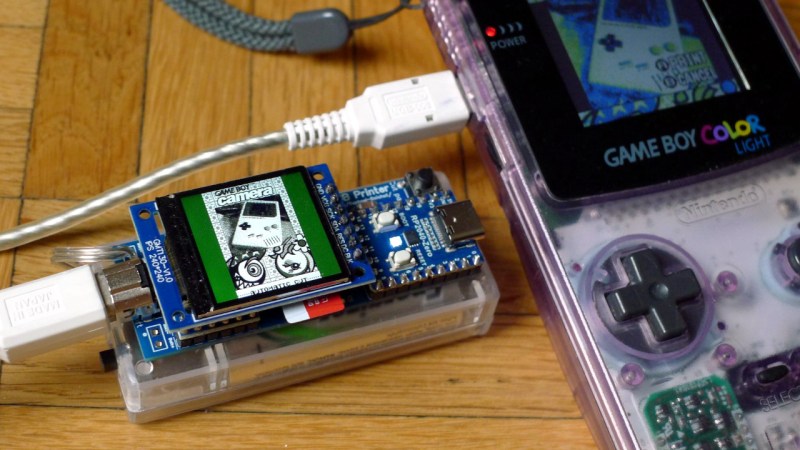
The TinyGB Printer, developed by [Raphaël BOICHOT] and [Brian KHUU], could be considered something of a Game Boy Non-Printer. Powered by the RP2040 Zero development board, this open source hardware device plugs into your Game Boy and is picked up by all the games as a legitimate Printer. But instead of cranking out a little slip of thermal paper once you hit the button, the image is displayed in all its 240×240 glory on a 1.3 inch TFT display mounted to the top of the board.

Continue reading “An Instant Gratification Game Boy Printer”