Those twisty knobs connected to potentiometers aren’t necessarily a strict linear progression from one resistance to another. Potentiometers have a taper. Yes, sometimes it’s a linear taper that’s a straight line from one resistance to another, but you can find log (audio) taper pots, and anti-log taper pots. It’s been this way for a hundred years, and now we have a pot with a digitally controllable taper thanks to a guitar pedal that fits in your shoe.
For the last few years, [John] has been hard at work creating the SoulPedal, a shoe insert that’s the wireless, wearable alternative to expression pedals, wah pedals, and every other guitar effects pedal that uses an ankle. [John] got the idea by replacing the light-sensitive resistor in a wah pedal with a force sensitive resistor in his shoe. It worked, but there were wires. Now the SoulPedal is based on a TI SoC +Radio with all the niceties you would expect.
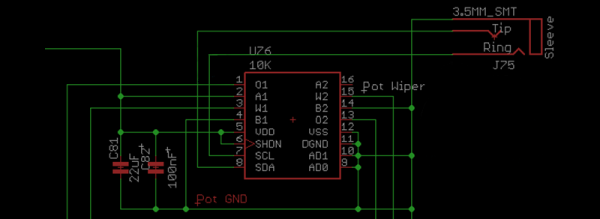
When designing the ‘base station pedal’, [John] realized he had a digital pot with two channels, and the entire device only uses one of these channels. Instead of letting that little bit of silicon go to waste, [John] wired these two digital pots in parallel, allowing the user to customize the taper of a digital pot. If you’re asking yourself, ‘why’, the answer is, ‘because he could.’
It’s an interesting application for sure, and while this digitally controllable pot can replicate the linear, log, and anti-log tapers, the really interesting thing will be to see what non-standard tapers sound and feel like.
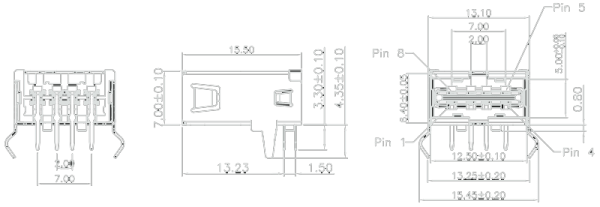
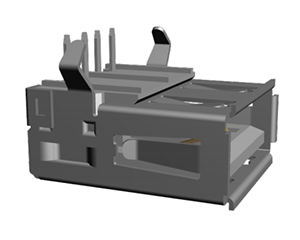 The connector isn’t the brand new USB 3.1 Type C connector that will eventually find its way into phones, laptops, wearables of all types. This is your standard Type A USB plug you’ve known and loved for the past eighteen years. The difference here is that the chunky block of plastic that has made the common USB cable non-reversible for so many years is gone. In its place is a tiny strip of plastic that has contacts on both sides. Yes, it took nearly two decades for someone to figure out this would be a marketable idea.

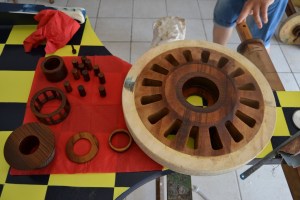 The course also includes full-width obstacles like hay bales. Teams are divided by community or “contrada”, and it was [Alessio]’s team captain who came to him with the special request of roller bearings. Unable to find evidence of other wooden bearings, [Alessio] knew he would have to invent them himself – so he did.