Software-Defined Radio Remotely Using A Linux Wall wart

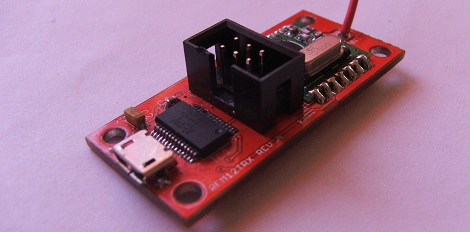
Here’s a interesting idea; if the hardware seen above is dropped at a location, you can monitor radio signals remotely via the Internet. [MS3FGX] has been toying with the idea for a little while now. He wanted to use a DVB dongle with a portable Linux solution to offer Software-Defined Radio (SDR) capability without the need to actually be there.

The white box is a PWN Plug, a branded version of the SheevaPlug. The black dongle that plugs into it is a DVB tuner dongle. It’s meant to receive television signals over the radio, but recently the hardware has been used as a simple way to implement SDR. Combine the two (along with the antenna), stir in a network connection, and you’ve got a remote listening post. What can you listen to? Just about anything that’s within the dongle’s bandwidth range. [MS3FGX] mentions walkie-talkie traffic and pager signals, to name just two.

He even wrote an installation script that gets you up and running in no time.

Adding More Frequencies To Your Software Defined Radio

[regveg] was looking for a way to receive signals outside the normal 64-1700MHz range his TV tuner software defined radio dongle can get. After finding a few $100+ upconverters on the Internet, he stumbled across a DIY project that greatly expands the frequencies his RTLSDR can receive.

[George]’s upconverter uses heterodyning to increase the frequencies received by a SDR dongle. The basic idea is mixing a signal from an antenna with a 100MHz frequency oscillator. The resulting output will be λ + 100MHz and λ – 100MHz, allowing for a wider range of frequencies that can be received by the SDR TV tuner dongle.

Now [regveg] has a board and schematic that makes it possible to receive just about anything with his TV tuner dongle. Interestingly, this upconverter contains less than $10 in parts and is easily etched at home thanks to a single-sided construction and through-hole parts.

As a small aside, [Andrew] sent in a tip a few days ago telling us his RTL dongle didn’t have any ESD protection. This is a very bad thing, but the good news is the fix is very cheap: just solder in a 10 cent diode and you’re good to go.

Resurrecting A Hi-Fi Cabinet

[VintagePC] pulled this old stereo out of a barn. It was in pretty shabby shape, but he managed get it running again and make it look great as well.

While it had been protected from the elements, it had not been protected from the rodents. Mice had chewed their way through the fiberboard backing and made a nice home inside. He mentions that they chewed the string which operates the tuning dial, and we’re sure they were the cause of other problems as well. He gives the wise advice of not powering on an old set like this until you have a chance to assess the situation.

The insides of the amplifier were about as disorderly as the last radio repair we looked at. But after carefully working his way through the circuits, replacing capacitors and resistors as needed, he started to make some progress. The receiver coil needed to be rewound and he used wire from an old CRT monitor for this purpose. The loop antenna was remounted and the record player arm was given a new cartridge and balanced using a clever LEGO apparatus. Some veneer work and wood finishing brought the case itself back to its original beauty. We’d say the hard work was well worth it. He’s got a big piece of furniture he can always be proud of!

Ancient Radio Repair

They sure don’t build them like that anymore. [J.W. Koebel] managed to take this 1934 Simplex Model P radio and bring it back to life.

So where do you start with a repair job like this one? Being a ham radio guy he has a good idea of what he’s doing, and started by replacing the AC capacitor with one which will provide quality noise filtering. He tried to make fixes throughout that would improve functionality and declutter the wire mess. This led him to find a snapped solder connection on the volume knob. Next he tested out the speaker and found that the primary transformer needed replacing. After as replacing the A67 converter (we’ve got no idea what that is) he swapped out the rest of the original capacitors, most of the resistors, and fixed the mechanical problems with the tuning dial. The result is a working radio that looks fantastic!

[via Reddit]

Adding A Bomb Bay To A Quadcopter

The Fourth of July is fast approaching, and what better way to celebrate the independence of your country than by blowing up a small piece of it? [Anzel360] decided to take that line of thought to a whole new level by adding a bomb bay to his quadrocopter.

[Anzel360] recently upgraded his transmitter to a Spektrum DX8, giving him two extra channels on his four-channel quadrotor. After adding a small servo to the quad, it was a simple matter of taping a box to the undercarriage and filling it full of fireworks.

The ammo [Anzel] is using is just a handful of Snappin’ Pops – otherwise known as the lamest firework ever created. We won’t hold that against him, though; a remote ignition system for a few Black Cats mounted on a fancy quadrocopter is just asking for trouble. We do recall a throwable cap gun bomb from our youth, though, that would allow for year-round ammo replenishment…

Getting Started With Software Defined Radio

In the last few months, software defined radio has seen an explosion in popularity thanks to a small USB TV tuner dongle able to receive anything broadcast between 64 and 1700 MHz. It’s a very neat project that opens the door to a whole bunch of radio experimentations, but getting started in the SDR world can be a bit daunting. To help everyone out, [MS3FGX] is writing a getting started guide so everyone can get into the world of software defined radio.

After getting one of the TV tuners supported by the RTL-SDR project (by far the most commonly used is this one from Dealextreme), the next thing you’ll need is a decent antenna. [MS3FGX] has had some success with this Radio Shack antenna, but it’s very easy to make your own.

The most popular software package to use with the RTL TV dongle is GNU Radio, and [MS3FGX] goes over the ins and outs of setting this up along with a brief aside for the Gqrx receiver.

After your hardware and software is set up, the only thing left to do is tuning into a few of your favorite stations. The range of frequencies the RTL covers includes AM and FM radio, along with GSM and GPS signals. Of course there’s a whole lot more you can do with this project like listening in on your car’s keyless entry fob, pagers, and wireless weather stations.

Amateur Radio Field Day Is Upon Us

Looking for something to do this fine Saturday morning? For the US and Canadian readers out there, the fourth weekend in June is amateur radio field day, a day when all the amateur radio and ham geeks get together, string up a few antennas, and do their yearly community outreach/contact as many other radio heads as possible.

This weekend, there are more than 1600 field day events taking place all across the US and Canada. Odds are, you’re not more than a half hour drive from a field day event; you can find the closest one with the AARL’s handy Google Map of field day locations.

Since last year, we’ve seen a whole host of cool stuff to do with radio including a $20 software defined radio. If getting your license is too big of a step for you right now, you could at least plug a USB TV tuner dongle into your computer and see what is possible with radio. As a neat little bonus, you don’t even need a license for SDR. You might need a better antenna, and the ham guys at field day will be more than happy to point you into the right direction.