Raspberry Pi Bitcoin Miner

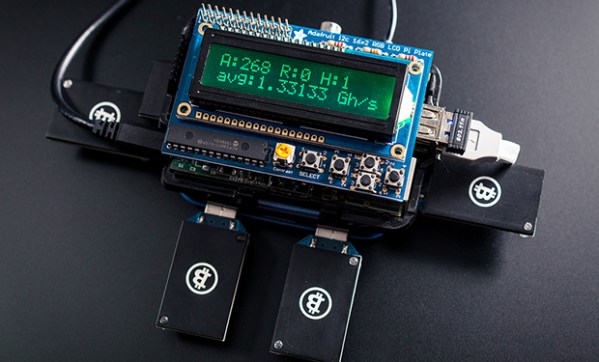
Mining bitcoins is becoming a fool’s errand, but there’s always some new piece of hardware coming out that allows those hard-core miners to keep ahead of the curve. One such piece of hardware are new custom ASIC devices that are just as fast as an FPGA while being much less expensive. A lot of these ASIC devices come in interesting packages that look just like a large USB thumb drive. Of course this is the perfect opportunity to show off what the Raspberry Pi can do by mining Bitcoins at rates comparable to the best graphics used in mining today.

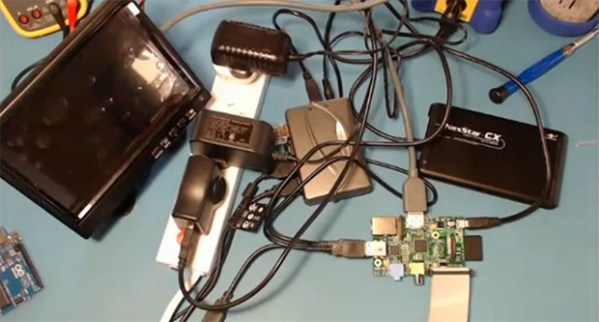
The Raspberry Pi simply doesn’t have enough horsepower to mine bitcoins at any worthwhile rate. There are, however, USB ASIC devices that will mine for you at about the same speed as a high-end graphics card. Since multiple ASIC devices can be controlled through a USB hub, it’s simply a matter of plugging a USB hub into a Raspberry Pi, loading up CGminer, and letting your new PiMiner loose on a mining pool.

The Adafruit Pi Miner uses one of their really cool LCD character displays and keypad to display the current mining rate, accepted shares, and enough information for you to calculate how long it will take to break even with your Pi powered mining rig. How long that will be for this four device rig we’ll leave to the comments section.

Pager Message Sniffing With RPi And SDR

rpi-pager-message-sniffing

The 1990’s called, they want you to use modern technology to listen in on your friends’ pager messages. Seriously, how many people are still using pagers these days? We guess you can find out by building your own Software-Define Radio pager message decoder.

[Sonny_Jim] bought an RTL2832 based USB dongle to listen in on ADS-B airplane communications only to find out the hardware wasn’t capable of communicating in that bandwidth range. So he set out to find a project the hardware was suited for and ended up exploring the POCSAG protocol used by paging devices. It turns out it’s not just used for person-to-person communications. There are still many automated systems that use the technology.

Setting things up is not all that hard. Reading the comments on the project log show some folks are having dependency issues, but these sound rather banal and will be a good chance for you to brush up on your Linux-fu. Once all the packages are installed you’re simply working with text which can be displayed in a myriad of ways. [Sonny] set up a text files on the Pi’s webserver so that he can check out the latest captures from a smartphone.

[Image Source]

Raspberry Pi Replaces A Volvo Nav System

rpi-replaces-volvo-nav

[Reinis] has a Volvo S80. One of the dashboard features it includes is a 6.5″ LCD screen which periscopes up to use as a navigation system. The problem is that Volvo stopped making maps for it around five years ago and there are no maps at all for Latvia where he lives. So it’s worthless… to you’re average driver. But [Reinis] is fixing it on his own by replacing the system with a Raspberry Pi.

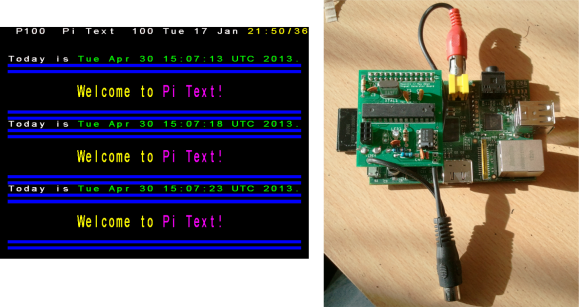
That link leads to his project overview page. But he’s already posted follow-ups on hardware design and initial testing. He’s basing the design around a Raspberry Pi board, but that doesn’t have all the hardware it needs to communicate with the car’s systems. For this he designed his own shield that uses an ATmega328 along with a CAN controller and CAN transceiver. The latter two chips patch into the CAN bus on the car’s On Board Diagnostic system. We didn’t see much about the wiring, but the overview post mentions that the screen takes RGB or Composite inputs so he must be running a composite video cable from the trunk to the dashboard.


Telegraph Sounder Clicks Out Email Messages

telegraph-box-together

[Patrick Schless] is excited to show off the project he took on about nine months ago. After finding an antique telegraph sounder he wired it up to an Arduino to see if he could make it tick. The successful experiment laid the ground work for different hardware that would make it into a morse code email reader.

He doesn’t know much about the background of the old hardware, but driving it is relatively simple. It’s basically a magnetic relay so you need to have a transistor for switching and a flyback diode for protection. Once those components are in place it’s just a matter of toggling a bit. [Patrick] knew he wanted to pull messages from an online source, so he set his Arduino aside and grabbed a Raspberry Pi. It worked like a charm. His plan was to put this on a bookshelf in perpetuity so he went the extra mile, designing his own PCB and having it spun using the OSH Park service. The project is finished with this low-profile laser-cut base which houses all of the electronics.

Now if he wants to respond to his emails in Morse code he needs to build this keyboard.

Continue reading “Telegraph Sounder Clicks Out Email Messages”

Automated Programming And Testing Jig Built With Raspberry Pi

[Doug Jackson] makes word clocks, and he must be doing quite a bit of business. We say that because he put together a programming and test bed for the clock circuit boards.

This is a great example to follow if you’re doing any kind of volume assembly. The jig lets the populated PCB snap into place, making all the necessary electrical connections. This was made possible by a package of goods he picked up on eBay which included rubber spacers to separate the board from the acrylic mounting plate, pogo pins to make the electrical connections, and a spring-loaded board clamp seen to the left in this image.

The switch in the lower right connects power to the board and pulls a Raspberry Pi GPIO pin high. The Python script running on the RPi polls that pin, executing a bash script which programs the ATmega169 microcontroller using the GPIO version of AVRdude. We looked through his Python script and didn’t see code for testing the boards. But the image above shows a “Passed” message on the screen that isn’t in his script. We would wager he has another version that takes the hardware through a self test routine.

We first saw one of [Doug’s] word clocks back in 2009 and then again a few months later. The look of the clock is fantastic and it’s nice to see the project is still going strong.

Learning Letters, Particularly R, F, I, & D

8993376562_55ff3846b3

After [yohanes] picked up a toy at a yard sale – a Leap Frog Letter Factory Phonics – he thought he could do better. The toy originally asked a child to find a letter, and after digging one of 26 plastic characters out of a plastic tub and placing them on the Letter Factory’s sensor, would play a short musical ditty. [yohanes]’ version does the same, but because he made it himself it is infinitely more expandable.

The letters for [yohanes]’ version are RFID tagged. This, combined with a cheap RFID module and a bluetooth module means a Raspberry Pi can read RFID cards from across the room. From there, it’s a simple matter of writing up some Python to ask his toddler for a letter, reading the bits coming from a bluetooth, and keeping score.

The build isn’t over by a long shot. [yohanes] still needs to make his build multilingual by adding Indonesian and Thai. There’s also a possibility of adding a spelling game to make it more interesting.

Raspberry Pi Used To Build A Smart Television

In the title of his post [Donald Derek] calls this a Google TV you can build yourself. That’s certainly an over-reach. But the project is still a very impressive smart television built using a Raspberry Pi.

The open source project starts with the Rasbian OS, an RPi version of Debian Linux. Functionality is built up by installing Chromium to display webpages, a script to download YouTube videos, and OMXPlayer to play videos including 1080P HD content. The image above shows the smart phone controller for the system. This is provided by a Node.js configuration that manages communication between the remote and the RPi board.

On the one hand we love that this is open source. On the other, it’s not going to be able to tap into a lot of the content which makes a Google TV so valuable. For instance, you won’t be able to watch Netflix because that service doesn’t work on Linux systems. But you should be able to watch browser-based content like Hulu.