VCF East 2024 Was Bigger And Better Than Ever

I knew something had changed before I even paid for my ticket to this year’s Vintage Computer Festival East at the InfoAge Science and History Museum in Wall, New Jersey.

Over the last couple of years, attendance has been growing to the point that parking in the lot directly next to the main entrance has been reserved for only the earliest of risers. That hasn’t described yours truly since the days when I still had what my wife refers to as a “real job”, so that’s meant parking in the overflow lot down the road and walking the half a mile or so back to the main gate. Penance for working on the Internet, let’s call it.
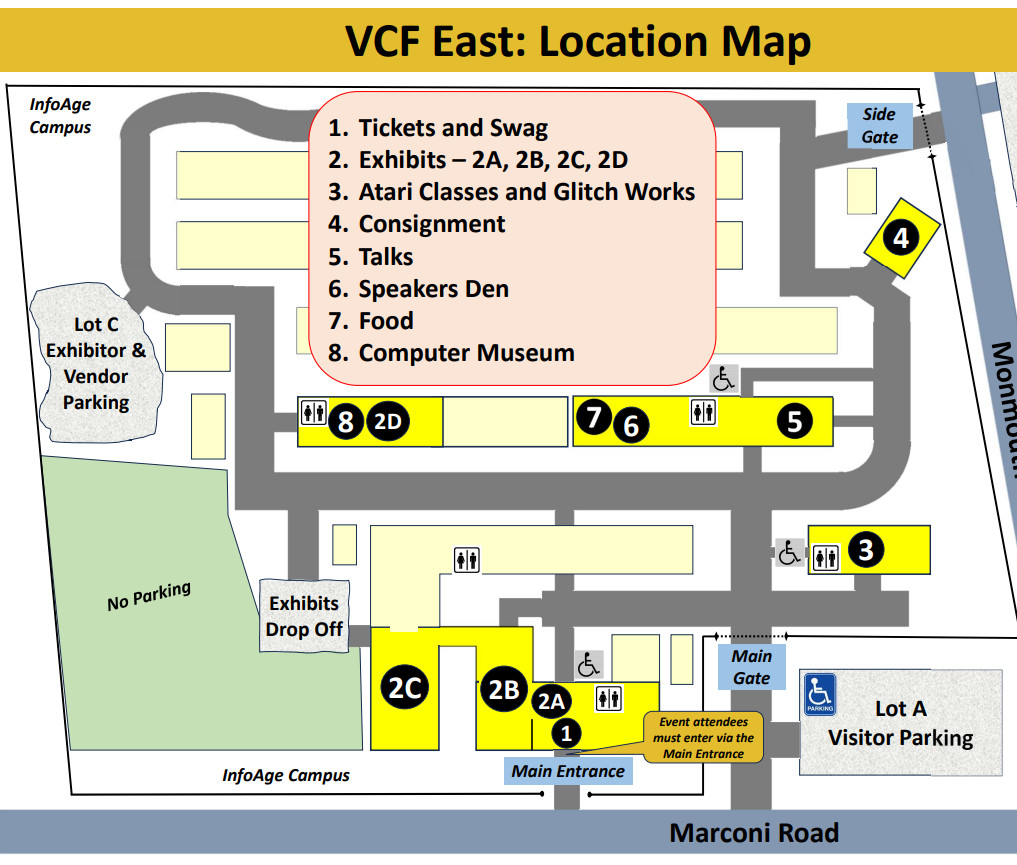
But this time, while walking along the fence that surrounds the sprawling InfoAge campus, I came across an open gate and a volunteer selling tickets. When commenting to her that this was a pleasant surprise compared to the march I’d anticipated, she responded that there had been so many people trying to get into the main entrance that morning that they decided to station her out here to handle the overflow.

I was a few steps past her table and into InfoAge before the implications of this interaction really hit me. Two entrances. How many attendees does there need to be before you setup a secondary ticket booth out by the reserve parking lot just to keep things moving smoothly? Well, I can’t tell you what the exact number is. But after spending the rest of the day walking between all the buildings it took to contain all of the exhibits, talks, and activities this year, I can tell you it’s however many people came to VCF East 2024.

Compared to its relatively humble beginnings, it’s incredible to see what this event has grown into. InfoAge was packed to the rafters, and despite what you might think about a festival celebrating decades old computing hardware, there were plenty of young faces in the crowd. I’m not sure exactly what’s changed, but the whole place was positively jumping. Perhaps it’s partially the generational nostalgia that’s kept Netflix cranking out new seasons of the 1980’s set Stranger Things. I’m sure attention (and attendance) from several well known YouTube personalities have played a big part as well.

Whatever the magic formula that’s turned what was once a somewhat somber retrospective on early desktop computers into a major destination for tech lovers, I’m all for it. Love Live the Vintage Computer Festival!

Continue reading “VCF East 2024 Was Bigger And Better Than Ever”
Compaq Portable III Is More Than Meets The Eye

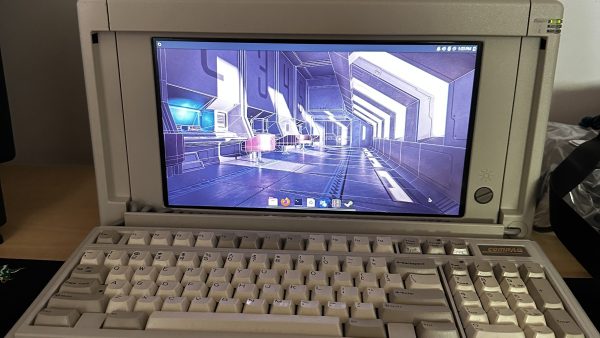
The Compaq Portable III hails from the 386 era — in the days before the laptop form factor was what we know today. It’s got a bit of an odd design, but a compelling one, and the keyboard is pretty nifty, too. [r0r0] found one of these old-school machines and decided it was well worth refitting it to give it some modern grunt.

The Portable III ended up scoring a mini-ITX build, with an AMD Ryzen 7 3700X and an AMD RX580 GPU. Cramming all this into the original shell took some work, like using a vertical riser to fit in the GPU. Hilariously, the RGB RAM sticks are a little bit wasted when the enclosure is closed.

For the purists out there, you’ll be relieved to know the machine’s original plasma display was dead. Thus, a larger modern LCD was fitted instead. However, [r0r0] did play around with software to emulate the plasma look just for fun.

It’s funny to think you could once score one of these proud machines for free at a swap meet.

Continue reading “Compaq Portable III Is More Than Meets The Eye”

Porting Modern Windows Applications To Windows 95

Windows 95 was an amazing operating system that would forever transform the world of home computing, setting the standard for user interaction on a desktop and quite possibly was the OS which had the longest queue of people lining up on launch day to snag a boxed copy. This raises the question of why we still don’t write software for this amazing OS, because ignoring the minor quibbles of ‘security patches’ and ‘modern hardware compatibility’, it’s still has pretty much the same Win32 API as supported in Windows 11, plus it doesn’t even spy on you, or show you ads. This line of reasoning led [MattKC] recently to look at easy ways to port modern applications to Windows 95.

In the video, the available options are ticked off, starting with straight Win32 API. Of course, nobody writes for the Win32 API for fun or to improve their mental well-being, and frameworks like WxWidgets and QuteQt have dropped support for Windows 9x and generally anything pre-Win2k for years now. The easiest option therefore might be Microsoft’s .NET framework, which in its (still supported) 2.0 iteration actually supports Windows 98 SE, or basically within spitting distance of running it on the original Win95.

Continue reading “Porting Modern Windows Applications To Windows 95”

The BBC Micro, Lovingly Simulated In VR

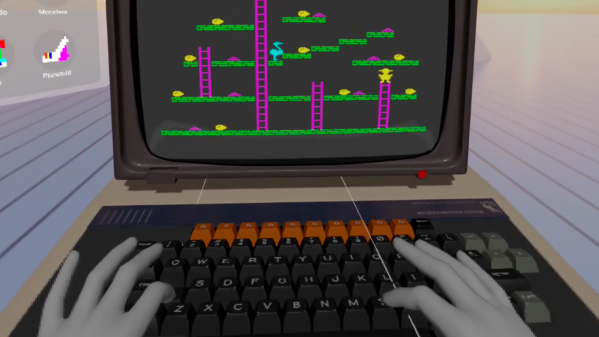
The BBC Micro was many peoples’ first exposure to home computing, and thanks to [Dominic Pajak], you can fire up this beloved hardware in WebXR. Is it an emulator? Yes, but it’s also much more than that.

The machine, the CRT, the keycaps, and even the sounds of the original keypresses are all brought to life as accurately as possible. The result is not just an emulator. It’s a lovingly-made BBC Micro simulator you can use with a VR headset. Or just use your browser and type on your real keyboard if you like.

Continue reading “The BBC Micro, Lovingly Simulated In VR”

Exploring The Bendix G-15’s Typewriter

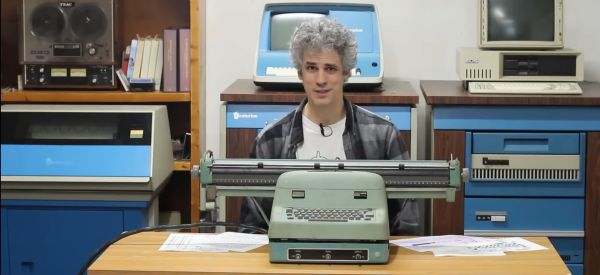
The Bendix Corporation’s Bendix G-15 was introduced in 1956 as an affordable system for industrial and scientific markets. As with any computer system, a range of peripheral devices for input and output were available, which includes an electric typewriter. Produced by IBM, this typewriter was heavily modified by Bendix, with the version that [Usagi Electric] got their mittens on being equipped with a gigantic 28″ platen. With just power applied to the machine it will even still work as a regular electric typewriter, but it can do much more.

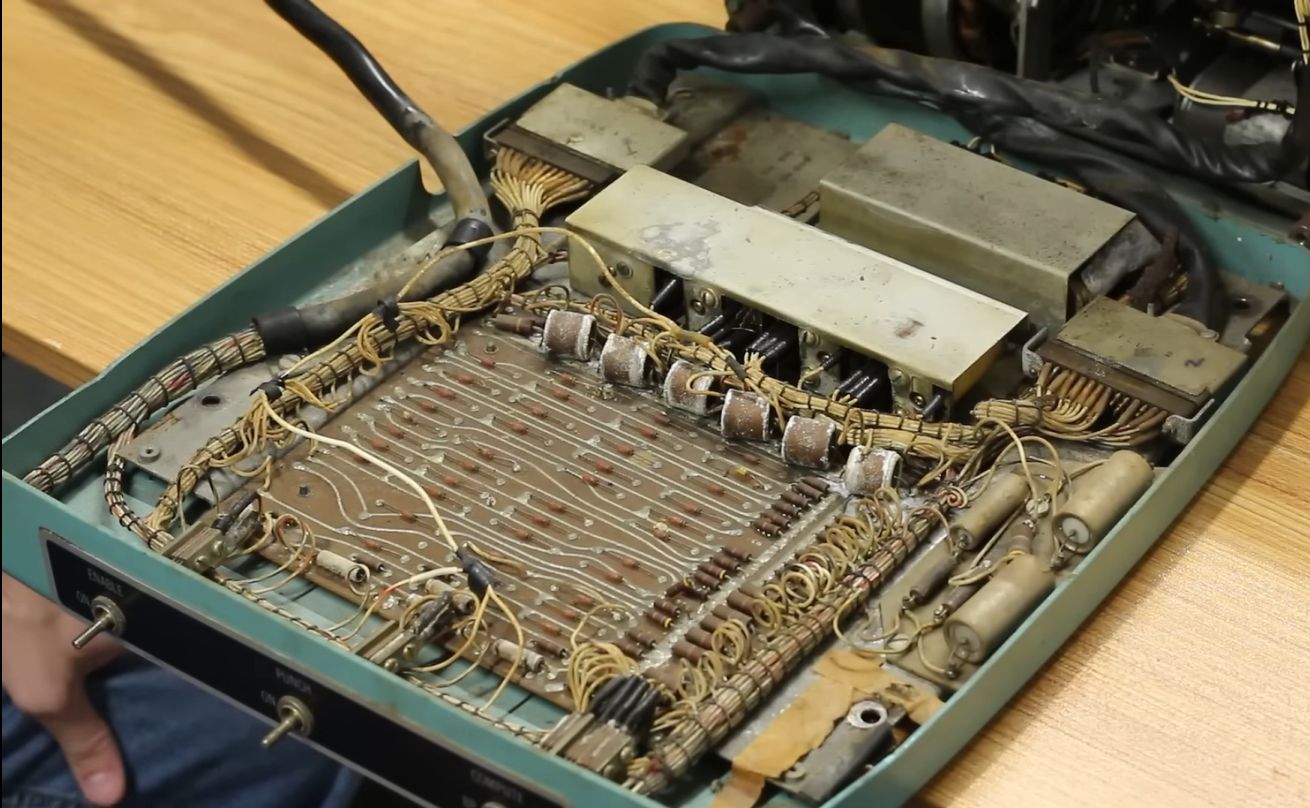
The bits that make an IBM electric typewriter into a Bendix G-15 accessory. (Credit: Usagi Electric)

Most typewriters for the G-15 have a much smaller platen, as can be seen in the brochures for the system. The typewriter is connected together with other peripherals like plotters, card punches and tabulators via a coupler which uses a 5-bit interface. For the encoding on this interface no standard encoding is used, but rather 4 bits are used as data followed by 1 bit to indicate a command. In addition a number of other signal lines are used with the Bendix G-15, which allows control over the punch card reader and run status on the computer from the comfort of the typewriter’s desk.

In addition to the added electronics that communicate with the Bendix G-15, there are also solenoids and sensors which interface with the typewriter’s keyboard. This is what allows for command keys on the typewriter to be recorded separately along with the regular number and letter keys, in addition to the Bendix G-15 using the typewriter to automatically type on the paper. After a good cleaning session the typewriter’s basic functionality is restored, with the hope that once the Bendix G-15 over at the Usagi Farm can power up its DC circuit both will happily chat with each other. Color us excited.

Continue reading “Exploring The Bendix G-15’s Typewriter”

Wozamp Turns Apple II Into Music Player

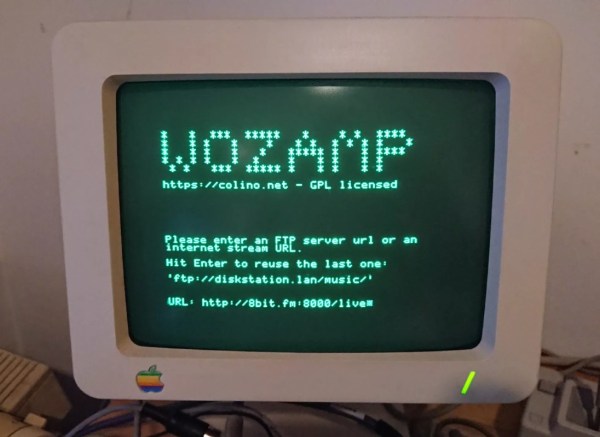
Besides obvious technological advancements, early computers built by Apple differed in a major way from their modern analogs. Rather than relying on planned obsolescence as a business model, computers like the Apple II were designed to be upgradable and long-term devices users would own for a substantially longer time than an iPhone or Macbook. With the right hardware they can even be used in the modern era as this project demonstrates by turning one into a music player.

The requirements for this build are fairly short; an Apple II with a serial card and a piece of software called surl-server which is a proxy that allows older computers to communicate over modern networks. In this case it handles transcoding and resampling with the help of a Raspberry Pi 3. With that all set up, the media player can play audio files in an FTP network share or an online web radio station. It can also display album art on the Apple II monitor and includes a VU meter that is active during playback.

Although the 11.52 kHz sampling rate and 5-bit DAC may not meet the stringent requirements of audiophile critics, it’s an impressive build for a machine of this era. In fact, the Apple II has a vibrant community still active in the retrocomputing world, with plenty of projects built for it including others related to its unique audio capabilities. And if you don’t have an original Apple II you can always get by with an FPGA instead.

PumpkinOS

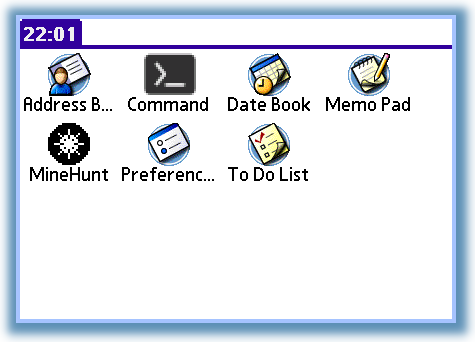
PumpkinOS: A Modern Reimplementation Of PalmOS For Today’s Platforms

In a world where the personal digital assistant (PDA) has become yet another retro computing system, it’s always nice when experiencing the software for such platforms can be done in a way that does not involve hunting down original hardware of questionable functionality. Here PumpkinOS is a PalmOS-compatible project by [migueletto] which runs as a regular application on modern systems and allows for  original PalmOS applications for the Motorola 68k to run on x86 and ARM host systems.

On start-up the Launcher shows up first, just like with PalmOS, from which the four standard PalmOS applications (AddressBook, MemoPad, ToDoList and DateBook) can be launched. Due to endianness issues (m68k being Big Endian), files created by these applications cannot be shared between PumpkinOS and PalmOS, and as noted on the GitHub page, it’s still a far from finished project. That said, it appears to be able to run quite a few original PalmOS applications from sites like PalmDB, and compatibility should get better over time.

The author maintains a development blog as well, for those who are interested in the more in-depth details of this project.