Celebrating The 6502 With Song

In a wonderful ode to tech nostalgia, The Taylor and Amy Show, comprised of YouTubers [Taylor] and [Amy], have released a new video “THE 6502 SONG”. This song had me singing along in roughly six clock cycles, possibly a little dancing around may have occurred as well. This isn’t just any chip they’re singing about; it’s the venerable 6502 microprocessor, the silicon heart behind iconic machines like the Apple II, Commodore 64/128, and the Atari 2600.

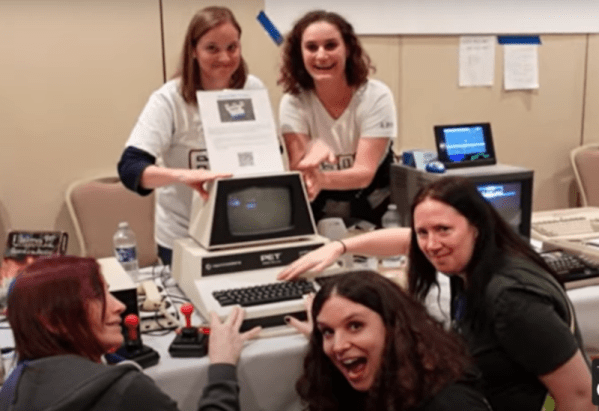
Their lyrics reminds me of when I lived for assembly language mnemonics and counting clock cycles, the “feeling” of a processor coming out of tristate to pronounce what it had learned in the last 500ns, and the undulations of the DRAMs like speed bumps. To top it off, portions of the song were actually recorded live at the Vintage Computer Festival Midwest 2023, where fans and computing history aficionados alike were treated to an impressive display of vintage tech.

What sets “THE 6502 SONG” apart isn’t just its catchy, melodic tune; it’s the expert blend of historical detail and genuine enthusiasm that resonates with everyone from grizzled assembly-language programmers to youngsters newly fascinated by the allure of 8-bit computing. With guest appearances from other female tech YouTubers like [Veronica Explains] and [Evie’s Revue], [AJ], [Jeri and Amy- Tilt5] and [FuzzyBad].

I believe [Chuck Peddle] father of the 6502, would be proud to see his creation live on and be appreciated so.
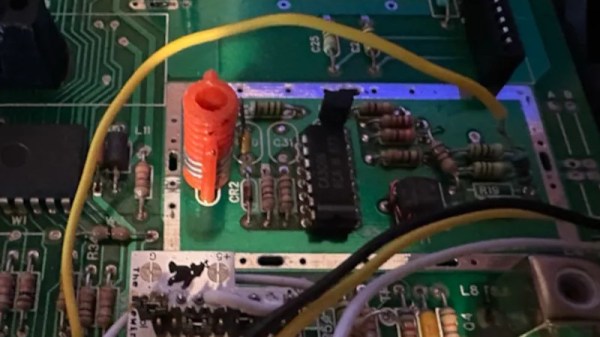
Continue reading “Celebrating The 6502 With Song”

RP2040 Emulator Brings The Voice Of The 80s Back To Life

You may not have heard, but there’s a chip shortage out there. And it’s not just the fancy new chips that are in short supply; the chips that were fancy and new back when you could still buy them from Radio Shack are getting hard to come by, too. For different reasons, of course, but it does pose a problem that requires a little hacking to fix.

The chip in question here is the General Instrument SP0256, a 1980s-era speech synthesizer chip that [Andrew Menadue] relies on. The LSI chip stored 59 unique allophones, or basic sounds the vocal tract is capable of, and synthesized speech by rapidly concatenating these sounds. The chip and its descendants made regular appearances in computers and games throughout the 80s, so chances are good you’ve heard it. If not, think WarGames (yes, we know that wasn’t actually a computerized voice) or [Stephen Hawking] and you’ll be pretty close.

[Andrew]’s need for such a chip stems from his attempts to give voice to his collection of Psion Organisers, another 80s relic that was one of the first pocket computers. Some time ago he built a speech board for the Psion based on the SP0256-AL2, but had to resort to building an emulator for the chip since none were to be had. The emulator uses an RP2040 and lives on a PCB that has the same footprint as the original chip, so it can just plug right in. He dug up WAV files of the allophones and translated those to sequences of bytes, allowing the RP2040 to output the correct sounds as they’re called for. Speaker problems notwithstanding, it sounds pretty good in the video below.

We’ve featured a fair number of SP0256 projects before, on everything from Amstrad to Z80. We’ve also shown off a few of [Andrew]’s builds before, including this exploration of the voltage tolerance of the RP2040.

Continue reading “RP2040 Emulator Brings The Voice Of The 80s Back To Life”

Atari Gets Semi-Modern Video Output

The Atari 2600 is a historical enigma in many ways. On one hand, it was the most popular gaming console of its era, but it was also at the center of the video game crash of 1983 due to the poor quality of its games at the time. It is a fascinating system in many ways that are still relevant today, especially when it comes to pushing hardware much farther than it was designed to go. [nicole] brings us a project that overcomes some of the limitations in its hardware to provide a more modern video output.

At the heart of the Atari is a custom chip called teh Television Interface Adapter (TIA) that generates the console’s video signal as well as handling controller information and a few other tasks. It was designed at a time where memory was expensive, and essentially trades programmer effort to reduce memory requirements. Interestingly, it separates luminance and chrominance information much like S-video does, so that’s where [nicole] focused their efforts. Thanks to some help from an adapter board, the video signals can be intercepted and reprocessed for the S-video standard instead of using RF modulation to send video data out, although this does involve some soldering and modifying of the original Atari hardware. In [nicole]’s case this was a little more involved due to the differences of the 2600jr compared to more standard versions of the console.

While S-video isn’t modern in the strictest sense, as a standard from 1987 it is a huge step forward compared to the available video output methods available in the 1970s when the 2600 was first produced. Plenty of older consoles and other hardware like VCRs and the like used S-video, so if you have a retro gaming setup complete with a CRT you might want to take a look at this 12-input A/V switch to keep everything managed.

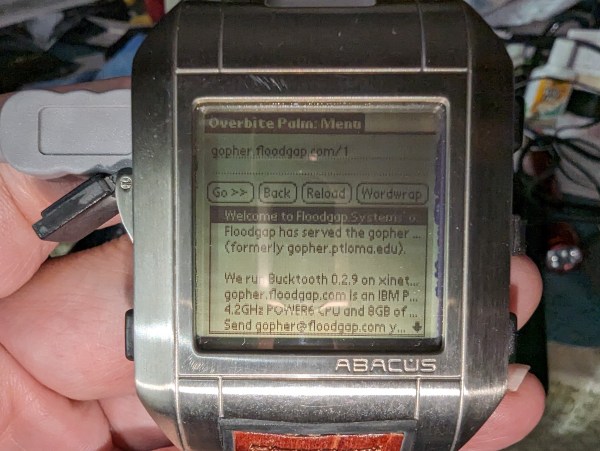
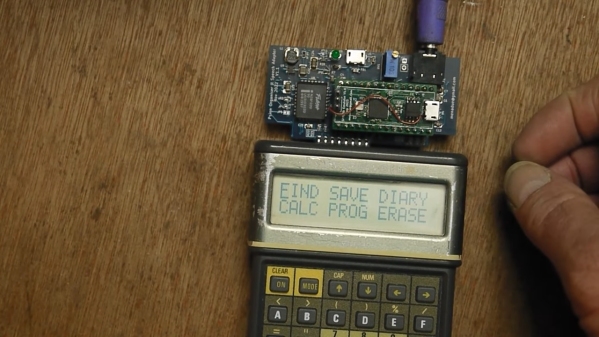
A Fossil Wrist PDA running the Overbite Gopher browser

Mobile Gopher Client Brings Fossil Wrist PDA Online

Like many new technologies, smartwatches needed a few iterations before they became useful enough for the average person. Early examples were too clunky and limited to be of use to anyone but geeks who wanted to show off their “next big thing”. The 2005 Fossil Wrist PDA was a prime example: although impressively compact for its time, its limited battery life and poor feature set made it obsolete as soon as it was released. But since it ran on Palm OS, it offered plenty of opportunity for hacking: Palm expert [Cameron Kaiser] has upgraded his Wrist with internet access.

While Palm OS 4 natively supports TCP/IP networking, this component was deleted from the Wrist version to save memory. In any case, the only viable network interface would have been the USB port, which isn’t too convenient for a watch. Not to be deterred, [Cameron] worked out a way to add network support back into the Wrist: he used the IR port on a Palm m505 to send a copy of its own network drivers to the watch. This works because both devices run the same basic OS version on the same CPU type; the only drawback is that the network setup dialog doesn’t respond correctly to the Wrist’s different set of buttons. Continue reading “Mobile Gopher Client Brings Fossil Wrist PDA Online”

Preserving Floppy Disks

Time is almost up for magnetic storage from the 80s and 90s. Various physical limitations in storage methods from this era are conspiring to slowly degrade the data stored on things like tape, floppy disks, and hard disk drives, and after several decades data may not be recoverable anymore. It’s always worth trying to back it up, though, especially if you have something on your hands like critical evidence or court records on a nearly 50-year-old floppy disk last written to in 1993 using a DEC PDP-11.

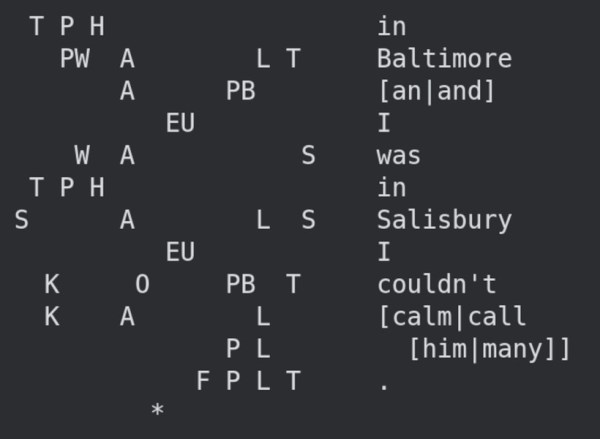
This project all started when an investigation unit in Maryland approached the Bloop Museum with a request to use their antique computer resources to decode the information on a 5.25″ floppy disk. Even finding a floppy disk drive of this size is a difficult task, but this was further compounded not just by the age of the disk but that the data wasn’t encoded in the expected format. Using a GreaseWeazle controlled by a Raspberry Pi, they generated an audio file from the data on the disk to capture all available data, and then used that to work backwards to get to the usable information.

After some more trials with converting the analog information to digital and a clue that the data on the disk was not fragmented, they realized they were looking at data from a digital stenography machine and were finally able to decode it into something useful. Of course, stenography machines are dark magic in their own right so just getting this record still requires a stenographer to make much sense out of it.

Building RAM Expansions For The DEC Rainbow 100

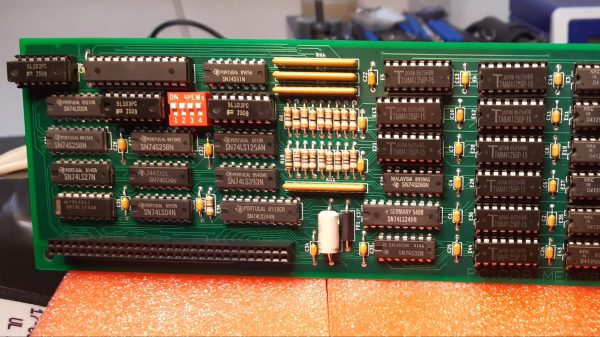
It’s hard enough to get your hands on a forgotten computer from yesteryear. It’s even more difficult to get accessories like RAM expansions and graphics cards, because half the time they’re just discarded as random e-waste when they’re outside of their original context. [na103] has solved this problem for the DEC Rainbow 100 to a degree, by building new RAM expansions and graphics cards from scratch.

In the case of the RAM expansion, the design [na103] built is capable of boosting a Rainbow 100 computer to a full 896KB. This is more than other contemporary IBM machines like the 8088 XT, which had an architecture-enforced limit of 640 KB.  It was rebuilt from some notes and original DEC schematics.

Continue reading “Building RAM Expansions For The DEC Rainbow 100”

Paper Punching Machine Looks Like Cute Piece Of Computer History Past

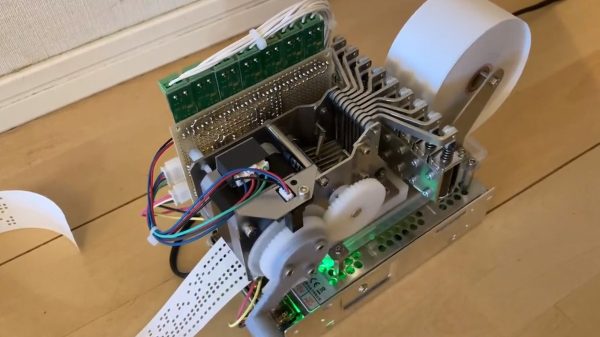
Computing used to run on punch cards. Great stacks of cards would run middling programs, with data output onto more punched cards in turn. [Nii] has built a machine in this vein, capable of punching binary into paper tape. 

The machine is run by a stepper motor, which is charged with feeding the paper tape through the machine in steady steps. A series of vertically-actuated solenoids punch holes in the paper tape as directed. The machine buzzes and clicks away like the best electromechanical computing devices of the mid-century era.

To what end, we couldn’t possibly say. One user noted the machine was punching seemingly random binary into the paper tape, and [Nii] has not provided any explanation as to the machine’s higher purpose. Regardless, whatever it is doing, it looks like it’s doing it well. Feel free to speculate in the comments.

Impressively, the petite device will be demonstrated at MF-TOKYO, the 7th Annual Metal Forming Fair in Tokyo this year. We’re sure the clickity-clack will be muchly appreciated in person.  Video after the break.

Continue reading “Paper Punching Machine Looks Like Cute Piece Of Computer History Past”