Make Me A Drink, Drinkmo.

[Cabe Atwell’s] latest project is a work of art. Let us introduce the Drinkmotizer: a Raspberry Pi Drink Mixing Robot.

As [Cabe] says, almost every engineer has a drink-mixing robot on their project todo list. We’d probably have to agree; they’re functional, cool, and useful at parties.

You need the Drinkmotizer at your party… At some point, dexterity for drink mixing is lost at a gathering.

Drinkmo is your designated, sober, mixologist.

Your enabler.

Your friend.

Drinkmo works by rotating a long leadscrew that moves the mixing glass from bottle to bottle. The entire setup is made using aluminum extrusion, and is by nature, completely expandable. On the top shelf are gravity fed shot dispensers, controlled by 12VDC car lock actuators. The chaser station (at the end, on the right) works differently. The chaser bottle is actually pressurized by a paintball gun tank and dispensed using a solenoid valve. We hope he’s got a pressure regulator in there, considering the pressure capacity of paintball tanks can range from anywhere from 1000-3000PSI!

The entire system is controlled by a Raspberry Pi running Raspbian, and [Cabe] is using Tkinter for the GUI of the program. He’s got tons of info on the original forum post linked above (including the schematic!), and if you stick around after the break, there’s a very well produced video of Drinkmo in all its glory.

Continue reading “Make Me A Drink, Drinkmo.”

Gamecube Robot Is More Than Meets The Eye

[Joshua] had his old Gamecube kicking around. Rather than let it gather dust, he took it into the machine shop at Harvey Mudd College and used its body as the shell of a mobile robot. With a bit of thought, it turns out that you can fit quite a lot inside the rather small Gamecube case. [Joshua] started with a couple of R/C plane style brushless outrunner motors. These motors generally give more torque and spin slower than their inrunner counterparts. Several thousand RPM was still too fast to directly drive the LEGO tires though. He needed a gear reduction.

Gears and tight spaces usually send people running for the SDP/SI website. We’ve used SDP/SI parts before, and have found that they make incredibly accurate gears and assemblies. Things can get pricey, however, when you’re buying two of everything. In search of a solution a bit more within his college-student-budget, [Joshua] looked at radio control servos. R/C servos have some rather strong output gears, especially the metal gear variety. Even with strong gears, parts do break in crashes, so replacement gear sets are available and cheap. [Joshua] settled on gears made for Hitec servos. His next problem was finding a pinion gear for his motors. That turned out to be easy, as 64 pitch gears commonly used in RC cars mesh with metric servo gears.  The final results are great. His robot has tons of torque and plenty of speed to zip around. The only thing it’s missing is a brain. Videos after the break.

Continue reading “Gamecube Robot Is More Than Meets The Eye”

0.19 Leagues Under The Sea

ROV

[Doug] and [Kay] have been building a steel 70-foot sailboat for the last few years, and since it’s a little too cold to work outside their home/shop in Oklahoma, they’re bringing their projects inside for the winter. Until it warms up a bit, they’re working on an underwater ROV capable of diving to 3000 feet below the waves, maneuvering on the ocean floor, and sending video and side-scan sonar back to their homebuilt ship.

Like [Doug] and [Kay]’s adventures in shipbuilding, they’re documenting the entire build process of ROV construction via YouTube videos. The first video covers the construction of a pressure vessel out of a huge piece of 10″ ID, half inch wall steel pipe. The design of the ROV will look somewhat like a torpedo, towed by the ship with cameras pointing in all directions.

For communication with the surface everything is passing over a single Cat5 cable. They’re using an Ethernet extender that uses a twisted wire pair to bring Ethernet to the ocean bottom. With that, a few IP webcams relay video up to the ship and a simple Arduino setup allows for control of the ships thrusters.

The thrusters? Instead of an expensive custom solution they’re using off the shelf brushless motors for RC cars and planes. By potting the coils of a brushless outrunner motor, [Doug] and [Kay] found this solution makes an awful lot of sense; it’s cheap, fairly reliable, doesn’t require a whole lot of engineering, and most importantly cheap.

Bunch of videos below, or just check out [Doug] and [Kay]’s progress on their slightly out-of-date blog.

Continue reading “0.19 Leagues Under The Sea”

PIDDYBOT – A Self Balancing Teaching Tool

We’re sure that most Hackaday readers are already familiar with the inverted pendulum system, which basically consists of a pendulum having its center of mass above its pivot point. Most applications (like the one we are going to describe) limit the pendulum to 1 degree of freedom by affixing the pole (or circuit board here) to an axis of rotation. The overall system is therefore inherently unstable and must be actively balanced in order to remain upright.

[Sean] created the piddybot, a tiny balancing robot aimed to teach the basics of PID control by trying to get the robot to stand still. More interestingly, the Proportional / Integral / Derivative values can directly be adjusted using the three on-board potentiometers. This will allow users to get the feel of each parameter’s impact on the robot behavior. The piddybot is based around the Arduino nano, a custom PCB, 2x 26:1 geared motors, one 1A dual motor driver board, a six degrees of freedom Inertial Measurement Unit, 2 batteries and finally a 3D printed body. You can check out a video of the robot in action after the break.

This project stems from a non-PID self balancer which [Sean] hacked together in September.

Continue reading “PIDDYBOT – A Self Balancing Teaching Tool”

Miniscule Line-Follower

miniscule-line-follower

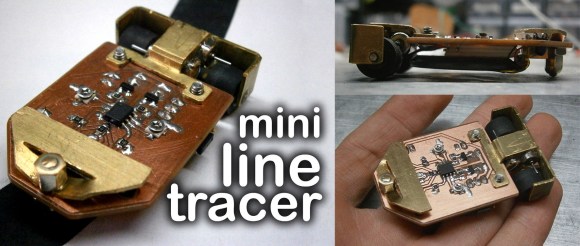
Building line following robots is fun and easy. Building a line-follower that is this tiny is a different story. The surprising thing for us is that despite how it looks, this robot whose name is Rizeh doesn’t use wheels to get around. [Naghi Sotoudeh] built the line-follower using two vibrating motors, with needles (not shown above) making three points of contact with the ground.

His website is a little sparse, but hit the downloads page to get a PDF file that serves as the build log. We also downloaded the 32 second demo video which is worth it. The magic-marker track that the bot is circumnavigating isn’t any bigger than the palm of your hand!

Onboard the diy PCB you’ll find two GP2S04 IR reflectance sensors which detect the black line on a white paper. The power-up sequence spends a few seconds calibrating these sensors. Speaking of power, [Naghi] went with a lithium polymer cell from a Bluetooth headset. At the heart of it all is an ATtiny45 which uses its hardware PWM capabilities to drive the two motors.

Of course line-followers rank up there with self-balancers as our favorite robot projects. But by far the ones we love the most are the speed-run maze solvers.

R/C Rock Crawler Prepped To Become Stair Climbing Robot

rc-robot-frame

[Starlino] is working on an autonomous mobile robot. Like many before him, he looked to the radio controlled car world for a base frame. He found a good candidate in a rock crawler model called “Mad Torque”. Crawlers have been around for years, but they’ve recently been getting more popular. As always, popularity leads to lower priced entry-level models, which puts this crawler at a reasonable price for a robot frame. As the name implies, rock crawlers are all about crawling. Relatively low speeds, locked differentials, four-wheel drive, and (optional) four-wheel steering.

Of course, [Starlino] had to test drive his frame out before tearing it down to install electronics. As long time R/C modelers ourselves, we can’t blame him. Testing uncovered one major problem. The Mad Torque wasn’t quite mad enough to climb the stairs in his house. The front tires would grab and pull over the first step, but the wheelbase wasn’t quite long enough for the rear wheels to grab hold.

[Starlino’s] solution was to extend the wheelbase. For most 4WD R/C cars or trucks this would be a major problem, as the motors are mounted amidships. An extended wheelbase would mean also extending the drive shafts or belts. This isn’t a problem with rock crawlers. Crawlers need to support huge amounts of suspension articulation. Rather than create complex drive linkages, the common design is to place an electric motor on each axle. This isn’t the greatest idea in terms of unsprung mass, but it does make for easy wheelbase changes. [Starlino] found that the design was so modular he could bolt a second chassis up to the original. The new rear chassis bolted to the front at the top shock mounts. An extra set of battery brackets formed a lower brace. The new extended truck was long enough to clear the steps, though it does still struggle a bit, as can be seen in the video. We think larger diameter tires might help a bit here. [Starlino’s] next step is to ditch the R/C unit and give this ‘bot a brain!

Continue reading “R/C Rock Crawler Prepped To Become Stair Climbing Robot”

Autonomous Quadcopter Fits In The Palm Of Your Hand

[Horiken Engineering], which is made up of engineering students at the department of aerospace at the University of Tokyo have developed an autonomous quadcopter that requires no external control — and its tiny. By using two cameras and a sonar sensor, the quadcopter is capable of flying by itself due to its ability to process the data from the on-board sensors. To do the complex data processing fast enough to fly, it is using a Cortex-M4 MCU, a Spartan-6 FPGA, and 64MBs of DDRSDRAM. It also has the normal parts of a quadcopter, plus gyros, a 3D printed frame and a 3-axis compass. The following video demonstrates the quadcopter’s tracking ability above a static image (or a way point). The data you see in real-time is only the flight log, as the quadcopter receives no signal — it can only transmit data.

Continue reading “Autonomous Quadcopter Fits In The Palm Of Your Hand”