Flocking Behavior Using Mindstorm Robots

flock-behavior-with-mindstorm

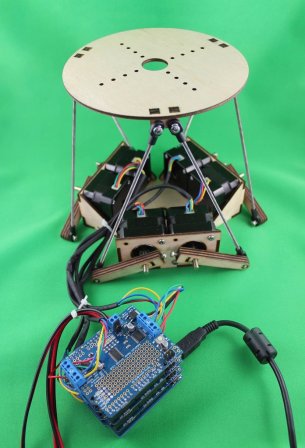
Do you ever wonder why geese always fly together in a V-shape? We’re not asking about the fact that it makes the work load much less for all but the lead goose. We mean how is it that all geese know to form up like this? It’s is the act of flocking, and it’s long been a subject of fascination when it comes to robotics. [Scott Snowden] researched the topic while working on his degree a few years ago. Above you can see the demonstration of the behavior using LEGO Mindstorm robots. That’s certainly interesting and you’ll want to check out the video after the break. But his offering doesn’t end with the demo. He also posted a huge article about his work that will provide days of fascinating reading.

We can’t begin to scratch the surface of all that he covers, but we can give you a quick primer on his Mindstorm (NXT) setup. He uses these three bots along with a central brick (the computer part of the NXT hardware) which communicates with them. This lets him use a wide range of powerful tools like MatLab and Processing to recognize each robot with a top-down camera, passing it data based on info harvested with computer vision. From there it’s a wild ride of modeling the behavior as a set of algorithms.

Continue reading “Flocking Behavior Using Mindstorm Robots”

Clean And Minimal Self-balancing Robot

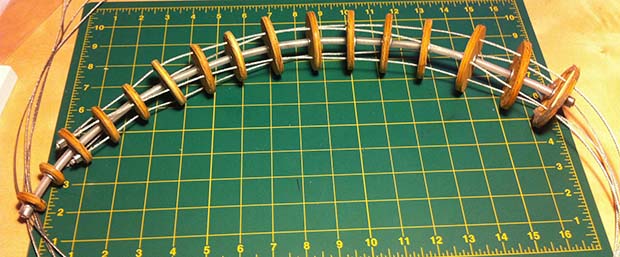
The VertiBOT is a self balancing robot project taken on for the purpose of exploring how the sensors work in conjunction with some PID algorithms.

[Miguel] didn’t roll any extras into the build. But you have to admit that makes it look interesting. There’s almost nothing to it and yet, as you can see in the clip after the break, he accomplished everything he set out to.

The body and wheels are 3D printed, with black bands for tires to help give it some traction. Note the connection in the center of the body which allowed him to make a longer part by printing in two stages. On the electronic side of things he’s using an Arduino Nano. A level converter lets it communicate with the 6 DOF IMU board which is used to detect movement. Three potentiometers provide a way for him to tweak the PID loop without having to bother with reflashing any code. And of course there’s an option to control it remotely thanks to a Bluetooth module also in the mix.

Continue reading “Clean And Minimal Self-balancing Robot”

Voice Controlled Chess Robot

voice-controlled-chess-robot

[Ben Yeh] wrote in to tell us about this voice-controlled chess robot he built along with three others as a final project for their Georgia Tech ECE 4180 Embedded Systems Design class.

To handle the speech recognition they grabbed an EasyVR board. This is a fine solution because it prevents the need for a computer to process voice commands (remember, it’s an embedded systems class). This concept breaks down when you find out that the desktop computer next to the robot is where the chess game is running. Perhaps that can be moved to a microcontroller by the next set of 4180 students.

The robot arm portion of the project is shown off well in the clip after the break. Normally we’d expect to see stepper motors driving the axes of a CNC machine but in this case they’re using servo motors with built-in encoders. The encoders are i2c devices which feed info back to the main controller. There was a parts ordering snafu and the z axis motor doesn’t have an encoder. No problem, they just added a distance sensor and a reflector to measure the up and down movement of the claw.

Continue reading “Voice Controlled Chess Robot”

Quadruped Walks Of Four Legs, Rolls On Four Treads

tracked-quadruped-robot

This robot doesn’t know if it’s a walker or a tank. It’s the brain-child of [Marc Hamende] who works as a mechanical engineer by day and mad roboticist at night. The best place to find full details is by digging into the long thread he’s been posting to for about six weeks. It will give you a pretty good snapshot of his approach, starting with SolidWorks renderings of the project, and adding in assembled components as he brings the project together.

The mechanism for each foot is fascinating. He milled the white pieces which stack together to encapsulate the motor that runs the treads. These assemblies pivot to bring the metal rod serving as a walking foot in contact with the ground. But they also make it possible to adjust the treads to deal with rough terrain. A Propeller chip drives the device, with an Xbee module to communicate with the controller.

Don’t miss the video after the break. You’ll hear some skidding as it makes turns, but [Marc] plans to add code to adjust motor speed in order to compensate for the inside/outside differential issues. He’s also posted an image album over at Flickr.

Continue reading “Quadruped Walks Of Four Legs, Rolls On Four Treads”

[FlorianH] Shows Off MinimaBL, The Next Generation Of His Quadcopter Project

minimabl

[FlorianH] has all kinds of new features to show off with this generation of his quadcopter project. Just about everything has seen an upgrade or some other kind of tweak since we looked in on the last version of the aircraft.

You’ll find some outdoor flight demo clips after the break. Right off the bat we’re impressed at the rock solid stability of the quadrotor while in flight. Even indoors the last version had a hint of a wobble as the control loop calculated stabilization. Here he borrowed some code from the open source Aeroquad project which helps account for this improvement. But the hardware choices lend a hand too. He moved from an ATmega32 up to an STM32F405RG processor. That’s an ARM chip which he programs using one of STM’s Discovery boards. The motors have all been upgraded as well (if you listen in the demo videos for both models you can hear a difference) and he redesigned the frame, which combines carbon tube with 3D printed parts to keep it light yet strong. The upgrade is every bit as impressive as the original build!

Continue reading “[FlorianH] Shows Off MinimaBL, The Next Generation Of His Quadcopter Project”

Solar Powered Robot Mows Your Lawn While You Chill Indoors

We’ve heard quite a number of radio ads lately trying to sell an automatic lawn mowing robot (like a Roomba for your grass). But wouldn’t it be a lot more fun to hack your own from an existing lawnmower? That’s what [Daniel Epperson] did. In fact, the project has been ongoing for years. But he wrote in to share the latest development which adds solar charging capabilities to the robot mower.

First off let’s discuss the fact that this is not an electric lawnmower. This is the Prius of lawnmowers, bringing together hybrid technology to cut the grass with the gasoline powered motor, and to propel the rig with electricity. [Danny’s] worked hard to shoe-horn just about every feature imaginable (other than autonomy) into the thing, and that’s why the batteries can be charged from mains, an alternator powered by the gas motor, and now from the PV panel mounted on top of it. Get the entire project overview in his roundup post.

This a wireless video feed and the mower is driven by remote-controlled. So you can give your yard a trim without getting sweaty. After the jump we’ve embedded a clip of an earlier revision demonstrating that remote control. If you’re not interest in having all the features you could simply build an analog version.

Continue reading “Solar Powered Robot Mows Your Lawn While You Chill Indoors”

Adding An Optical Mouse Sensor To An Autonomous Vehicle

[Tim] is getting his drone ready for SparkFun’s 2013 Autonomous Vehicle Competition on June 8th. He has a pretty good start, but was having some problems accurately measuring travel distance. The technique he chose for the task was to glue magnets onto the axles of the vehicle and monitor them with a hall effect sensor. Those sensors are finicky and a few problems during testing prompted him to look at a redundant system. Right now he’s experimenting with adding an optical mouse sensor to the autonomous vehicle.

Recently we saw the same concept used, but it was meant for tracking movement of a full-sized automobile. If it can work in that application it should be perfect here since the vehicle is much closer to the ground and will be used in ideal conditions (flat pavement with clear weather). [Tim] cracked open an old HP mouse he had lying around. Inside he found an Avago ADNS-5020 sensor. After grabbing the datasheet he discovered that it’s simply an I2C device. Above you can see the Arduino Leonardo he used for the first tests.

[Tim] coded functions to monitor the chip, including some interesting ones like measuring how in-focus the surface below the sensor is. This brings up a question, is there limit on how fast the vehicle can travel before the sensor fails to report back accurately?