Retrotechtacular: Shakey Shows Off Robotics Innovation From 1972

In this installement of Retrotechtacular we’re taking a look at Shakey, a robot developed between 1966 and 1972 at the Stanford Reserach Lab. This was a glorious time when students had long hair but still wore long sleeves and ties to do their research.

The robot is actually communicating wirelessly with the PDP-10 computer which handles the processing. No computer monitor is used for interacting with the robot. Instead, a teletype machine lets you type out your commands on paper, and the response from the machine is printed back to you on the same sheet. There’s a camera which is used for image recognition, and sensors that give feedback when the body comes in contact with an obstacle.

We’d sure love to know what kind of budget this project had, but alas we couldn’t find any info about that. You can go and see Shakey in person if you want to. This info page mentions that the machine is on display at the Computer History Museum in Mountain View, California.

Continue reading “Retrotechtacular: Shakey Shows Off Robotics Innovation From 1972”

Cheap Wooden Hexapod Frame Greatly Reduces Cost

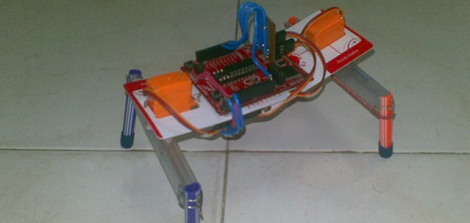
[Balline] really wanted to play with a hexapod but found the cost to be prohibitive. Being a mechanical engineer, he was able to fairly quickly come up with a stable 3 servo design that would allow him to experiment with the platform. He chose to use wood as the construction material to help reduce costs even more.  As you can see in the video after the break, his design gets around fairly well.  His cost for the whole thing, including the 3 servos, the basic stamp hobby board, the recycled batteries, and the frame, was under $100.

This is a great system to start with, though he unfairly compares the cost to the dancing ones he had seen in the past. C’mon, your bot ain’t no [Lou Vega]. It is still pretty cool though.

Continue reading “Cheap Wooden Hexapod Frame Greatly Reduces Cost”

Snake-like Robot Can Roll Around In A Ring

A lot of 3D printing and a many servo motors went into this snake-like robot, and it’s only about half of what [Toby Baumgartner] plans to accomplish. In this orientation the snake is rolled into a circle, and apparently some special movements in the segments allow it to roll around like this. He compares it to a tank tread without the tank attached to it. Notice that each link is rounded on the outside. When the snake opens itself up, the toothed inside of the links contacts the ground for added traction.

It looks like eventually the larger link at the bottom will be about three times as wide. This will make room for him to mount a second ring of links. The idea is that the larger link will act as the body and this can unfold itself into a quaruped. Motors that allow the segments to pivot side to side would make it something like a four-legged spider bot.

Floating Sensor Networks

These cool looking little bots are part of a fleet of floating water sensors built by The Lagrangian Sensor Systems Laboratory (LSSL) at UC Berkeley, the Lawrence Berkeley National Laboratories (LBNL) and the California Department of Water Resources.

In an emergency such as a levee break, flood, or spill, they can be deployed to gather information in a way that is completely impossible with stationary sensors. These 17″ tall bots can steer with the help of their twin props and communicate water quality information back to the base via cellular communication and short wave radio. They describe the resulting data as being like a “google traffic map” showing speed, depth, and contamination of the water.

There’s a ton of detail on their site, including breakdowns of how the software and hardware are put together. There’s even a bit of the evolution of the hardware showing the abandoned previous models.

Pipe Crawling Snake Robot Is A Masterpiece Of A Senior Project

Here’s an oldie but a goodie: [Eiki], [Mark], and [Sheraz] built a pipe crawling robot for their senior engineering project at Florida Atlantic University way back in 2004. Despite being a rather old build, its aged well and still demonstrates the clever ways the guys overcame some engineering obstacles.

The original plan for the pipe crawler was to mount three spring-loaded wheels 120° apart at the fore and aft of each robot section. Six independent wheels for each section of the robot is overly complex, and too much for a single operator to control; the team moved on to a ‘screw drive’ system where each wheel is canted forward a few degrees. This drive system propels the snakebot along by simply spinning, although it does bring in a few challenges all its own.

The robot had separate sections consisting to house a motor, camera, and electronics, so a way to pass wires through a rotating shaft was needed. This came in the form of a few pairs of incredibly small ball bearings around a hollow shaft. After the mechanical portion of the build was finished, the team moved on to the electronic part where an IMU was built out of three small gyroscope sensors mounted perpendicularly to each other.

Sadly, there are no videos of the inside of a sewage pipe from the pipe crawler’s point of view, but YouTube wasn’t launched until a year after this project was finished.

Project Octopus

You know who thinks building a robotic octopus is an awesome idea? EVERYONE. Apparently the idea is a solid enough idea that the European Commision has funded this project. The goal is to mimic the capabilities of the squishiest of the cephalopods in order to advance soft robotics. Or possibly to take over the world.  They are hoping to have a fully capable robot octopus with no rigid structures at all.

You may be thinking that making a squirming tentacle is easy business. What they are attempting however, is the actual movement of an octopus including extension/contraction as well as grasping. This requires a complex system of control wires as well as “artificial muscular hydrostats” to allow it to do all these movements. A flexible skin covered in sensors will be added to the final design.

There’s More Than Meets The Eye To This Robot Car

This is a robot that any Transformers enthusiast will love. Sure, the car looks just a bit boxy, but you’ll forget all about that when you see it unfold into a bipedal robot (translated). [Zak Sawa] is responsible for the creation. He pull off the build using 22 servo motors which let the car transform, and provide the somewhat awkward ability to walk. Fold it back up again and the car can drive away. In other words, here’s the Transformers toy that you always wanted; radio controled and it actually works!

This is the result of about four years of work. Apparently it’s the eighth iteration, and a note on the video after the break teases a ninth version on the way. It’s not just the robot that looks great, check out the carrying case that houses it for storage.

Continue reading “There’s More Than Meets The Eye To This Robot Car”