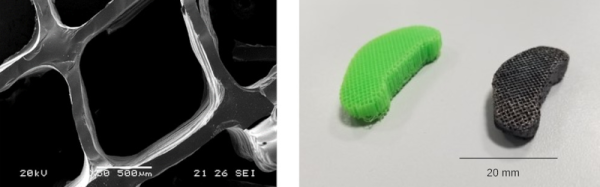
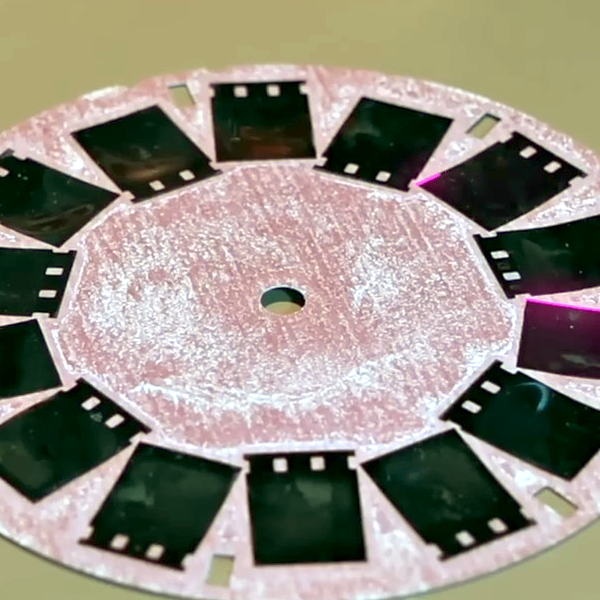
Creating things with ceramics is nothing new — people have done it for centuries. There are ways to 3D print ceramics, too. Well, you typically 3D print the wet ceramic and then fire it in a kiln. However, recent research is proposing a new way to produce 3D printed ceramics. The idea is to print using TPU which is infused with polysilazane, a preceramic polymer. Then the resulting print is fired to create the final ceramic product.
The process relies on a specific type of infill to create small channels inside the print to assist in the update of the polysilazane. The printer was a garden-variety Lulzbot TAZ 6 with ordinary 0.15mm and 0.25mm nozzles.
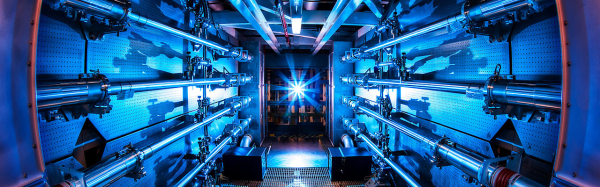
Earlier this month, Lawrence Livermore National Laboratory (LLNL) announced to the world that they had achieved a record 1.3 MJ yield from a fusion experiment at their National Ignition Facility (NIF). Yet what does this mean, exactly? As their press release notes, the main advancement of these results will go towards the US’s nuclear weapons arsenal.
This pertains specifically to the US’s nuclear fusion weapons, which LLNL along with Los Alamos National Laboratory (LANL) and other facilities are involved in the research and maintenance of. This traces back to the NIF’s roots in the 1990s, when the stockpile stewardship program was set up as an alternative to nuclear weapons testing. Much of this research involves examining how today’s nuclear weapons degrade over time, and ways to modernize the existing arsenal.
In light of this, one may wonder what the impact of these experimental findings from the NIF are beyond merely ensuring that the principle of MAD remains intact. To answer that question, we have to take a look at inertial confinement fusion (ICF), which is the technology at the core of the NIF’s experiments.
You don’t really create energy, you convert it from one form to another. For example, many ways that we generate electricity use heat from burning or nuclear decay to generate steam which turns a generator. Thermocouples generate electricity directly from heat, but generally not very much. Still, some nuclear batteries directly convert heat to electricity, they just aren’t very efficient. Now researchers have developed a way of preparing a material that is better at doing the conversion: tin selenide.
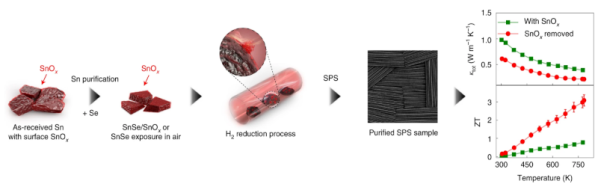
Tin selenide is known to have good performance converting heat into electricity when in its crystal form. However, practical applications are more likely to use polycrystalline forms, which are known to have reduced conversion performance.
The material works well because it is not very thermally conductive and it has a favorable band structure that allows multiple bands to participate in charge transport. However, in polycrystal configurations, the results are not as good due to higher thermal conductivity. Yet crystalline tin selenide is difficult to manufacture and not very robust in real-world use.
The team worked out that the polycrystal material’s thermal properties were due to tin oxide films on the surface. Using a particular method of construction, you can remove the tin oxide and improve performance even better than the crystal version of tin selenide.
Creating this material might be beyond your garage lab, though. You need a fused silica oven that can reach a pretty tight vacuum. Although you might be able to swing it. Otherwise, you might stick with more conventional methods.
Levitation may seem like magic. However, for certain objects, and in certain conditions, it’s actually a solved technology. If you want to move small particles around or do experiments with ultrasonic haptic feedback, you might find SonicSurface to be a useful platform for experimentation.
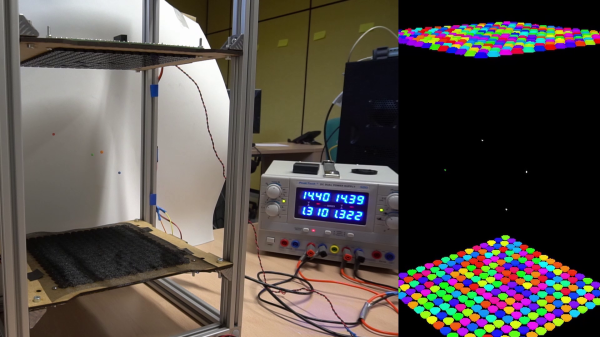
The build comes to us from [UpnaLab], and is no small feat of engineering. It packs in 256 ultrasonic emitters in a 16×16 grid, with individual phase control across the entire panel. This allows for the generation of complex ultrasonic wave fields over the SonicSurface board. Two boards can be paired together in a vertically opposed configuration, too. This allows the levitation of tiny particles in 3D space.
As you might expect, an FPGA is pressed into service to handle the heavy lifting – in this case, an Altera CoreEP4CE6. Commands are sent to the SonicSurface by a USB-to-serial connection from an attached PC.
The board is largely limited to the levitation of small spherical pieces of foam, with the ultrasonic field levitating them in midair. However, the project video shows how these tiny pieces of foam can be attached to threads, tapes, and other objects in order to manipulate them with the ultrasonic array.
It may not be a simple project, but it serves as a great basis for your own levitation experiments. Of course, if you want to start smaller, that’s fine too. If you come up with any great levitation breakthroughs of your own, be sure to let us know.
After decades in development, the Philippines became the first country on July 21st of this year to formally approve the commercial propagation of so-called golden rice. This is a rice strain that has been genetically engineered to produce beta-carotene in its grains. This is the same compound that has made carrots so famous, and is a significant source of vitamin A.
Getting enough vitamin A is essential for not only children and newborns, but also for pregnant and lactating women. Currently, vitamin A deficiency (VAD) is the primary cause of preventable childhood blindness and an important cause of infant mortality. While VAD is hardly the only major form of world-wide malnutrition, biofortification efforts like golden rice stand to dramatically improve the lives of millions of people around the globe by reducing the impact of VAD.
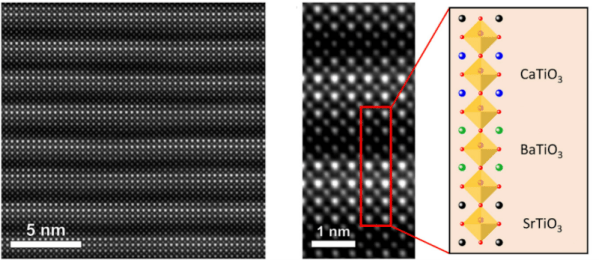
Researchers claim that using several very thin layers of ferroelectric crystals can lead to significantly better ferroelectric solar cell efficiency. But don’t pull the panels off your roof yet. Conventional cells are still much more efficient than ferroelectric devices — at least, for now.
Unlike conventional silicon-based solar cells, ferroelectric cells don’t depend on a PN junction and — in theory — can be cheaper and easier to produce. However, they typically don’t absorb as much sunlight as other materials.
Roughly 4.6 billion years ago, Earth would gain its first atmosphere, yet this was an atmosphere that was completely unlike the atmosphere we know today. Today’s oxygen-rich atmosphere we’re familiar with didn’t form until the Proterozoic, between 2,500 and 541 million years ago, when oxygen-producing bacteria killed off much of the previously thriving life from the preceding Archean.
This, along with studies of massive insects such as the 75 cm wingspan Meganeuropsis permiana dragonflies from the Permian, and reconstructed temperature, oxygen, and carbon dioxide levels via paleoclimatology show periods during which Earth’s atmosphere and accompanying climate would be unrecognizable to us humans.
Human history covers only a minuscule fraction of Earth’s history during arguably one of the latter’s coolest, least eventful periods, and yet anthropogenic (man-made) climate change now threatens to rapidly change this. But wait, how do we know what the climate was like over such vast time scales? Let’s take a look into how we managed to reconstruct the Earth’s ancient climate, and what these findings mean for our prospects as a species today.