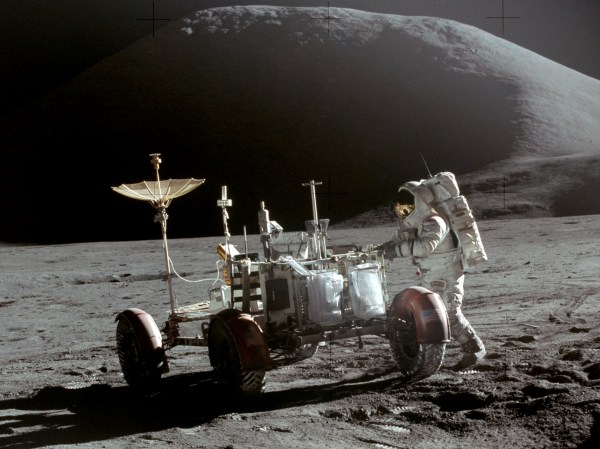
We’re looking to go back to the Moon. Not just with robots this time, but with astronauts, too! They’ll be doing all kinds of interesting things when they get there. Maybe they’ll even work towards establishing a more permanent presence for humanity on the lunar surface, in which case they’ll have to get up in the morning, eat breakfast, and get to work.
This raises the question—how does time work on the Moon? As simple as they can be down here, Earthly days and years have little meaning up there, after all. So what’s going on up there?
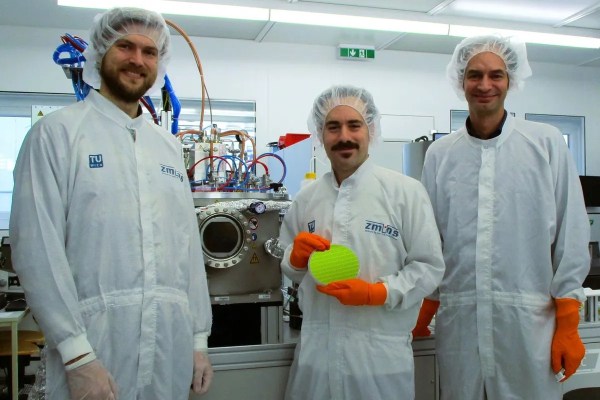
Not every computer can make use of a disk drive when it needs to store persistent data. Embedded systems especially have pushed the development of a series of erasable programmable read-only memories (EPROMs) because of their need for speed and reliability. But erasing memory and writing it over again, whether it’s an EPROM, an EEPROM, an FPGA, or some other type of configurable solid-state memory is just scratching the surface of what it might be possible to get integrated circuits and their transistors to do. This team has created a transistor that itself is programmable.
Rather than doping the semiconductor material with impurities to create the electrical characteristics needed for the transistor, the team from TU Wien in Vienna has developed a way to “electrostatically dope” the semiconductor, using electric fields instead of physical impurities to achieve the performance needed in the material. A second gate, called the program gate, can be used to reconfigure the electric fields within the transistor, changing its properties on the fly. This still requires some electrical control, though, so the team doesn’t expect their new invention to outright replace all transistors in the future, and they also note that it’s unlikely that these could be made as small as existing transistors due to the extra complexity.
While the article from IEEE lists some potential applications for this technology in the broad sense, we’d like to see what these transistors are actually capable of doing on a more specific level. It seems like these types of circuits could improve efficiency, as fewer transistors might be needed for a wider variety of tasks, and that there are certainly some enhanced security features these could provide as well. For a refresher on the operation of an everyday transistor, though, take a look at this guide to the field-effect transistor.
Finding extraterrestrial life in any form would be truly one of the largest discoveries in humankind’s history, yet after decades of scouring the surface of Mars and investigating other bodies like asteroids, we still have found no evidence. While we generally assume that we’re looking for carbon-based lifeforms in a water-rich environment like Jupiter’s moon Europa, what if complex organic chemistry would be just as happy with sulfuric acid (H2SO4) as solvent rather than dihydrogen monoxide (H2O)? This is the premise behind a range of recent studies, with a newly published research article in Astrobiology by [Maxwell D. Seager] and colleagues lending credence to this idea.
Previous studies have shown that organic chemistry in concentrated sulfuric acid is possible, and that nucleic acid bases – including adenosine, cytosine, guanine, thymine and uracil which form DNA – are also stable in this environment, which is similar to that of the Venusian clouds at an altitude where air pressure is roughly one atmosphere. In this new article, twenty amino acids were exposed to the concentrations of sulfuric acid usually found on Venus, at 98% and 81%, with the rest being water. Of these, 11 were unchanged after 4 weeks, 9 were reactive on their side chains, much like they would have been in pure water. Only tryptophan ended up being unstable, but as the researchers note, not all amino acids are stable in water either.
Every 26 months, Earth and Mars come tantalizingly close by virtue of their relative orbits. The closest they’ve been in recent memory was a mere 55.7 million kilometers, a proximity not seen in 60,000 years when it happened in 2003.
However, we’ve been playing close attention to Mars for longer than that. All the way back in 1924, astronomers and scientists were contemplating another close fly by from the red planet. With radio then being the hot new technology on the block, the question was raised—should we be listening for transmissions from fellows over on Mars?
Think of a greenhouse. It’s a structure with glass walls that lets light in and traps heat, all for the benefit of the plants inside. As for how it works, that’s elementary! It’s all down to the greenhouse effect… right?
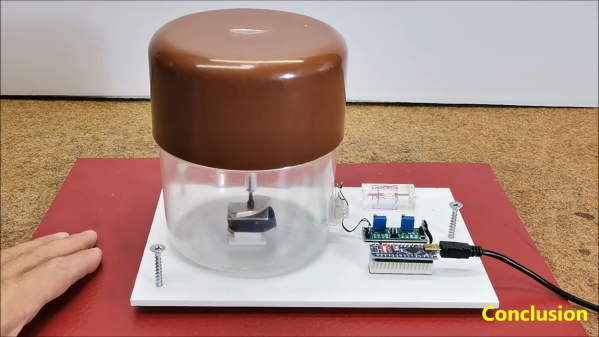
If you’re a child, there are certain things you’re taught even though they’re probably not directly relevant to your life. We teach young kids all about dinosaurs, and we teach older kids all about how the mitochondria is the powerhouse of the cell. We also teach kids about natural phenomena like earthquakes, and the equipment used to measure them. Namely, seismometers. You might like to satisfy your own child-like curiosity by building one of your own, like [mircemk] did.
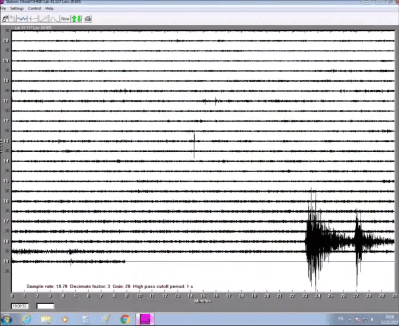
Output from the build showing tremors in the Earth.
The build starts with a sensitive geophone of [mircemk’s] own design. That’s basically a microphone but it’s for picking up vibrations in the ground, not in the air. However, a geophone is not enough. You need to be able to pick up the signals from the geophone and then plot them if you want a seismometer.
First, the signals from the geophone must be amplified, which is achieved with a small circuit based around the LM358 op-amp. From there, the signal is sent to an Arduino where the output is captured via the analog-to-digital converter. This passes the signal to an attached PC which plots the results using a piece of software called NERdaq, which was developed for schools that built their own slinky-based seismometers.
[mircemk] reports that this setup has served as a reliable tool for visualizing earthquake activity for over 6 years. Though, it bears noting, it’s not calibrated so don’t expect to get science grade results out of it. Regardless, though, it’s a super cool way to understand more about what is going on with the geology around us. Video after the break.
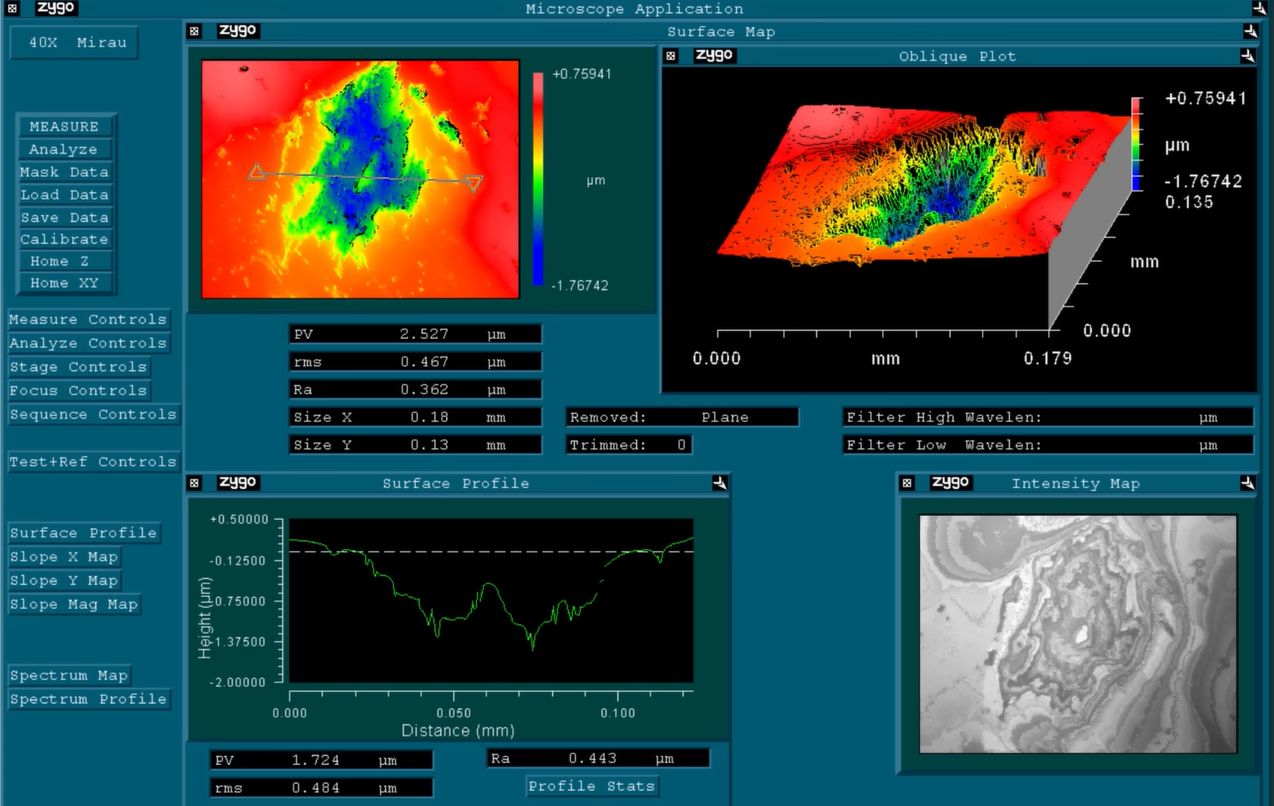
Screenshot of the Zygo white light interferometry microscope software. (Credit: Huygens Optics)
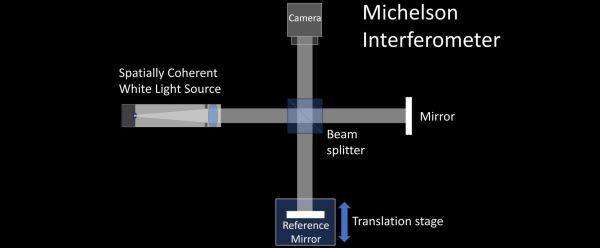
White light interferometry (WLI) is a contact-free optical method for measuring surface height. It uses the phase difference between the light reflected off a reference mirror and the target sample to calculate the height profile of the sample’s surface. As complex as this sounds, it doesn’t take expensive hardware to build a WLI microscope, as [Huygen Optics] explains in a detailed introductory video on the topic. At its core you need a source of white light (e.g. a white LED), with a way to focus the light so as to get a spatially coherent light source, like aluminium foil with a pin hole and a lens.
This light source then targets a beam splitter, which splits the light into one beam that targets the sample, and one that targets the reference mirror. When both beams are reflected and return to the beam splitter, part of the reflected light from either side ends up at the camera, which captures the result of the reference and sample beams after their interference (i.e. combination of the amplitudes). This creates a Michelson interferometer, which is simple, but quite low resolution. For the demonstrated Zygo Newview 100 WLI microscope this is the first objective used, followed by a more recent innovation: the Mirau interferometer, which integrates the reference mirror in such a manner that much higher resolutions are possible, down to a few µm.