THP Entry: A Wireless Bootloaders And Linux Build Systems

radioWith The Hackaday Prize, you’re not just limited to one entry. Of course it would be better to devote your time and efforts to only one project if you’re competing for a trip to space, but if you’re [Necromant], you might be working on two highly related project that are both good enough for The Hackaday Prize

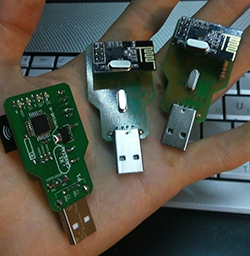
[Necromant]’s first project is rf24boot, an over-the-air bootloader using the very cheap and very popular NRF24L01 2.4GHz wireless module. There have been many, many projects that add wireless bootloading to microcontrollers using XBees and the NRF24, but [Necromant] is doing something different with this project: he’s building in support for a wide variety of microcontrollers, that include the STM32, MSP430, PIC32, 8051, and of course AVR chips for that ever so popular Arduino compatibility.

The support of multiple microcontroller platforms is a result of [Necromant]’s other entry to The Hackaday Prize, Antares, the Linux kernel-like build system for microcontrollers. The idea behind Antares is to separate the writing of code from microcontrollers away from compiling and burning. Think of it as a giant makefile on steroids that works with everything, that also includes a few libraries for common projects.

Supported platforms for Antares include the popular aforementioned targets, and allow you to use any IDE you could possibly desire. emacs? Sure. Eclipse? Right on. Arduino? You’re a masochist. For a really great overview of Antares you can check out the Readme, or the post we did a year or so ago.

It’s all very cool stuff, and very easy to see the potential of what [Necromant]’s working on. Combining the two together, it’s almost a complete system for developing that Internet of Things we’ve been hearing about – uploading code to simple AVRs for simple sensors, and deploying significantly more complex code for your ARM-powered dishwasher or microwave.
Goliath: One Drone To Rule Them All

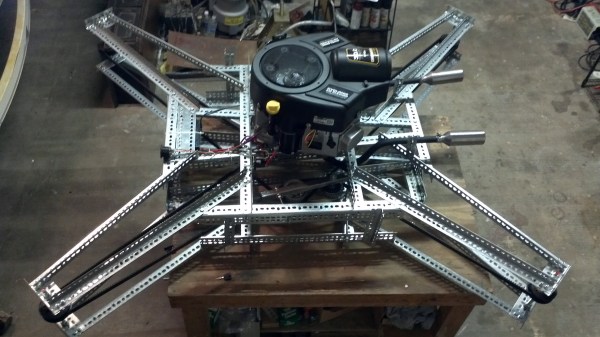
We see quadcopter projects all the time here on Hackaday, so it takes something special to get our attention. [Peter McCloud] has done just that with Goliath, a gas powered quadcopter he’s entered in The Hackaday Prize. By gas, we don’t mean a little glow fuel buzzer, We’re talking about a 30 horsepower V-twin lawnmower engine running good old-fashioned gasoline.

Multicopters powered by a single power source present a unique set of problems. Quadcopter propellers need to rotate in opposite directions to avoid the entire craft spinning due to torque action. With individual electric motors that’s as easy as swapping a couple of wires. Not so with a single rotating engine. [Peter] has accomplished this feat with a clever arrangement of single and double-sided belts.

Control is another issue. Generally, central powered multicopters use collective pitch, similar to a helicopter control system. [Peter] has decided to go with high-efficiency fixed pitch blades and a vane system for directional control. Much like hovercraft use vanes to steer, Goliath will use vanes to affect its attitude and yaw.

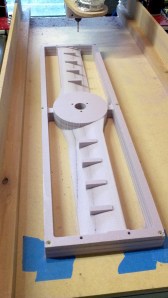
goliathPropThe propellers are works of art in their own right. [Peter] modeled the propellers in CAD using the principles of blade element theory, then used a Shopbot style CNC to carve them out of pink insulation foam. Styrofoam alone won’t withstand the 60 lbs each propeller will be supporting, so [Peter] plans to laminate the props in composite cloth. This is the similar to the way many full-scale helicopter rotor blades are assembled.

Goliath’s frame is constructed of Dexion style slotted steel angles, and we have to admit, at 240 lbs with engine, it seems like it’s going to be a heavy beast. Big enough to ride at least. Who knows… if the judges like it [Peter] may ride Goliath all the way to space!


SpaceWrencherThe project featured in this post is an entry in The Hackaday Prize. Build something awesome and win a trip to space or hundreds of other prizes.
THP Hacker Bio: Infinityis

thp-contestant-bio-infinityis

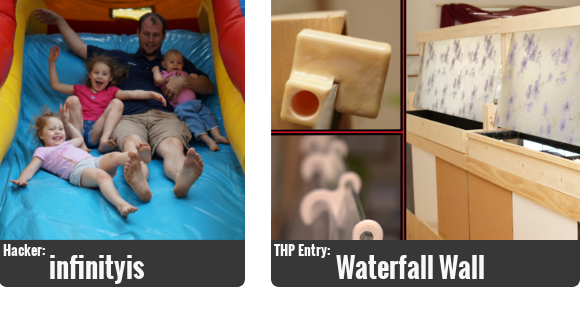
That profile picture is full of pure joy! Meet [infinityis], aka [David Hoelscher] — don’t worry, we’re not revealing his secret identity; he posted his real name on his profile page.

His entry for The Hackaday Prize is a functional show piece to greet guests when they step into his home. His Waterfall Wall will serve as a way to separate the living space from the entryway. The top portion of it is a water feature which will be edge-lit with LEDs whose color will be controlled wirelessly. The bottom part of the wall will provide some storage space.

Join us after the break to find out more about [David], and check out his THP video for a brief introduction to his Waterfall Wall.

Continue reading “THP Hacker Bio: Infinityis”

Banner for community voting

Astronaut Or Not! Your Vote Matters.

You know that little contest we’re running? The one that sends a grand prize winner into SPACE!

We’re happy to announce that community voting for The Hackaday Prize starts today. It’s an interface that we’ve been calling Astronaut or Not! We have hundreds of prizes to give away and this is your chance to decide who some of them go to.

Best Project Concept

This week we’re voting on the best project concept. Don’t vote on projects based on how much work they have done or how many pictures there are, pick the ones that have the potential to be the the best project. We’ll be sending shirts to the top 10 projects voted on over the next few days.

We don’t want this to be purely a popularity contest, so we’re shaking things up a bit. Instead of voting for a particular project we’re pairing the entries in random head-to-head match-ups, with Hackaday readers deciding the ultimate ranking. Check out the contenders, learn a bit about each project, then choose the one you think is more worthy of The Hackaday Prize.

Submit your entry now to be included!

Astronaut or Not isn’t going to decide the top prizes, all entries will still be reviewed by our various judging panels. We are planning to give away different prizes with each round of voting. So make sure you post your entry right away to get in on these giveaways!

THP Entry: Etch-A-CNC

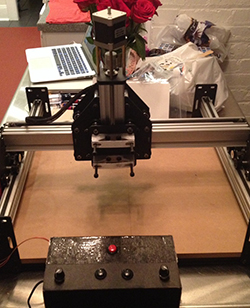
etchacncCNC machines have been around for decades, but only recently have small desktop routers, 3D printers, and laser cutters brought G code to the tabletop. Obviously, this is a teaching opportunity, and if you’re trying to get kids interested in the inner workings of machines that build things, you can’t begin with obtuse codes understood only by machines and CNC operators.

[johnyang] is building his own CNC controller based on something just about every kid is already familiar with: the Etch A Sketch. He’s retrofitted a small, travel size Etch A Sketch with an LCD, buttons, rotary encoders, and a Raspberry Pi to turn this primitive drawing toy into a machine that generates G code for a Shapeoko 2 CNC mill.

The user interface for this CNC controller is as similar to the Etch A Sketch as [johnyang] can make it – two rotary encoders draw a shape on the LCD, and G code is generated from the drawn shape. Adding a third dimension is a bit of a challenge – it looks like two buttons take care of the up and down movement of the spindle. Still, [johnyang] plans to add the definitive Etch A Sketch feature – holding it upside down and shaking it will reset the CNC to its original state.

There are a few videos of [johnyang]’s progress. You can check those out below.


SpaceWrencherThe project featured in this post is an entry in The Hackaday Prize. Build something awesome and win a trip to space or hundreds of other prizes.
Continue reading “THP Entry: Etch-A-CNC”

Judge Spotlight: Sprite_TM

Sprite_TM

His friends call him [Jeroen], but everyone else on the Internet knows this god of hacks and mods as [Sprite_TM]. He’s done everything from hacking hard drive controllers to making the best computer ever made even better. As one of the preeminent hardware hackers around, we’re proud to have [Sprite] as a judge in The Hackaday Prize, and happy to interview him on his thoughts on connected devices, the cloud-based Internet of Things, and his process of opening up black box devices for some sometimes subtle modifications.


judge-spotlight-q5You’re well known for your highly technical electronic hacks on your
blog SpritesMods. What about the professional side of your life, what kind
of projects keep you busy there?

judge-spotlight-a5I’m a software developer for a big broadcasting equipment manufacturer. Every now and then a hardware project comes along and I try to grab those too.

Continue reading “Judge Spotlight: Sprite_TM”

THP Entry: Digital Gauges For Everything Automotive

DDAQ

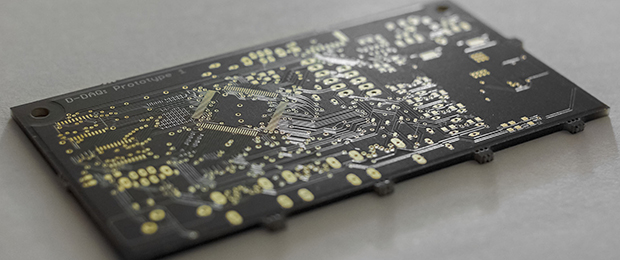
Way back in 2007, someone on a VW TDI forum came up with a new boost gauge project. At the time, it was a remarkable feat of engineering, capable of displaying the manifold pressure on a tiny OLED on the dashboard. No project has yet reached this caliber since. [Digital Corpus] is revisiting the project, making it his own, adding a few upgrades, and entering it into the Hackaday Prize.

The D-DAQ, as [Digital] calls his new project is using an absolute pressure sensor, unlike its predecessor. This gives the turbo gauge a much larger range than the original project, and also allows the D-DAQ to measure partial vacuum in non-diesel turbos.

In addition, the D-DAQ has a much wider scope than the original project, and as such will function as much more than a simple boost gauge. [Digital] sees the D-DAQ as being a complete performance monitor and logger, capable of tracking the exhaust gas temperature, battery voltage, and just about anything else with 10 analog pins. Data will be saved to a MicroSD card, and instead of a single display, the D-DAQ will feature three 160×128 OLEDs.

It’s certainly not what you’d expect from a Hackaday Prize entry, but with these features, it’s very possible the D-DAQ could be a successful product


SpaceWrencherThe project featured in this post is an entry in The Hackaday Prize. Build something awesome and win a trip to space or hundreds of other prizes.