Custom Aluminum Wheels Teach A Thing Or Two About Casting

For some mobile projects like small carts or rolling cabinets, your standard casters from Harbor Freight will do just fine. But some projects need big, beefy wheels, and these custom cast aluminum wheels certainly make a statement. Mostly, “Watch your toes!”

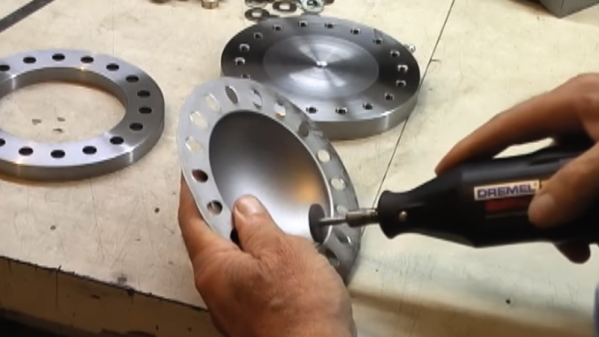
To be honest, [Brian Oltrogge]’s wheels are an accessory in search of a project, and won’t be crushing feet anytime soon. He made them just to make them, but we have no beef with that. They’ve got a great look that hearkens back to a time when heavy metal meant something else entirely, and things were made to last. Of course, being cast from aluminum sort of works against that, but there are practical limits to what can be done in the home foundry. [Brian] started with a session of CAD witchcraft followed by machining the cores for his molds. Rather than doing this as lost foam or PLA, he milled the cores from poplar wood. His sand mix is a cut above what we usually see in home-brew sand casting — sodium silicate sand that can be cured with carbon dioxide. All his careful preparation meant the pour went off without a hitch, and the wheels look great.

We’ve featured quite a few metal casting projects recently, some that went well and some that didn’t. [Brian] looks like he knows what he’s doing, and we appreciate the workmanship that he puts on display here.

Continue reading “Custom Aluminum Wheels Teach A Thing Or Two About Casting”

Something To Think About While You’re Mowing The Lawn

Well here we are, we’ve reached that time of year again at which our yearly ritual of resuscitating small internal combustion engines from their winter-induced morbidity is well under way. It’s lawn mowing season again, and a lot of us are spending our Saturday afternoons going up and down our little patches of grass courtesy of messers Briggs and Stratton. Where this is being written, the trusty Honda mower’s deck has unexpectedly failed, so an agricultural field topper is performing stand-in duty for a while, and leaving us with more of the rough shag pile of a steeplechaser’s course than the smooth velvet of a cricket ground. Tea on the lawn will be a mite springier this year.

When you think about it, there’s something ever so slightly odd about going to such effort over a patch of grass. Why do we do it? Because we like it? Because everyone else has one? Or simply because it’s less effort to fill the space with grass than it is to put something else there? It’s as if our little pockets of grassland have become one of those facets of our consumer culture that we never really think about, we just do. Continue reading “Something To Think About While You’re Mowing The Lawn”

Arduino Does Hard Science

We don’t know why [stoppi71] needs to do gamma spectroscopy. We only know that he has made one, including a high-voltage power supply, a photomultiplier tube, and–what else–an Arduino. You also need a scintillation crystal to convert the gamma rays to visible light for the tube to pick up.

He started out using an open source multichannel analyzer (MCA) called Theremino. This connects through a sound card and runs on a PC. However, he wanted to roll his own and did so with some simple circuitry and an Arduino.

Continue reading “Arduino Does Hard Science”

Dual-Purpose DIY Spot Welder Built With Safety In Mind

Ho-hum, another microwave oven transformer spot welder, right? Nope, not this one — [Kerry Wong]’s entry in the MOT spot welder arms race was built with safety in mind and has value-added features.

As [Kerry] points out, most MOT spot welder builds use a momentary switch of some sort to power the primary side of the transformer. Given that this means putting mains voltage dangerously close to your finger, [Kerry] chose to distance himself from the angry pixies and switch the primary with a triac. Not only that, he optically coupled the triac’s trigger to a small one-shot timer built around the venerable 555 chip. Pulse duration control results in the ability to weld different materials of varied thickness rather than burning out thin stock and getting weak welds on the thicker stuff. And a nice addition is a separate probe designed specifically for battery tab welding — bring on the 18650s.

Kudos to [Kerry] for building in some safety, but he may want to think about taking off or covering up that ring when working around high current sources. If you’re not quite so safety minded, this spot welder may or may not kill you.

Continue reading “Dual-Purpose DIY Spot Welder Built With Safety In Mind”

An Hour To Surface Mount

Most of us have made the transition from through hole parts to surface mount. There are lots of scattered tutorials, but if you want to learn some techniques or compare your technique to someone else’s, you might enjoy [Moto Geek’s] hour-long video on how he does surface mount with reflow soldering. You can see the video below.

What makes the video interesting is that it is an hour long and covers the gamut from where to get cheap PCBs, to a homebrew pick and place pencil. [Moto Geek] uses a stencil with solder paste, and he provides links to the materials he uses. Continue reading “An Hour To Surface Mount”

Another Helping Hands Build

[Punamenon2] wanted a soldering station with integrated helping hands. He couldn’t find one, but he decided it would be a good 3D printed project. In all fairness, this is really 3D printing integrating several off-the-shelf components including a magnifier, a soldering iron holder, a soldering iron cleaner, a couple of “octopus” tripods, and some alligator clips. Total cost? Less than $30.

In addition to holding the Frankenstein monster together, the 3D printed structure also provides a storage tray with special sloped edges to make removing small screws easier.

Continue reading “Another Helping Hands Build”

Adding A Riving Knife For Table Saw Safety

What in the world is a riving knife? Just the one thing that might save you from a very bad day in the shop. But if your table saw doesn’t come with one, fret not — with a little wherewithal you can add a riving knife to almost any table saw.

For those who have never experienced kickback on a table saw, we can assure you that at a minimum it will set your heart pounding. At the worst, it will suck your hand into the spinning blade and send your fingers flying, or perhaps embed a piece of wood in your chest or forehead. Riving knives mitigate such catastrophes by preventing the stock from touching the blade as it rotates up out of the table. Contractor table saws like [Craft Andu]’s little Makita are often stripped of such niceties, so he set about adding one. The essential features of a proper riving knife are being the same width as the blade, wrapping closely around it, raising and lowering with the blade, and not extending past the top of the blade. [Craft Andu] hit all those points with his DIY knife, and the result is extra safety with no inconvenience.

It only takes a few milliseconds to suffer a life-altering injury, so be safe out there. Even if you’re building your own table saw, you owe it to yourself.

Continue reading “Adding A Riving Knife For Table Saw Safety”