Bandsaw Tension Gauge Uses Raspberry Pi And Load Cell

No matter what material you’re cutting, getting the blade tension right is one of the keys to quality cuts on the bandsaw. Unfortunately, most bandsaws come with only a rudimentary tension gauge, and while there are plenty of tricks for measuring blade tension indirectly, nothing beats a digital blade tension gauge for repeatable results.

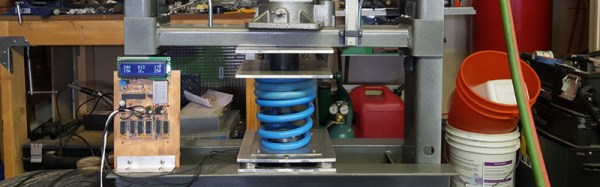
Despite being an aftermarket accessory for his beefy Hitachi CB-75F bandsaw, [Stephen B. Kirby]’s Pi-based tension guide looks like an OEM product. Housed in a sturdy case and sporting a sealed membrane keypad and four-line LCD display, the interface electronics are pretty straightforward. The tricky bit is sensing the amount of tension on the bandsaw blade. For that task, [Stephen] mounted a load cell in place of the original tensioning spring. A few adapters helped that job, and with a little calibration, the gauge is capable of displaying the tension by measuring the force over the cross-sectional area of the current blade.

We really like it when electronics can bring a new level of precision to old-school hardware, whether it’s a simple DRO for a manual lathe or a more accomplished build like [Stephen]’s. Sometimes adding new silicon can make old iron a little easier to use.

How To Sharpen Your Woodworking Tools On A Budget

Wood may seem like a soft, weak material if you’re used to working with steel, but to do good work, you’ll quickly learn you need your tools sharp. Buying and maintaining a good set of tools can be expensive for the home gamer, so [shopbuilt] put together an Instructable on how to sharpen your woodworking tools on a budget.

The trick is to use sandpaper. It’s a good quality abrasive material and is readily available. You’ll want a selection of different grits – low grits to get started, higher grits when finishing. The reason this is cheaper is that you can get a selection of 5-10 different sandpapers for under $20. Getting even a couple of decent sharpening stones wouldn’t be possible at that price. In the long run, they’ll last longer but this is a budget option we’re talking about.

Obviously you can’t just sharpen something with sandpaper – [shopbuilt] suggests mounting the paper to the flattest surface you can find. The use of a tempered glass panel from a fridge shelf is, in our mind, an inspired choice here. 3D printer enthusiasts have been using similar techniques for heated beds for the best part of a decade now.

We love woodworking here at Hackaday, so get your feet wet with these woodworking basics for the hardware hacker.

Milliohm Meter Version 1.5

A milliohm meter is a very handy piece of test equipment. Most hand-held multimeters cannot measure low resistances and bench meters that can, are usually quite expensive. [barbouri] has shared details of his milliohm meter build on his blog post, and it looks pretty nice.

When using a single pair of leads to measure very low ohms, the resistance of the measuring wires and voltage drops across the various joints become substantial enough to invalidate your measurement. The solution is to use the “Kelvin method” or 4-wire measurement. This involves passing a highly stable current derived from a temperature compensated constant-current source through the unknown resistance, and then using another pair of leads to measure the voltage drop across the resistor, which then gets displayed as a resistance on a voltmeter.

The finished project not only looks good, but is able to measure up to 2Ω with a resolution of 0.0001Ω (that’s 0.1mΩ). The project is originally designed by [Louis] from [Scullcom Hobby Electronics] and [barbouri]’s second iteration adds an improved board layout to the original project.

Continue reading “Milliohm Meter Version 1.5”

3D Printer Transforms To CNC

Superficially, it is easy to think about converting a 3D printer into a CNC machine. After all, they both do essentially the same thing. They move a tool around in three dimensions. Reducing this to practice, however, is a problem. A CNC tool probably weighs more than a typical hotend. In addition, cutting into solid material generates a lot of torque.

[Thomas Sanladerer] knew all this, but wanted to try a conversion anyway. He had a few printers to pick from, and he chose a very sturdy MendelMax 3. He wasn’t sure he’d wind up with a practical machine, but he wanted to do it for the educational value, at least. The result, as you can see in the video below, exceeded his expectations.

Continue reading “3D Printer Transforms To CNC”

New Lathe Day Is Best Day

As [Quinn Dunki] rightly points out, modern industrial civilization was probably conceived on the bed of a lathe. Turning is an essential step in building every machine tool, including lathes, and [Quinn] decided it was time to invite one into her shop. But she discovered a dearth of information to guide the lathe newbie through that first purchase, and thus was born the first installment in her series on choosing and using a new lathe.

As for the specifics of the purchase, [Quinn]’s article goes into some depth on the “old US iron” versus “new Asian manufacture” conundrum. Most of us would love an old South Bend or Cincinnati lathe, but it may raise practical questions about space planning, electrical requirements, and how much work is needed to get the old timer working again. In the end, [Quinn] took the path of least resistance and ordered a new lathe of Chinese heritage. She goes into some detail as to what led to that decision, which should help other first-timers too, and provides a complete account of everything from uncrating to first chips.

Nothing beats the advice of a grizzled vet, but there’s a lot to be learned from someone who’s only a few steps ahead of her intended audience. And once she’s got the lathe squared away, we trust she’ll find our tips for buying a mill helpful getting that next big shipment delivered.

“All the best things in life arrive on a pallet.” Have truer words ever been spoken? Sure, when the UPS truck pulls up with your latest Amazon or eBay treasure, it can be exciting. But a lift-gate truck rolling up to the curb? That’s a good day.

Programming Thousands Of AVRs

It is funny how almost everything has its own set of problems. Rich people complain about taxes. Famous people complain about their lack of privacy. It probably won’t happen us, but some Kickstarter campaigners find they are too successful and have to scale up production, fast. We’d love to have any of those problems.

[Limpkin] found himself in just that situation. He had to program several thousand Atmel chips. It is true that you can get them programmed by major distributors, but in this case, he wanted unique serial numbers, cryptographic keys, and other per-chip data programmed in. So he decided to build his own mass programming workbench.

Continue reading “Programming Thousands Of AVRs”

Cordless Drill Uses No Electricity

There are few projects on how to make your own cordless drill, but what sets [Johnnyq90’s] amazing project apart is the fact that his power plant is a nitro engine. Not an easy task of course, but he makes it look easier than it is, and we really enjoyed the construction process.

He uses an RC Kyosho GX12 engine that was previously modified, changing the cooling head with a larger one. The engine drives a gearbox that was taken from another drill. All other parts were hand made. The clutch was carefully machined, and the cooling fan was made in a 3D printer. Other necessary parts were the frame, brass spacers to adjust the engine height and alignment, throttle arm and handle. In the end even the gearbox had to be modified for higher speed. The finished drill sure looks and sounds terrific, and seems to be perfectly capable of doing its job.

As with other mechanical projects from [Johnnyq90], the video has good timing and attention to detail. His channel is definitely worth a visit, specially if you like turbines.