Superprobe

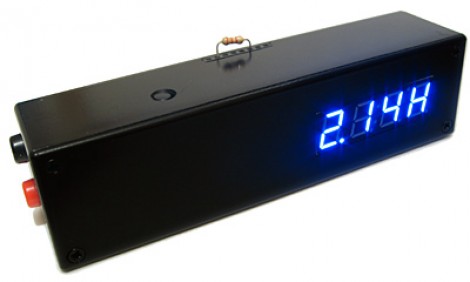
The Superprobe is a logic analyzer, multimeter, and much more rolled into a fun to build project. [Ben Ryves] didn’t come up with the original idea, but he definitely took a good thing and made it better. You can use it to test logic, inject logic into a circuit, read capacitors and resistors, test frequency, read the device address from 1-wire devices, and more. Interchangeable probes, choice of internal or external power, simple two-button operation, and a powerful PIC microcontroller at the heart of it all make this a fantastic tool for your electronics workbench. Check out the quality video after the break that  [Ben] put together to show off the results of his tinkering.
Continue reading “Superprobe”

USBasp: AVR Programmer Based On ATmega8

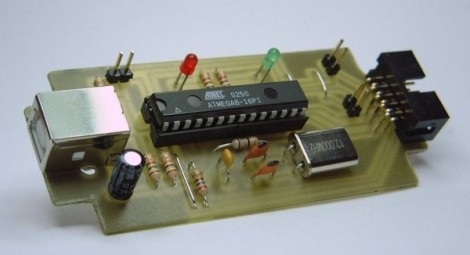
We love our AVR Dragon programmer but it can be nice to have a cheap and simple in system programmer on hand too. The USBasp is one such programmer that uses and ATmega8 as its only IC. It requires just a handful of components and can be purchased as a kit, or etched and assembled at home. If you source your own parts the chip does need to be programmed which makes for a chicken-or-egg scenario. We’ve used the Parallel-port dongle (schematic) from Adafruit’s Spoke POV before. It’s basically just a DAPA cable and a few resistors, a ribbon cable (use and old IDE cable if you have to) and a parallel port connector can have you up and running in no time. This is also a great way to get a friend into working with embedded systems. Order parts for a few of these and give them away to your buddies.

Brighten Up Your PCB Drilling Station

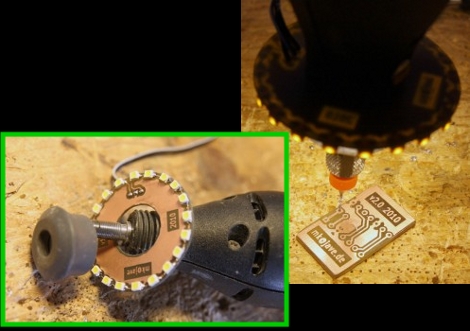
Being able to see what you’re doing can be the hardest part of drilling the through holes in those freshly etched printed circuit boards. We don’t know why we didn’t come up with this, but [Markus Gebhard] solved his shadowy woes with his 20-LED Dremel light ring. Honestly, how many times have we seen lights rings in photography without putting it together that a light ring is perfect for this purpose. So kudos to [Markus], now we’ve got to go and dig up some surface mount LEDs and uncork the copper chloride.

Power Drill Solder Spooler

[youtube=http://www.youtube.com/watch?v=cF4cw41SMvY]

[Scott] over at curiousinventor.com has posted an instructable detailing how to use an Arduino and a power drill to spool solder. The Arduino senses the speed that the drill is going via an opto interrupter and a laser and adjusts with a servo hooked to the trigger. While we don’t think many people will be dying to spool some solder, this system might be useful for all kinds of things, like winding yarn or making coils.

Solder Station Hack Adds Temperature Control

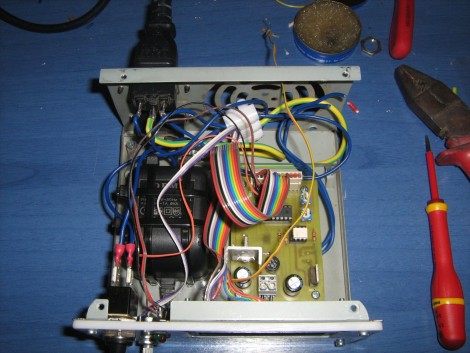
Take that cheap fire stick you call a soldering iron and turn it into a real tool. [Giorgos Lazaridis] turned his 30 watt soldering iron into a temperature controlled soldering station by adding a thermistor just above the tip to monitor how hot things are getting. A MAX6675 takes care of the thermocouple and shoots a digital temperature value off to the PIC 16F88 which controls the unit by taking user input from a potentiometer and displaying the settings on an HD44780 character display. His use of a dissected ‘wall wort’ inside of the ATX power supply carcass used as the case for the station is a clever hack. See it melt some metal in the clip after the break.

This makes a nice upgrade to our solder station guide, which had a temperature controlled iron but lacked the sensor and automation seen here. Continue reading “Solder Station Hack Adds Temperature Control”

Magically Repair AVR Chips

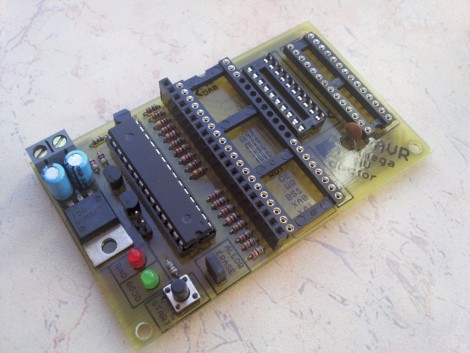
If you’ve ever spent time working with AVR microcontrollers you’ve probably set the fuse bits incorrectly at least once. The ATmega fusebit doctor will automatically repair the fuse bits and get you back in business until your next mishap. The ATmega8 that powers the device has the chip signatures for the ATmega family stored inside so it will automatically detect which chip you’re trying to ‘unbrick’. From there it looks up the correct fuse bits and resurrects the sick microcontroller. This is useful in recovering a chip that has serial programming disabled, used the reset pin as I/O, or just enabled an external clock without the necessary hardware to deliver on that feature.

This magic is taken care of by using High Voltage Parallel Programming. We’ve seen HVPP used in the Arduino rescue shield and it is a valuable feature of the AVR Dragon, our favorite AVR programmer, as well as others. Still, you can hardly beat the ease of plugging a dead chip into this board and pressing one button. Oh, did you brick a member of the ATtiny family? There’s a rescue board for those too.

[Thanks Stewe]

Ghetto Repairs: Desoldering With A Candle

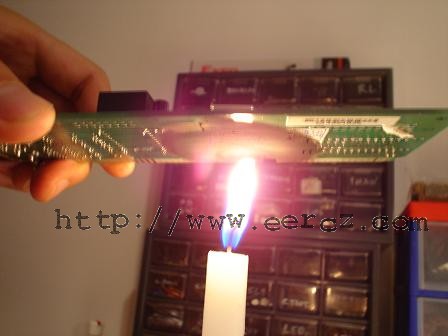
Yes, that picture you are seeing is serious. [Roland] needed a chip for a damaged piece of electronics. He was lucky enough to find one on an old board at a local shop. The problem was, he didn’t have the hot air gun to remove the chip the correct way. Instead, he simply cooked the board over a candle to melt the solder. Interestingly, after he cleaned the candle-cooked board, it looked like it survived without damage. The chip worked fine and fixed his problems. Sometimes, we just don’t have the right tools for the job.

[via HackedGadgets]