Control Everything In Your Car With The Car Kracker

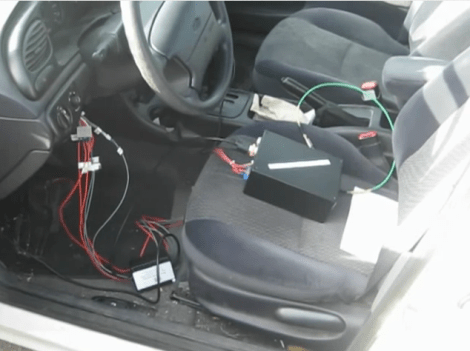
If your whip is a Honda, Toyota, BMW, Chrysler, VW, or Mini made in the last decade or so, the Car Kracker is for you. This project allows you to connect directly to your car’s computer system, allowing you to display messages on your stereo, play music off an SD card, and even override factory settings like always-on daytime running lights.

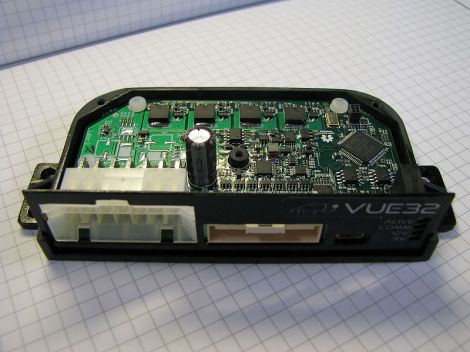
The Car Kracker uses ISO 9141, an in-car communications protocol that is now mostly used in foreign (for the US) cars. The build uses a Gadget Gangster Propeller board to connect to the CD changer port and OBD-2 port in the trunk, and the diagnostic port located under the hood.

With the Car Kracker, it’s easy to connect the Aux In on your stereo to an SD card loaded with music, or even plug in an iPod for the poor souls without a 1/8″ jack. Dealer customizations such as turning the ‘door is ajar’ noise off, toggling daytime running lights, and throwing a nav warning up are also possible.

Check out the two videos after the break, and if anyone has any more info on getting this deep into a car’s computer system (a wiki, maybe?), send a link in on the tip line.

Continue reading “Control Everything In Your Car With The Car Kracker”

Mechanical Relay Logic That Was Snubbed For A Microcontroller

[Alex] was tasked with a control design problem for a set of motors. The application called for the back of a truck to open up, some 3D scanning equipment to rise from its enclosure, and finally the equipment needed to rotate into place. All of this needed to happen with one flip of a switch, then proceed in reverse when the switch was turned off. We can understand why the final design used a microcontroller, but we also think that [Alex’s] relay logic circuit is an eloquent way of doing things.

He uses limiting switches as the feedback loop for the logic. In the video after the break he walks us through the schematic. Each of the three motors has an up and down limiting switch. These control the three relays which switch power to the motors. We like the design because interrupting the movement mid-operation provides no problem for the system. The only real issue we see is that relays wear out, and the automotive application of the hardware may cause this to happen more quickly than normal.

You may recognize the clear gears used in the demo. [Alex] previously showed us how he makes those.

Continue reading “Mechanical Relay Logic That Was Snubbed For A Microcontroller”

Girl Decides To Restore A Car In Time For Her 16th Birthday

When, born hacker, [Kathryn] was 12, she approached her parents with an interesting proposition; she wanted to restore a Pontiac Fiero before her 16th birthday. So, using her babysitting money, parental guidance, and an enviable attitude, she has set out to do just that. The build log linked above is  incomplete as she has not yet reached 16, but is a very good read. Lots of build logs gloss over some of the more basic steps because they’ve done this a time or two. It’s fun to learn along with [Kathryn] as she and her dad work all the way from upholstery and painting to grinding and welding wheel wells.  It seems this project has acquired quite a fan base over the past few months, us included, and even a 3M sponsorship. We look forward to seeing what [Kathryn] does next. It looks like some engine work, along with a lot more welding.

Didn’t [Jeri Ellsworth] have a history of building cars too?

Bamboo Bike

Reddit user [tkgarrett101] recently did away with expensive exotic materials for his bike frame and opted for a somewhat less processed form of natural building material, bamboo! The bike consists of a regular metal bike frame with a majority of the structural beams cut and replaced with bamboo poles. The bamboo is fit snug first with some expanding gorilla glue then tied in place with  hemp string and fiberglass resin. Instead of running cables along the frame the bike has coaster breaks brakes and a two speed hub, this also preserves the simplistic look of the whole ensemble. [tkgarrett101] says his bike is not so cheap, the overall parts cost was around 800 bucks (USD)! Plus it weighs a whole lot for a fixed gear. Plus the alignment is a bit off on the seat post. Either way this thing would surely turn some heads!

Too rich for your blood? Check out this cardboard bike, or if that green isn’t bright enough for you how about some glowbars for night visibility.

via Reddit

Bike Made From Cardboard Is Too Cheap To Steal

If you’ve ever had to replace a bicycle, [Izhar Gafni] is your man. He created a bicycle made completely out of cardboard that is strong enough to support the largest riders and costs about the same as combo meal at McDonald’s.

[Izhar]’s bikes are made from varying thicknesses of cardboard, the thickest sheet being about an inch wide. After cutting and gluing these pieces of cardboard together, [Izhar] submerges them in resin and brushes on a little paint creating an incredibly strong, very light, and unbelievably inexpensive bike.

[Izhar] says the cost of production is about $10 per bike and estimates it could be sold for $60 to $90, cheaper than even the most inexpensive metal bike. If you’ve ever had a bike stolen, you know the sting of having to replace your main means of transportation. [Izhar] says his bike is so cheap thieves wouldn’t even bother taking it off your hands.

You can check out the awesome video of [Izhar] making a cardboard bike after the break.

Continue reading “Bike Made From Cardboard Is Too Cheap To Steal”

Adding Bluetooth Audio Playback To A Toyota Matrix

In this project [Ryan] shows how he added Bluetooth audio to the stock stereo of his Toyota Matrix. The work he did with his add-on hardware is quite good. And the installation was surprisingly easy. For example, the dashboard bezel which is hanging in the foreground of this picture simply pulls off without the need for any tools. Also, the CD changer input for the stereo is what he uses to patch into the system. It just happened to have a 0.1″ pin header so finding a connector that would work wasn’t a problem.

As for the add-on hardware, he built his own circuit board around an ATmega168 microcontroller and Bluegiga WT32 Bluetooth module. To connect to the car’s data system he went with an RS485 driver chip. It’s not quite the right part but it works well enough for his purposes. So far he can get audio playback working and plans to add support for hands free phone calls and displaying audio track information. Hey, maybe he’ll even add some extra shake-based automation; who knows?

Get a look at the install in the clip after the break.

Continue reading “Adding Bluetooth Audio Playback To A Toyota Matrix”

Heads Up Controls For Your IPod

[Cmonaco3’s] girlfriend wanted a better way to control her iPod when driving. She didn’t want to take her eyes of the road and asked him if he could help. He ended up building a heads up display which reads out track information and offers a few simple buttons for control.

The display includes controls for track forward, track back, and play/pause. Those buttons, along with the LCD screen, mount on the windshield using a suction cup. This way the driver doesn’t have to completely remove focus from the road to control the iPod which is sitting in the passenger’s seat.

To accomplish this [Cmonaco] used a dock connector breakout board for communication between an Arduino and the iPod. The Arduino pulls song information to be displayed on the graphic LCD screen, and sends commands to the iPod when it detects a button push. See a quick demo of the setup after the break.

Continue reading “Heads Up Controls For Your IPod”