As far as giving mechanical instruments electronic control goes, drums are probably the best candidate for conversion; learning to play them is challenging and loud for a human, but they’re a straightforward matter for a microcontroller. [Jeremy Cook]’s latest project takes this approach by using an Arduino Opta to play a tongue drum.
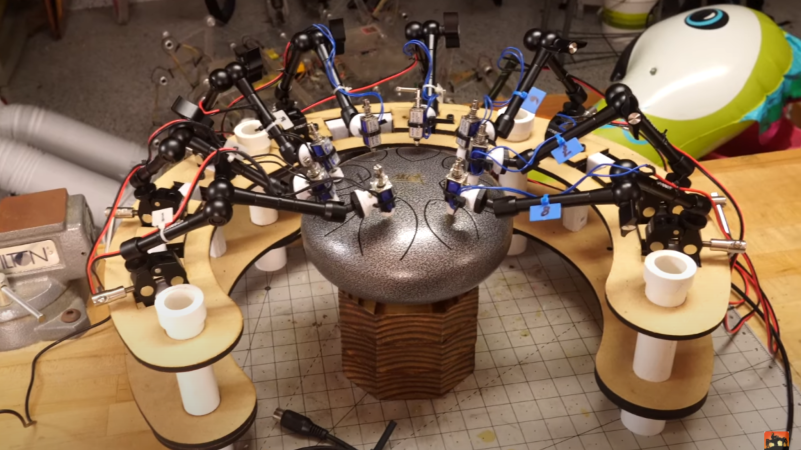
[Jeremy]’s design far the drum controller was inspired by the ring-shaped arrangement of the Cray 2 supercomputer. A laser-cut MDF frame forms a C-shape around the tongue drum, and holds eight camera mount friction arms. Each friction arm holds a solenoid above a different point on the drum head, making it easy to position them. A few supports were 3D-printed, and some sections of PVC tubing form pivots to close the ring frame. [Jeremy] found that the the bare metal tips of the solenoids made a harsh sound against the drum, so he covered the tips of six solenoids with plastic caps, while the other two uncoated tips provide an auditory contrast.
The Arduino Opta is an open-source programmable logic controller normally intended for industrial automation. Here, its silent solid-state relays drive the solenoids, as [Jeremy]’s done before in an earlier experiment. The Opta is programmed to accept MIDI input, which [Jeremy] provided from two of the MIDI controllers which we’ve seen him build previously. He was able to get it working in time for the 2024 Orlando Maker Faire, which was the major time constraint.
Of course, for a project like this you need a MIDI controller, and we’ve previously seen [Jeremy] convert a kalimba into such a controller. We’ve seen this kind of drum machine at least once before, but it’s more common to see a purely electronic implementation.
Meowsic Keyboard MIDI Adapter Aims For Purrfection
Both small children and cats have a certain tendency to make loud noises at inopportune times, but what if there were a way to combine these auditory effects? This seems to have been the reasoning behind the creation of the Meowsic keyboard, a children’s keyboard that renders notes as cats’ meows. [Steve Gilissen], an appreciator of unusual electronic instruments, discovered that while there had been projects that turned the Meowsic keyboard into a MIDI output device, no one had yet added MIDI input to it, which of course spurred the creation of his Meowsic MIDI adapter.
The switches in the keys of the original keyboard form a matrix of rows and columns, so that creating a connection between a particular row and column plays a certain note. [Steve]’s plan was to have a microcontroller read MIDI input, then connect the appropriate row and column to play the desired note. The first step was to use a small length of wire to connect rows and columns, thus manually mapping connections to notes. After this tedious step, he designed a PCB that hosts an Arduino Nano to accept input, two MCP23017 GPIO expanders to give it enough outputs, and CD4066BE CMOS switches to trigger the connections.
Continue reading “Meowsic Keyboard MIDI Adapter Aims For Purrfection”
A Parts Bin MIDI Controller In 24 Hours
Part of the reason MIDI has hung on as a standard in the musical world for so long is that it is incredibly versatile. Sure, standard instruments like pianos and drums can be interfaced with a computer fairly easily using this standard, but essentially anything can be converted to a MIDI instrument with the right wiring and a little bit of coding. [Jeremy] needed to build a MIDI controller in a single day, and with just a few off-the-shelf parts he was able to piece together a musical instrument from his parts bin.
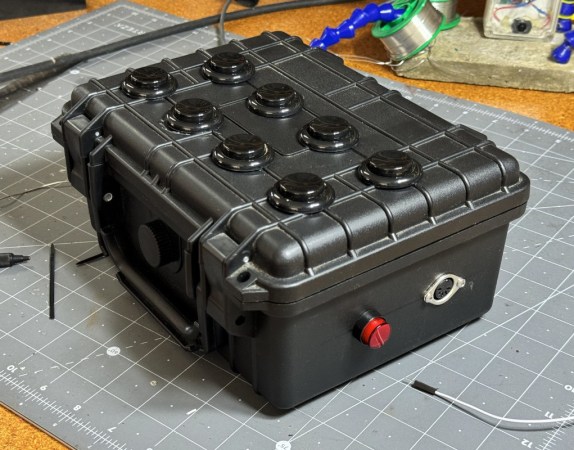
The build is housed in an off-brand protective case from a favorite American discount tool store, but the more unique part of the project is the choice to use arcade buttons as the instrument’s inputs. [Jeremy] tied eight of these buttons to an Arduino Uno to provide a full octave’s worth of notes, and before you jump to the comments to explain that there are 12 notes in an octave, he also added a button to the side of the case to bend any note when pressed simultaneously. An emergency stop button serves as a master on/off switch and a MIDI dongle on the other side serves as the interface point to a computer.
After a slight bit of debugging, the interface is up and running within [Jeremy]’s required 24-hour window. He’s eventually planning to use it to control a custom MIDI-enabled drum kit, but for now it was fun to play around with it in some other ways. He’s also posted the project code on a GitHub page. And, if this looks a bit familiar, this was not [Jeremy]’s first MIDI project. He was also the creator of one of the smallest MIDI interfaces we’ve ever seen.
The Last Instrument To Get Auto-Tuned
Various decades have their musical signature, like the excessive use of synthesizers and hairspray in the 1980s pop music scene. Likewise, the early 2010s was marked by a fairly extreme use of autotune, a technology that allows sounds, especially vocals, to be shifted to precise pitches regardless of the pitch of the original source. In this dark era, a wide swath of instruments and voices on the charts were auto-tuned at some point, although we don’t remember this iconic instrument ever being featured among the annals of pitch-shifted pop music.
The auto-tuned kazoo created by [Guy Dupont] does its pitch corrections on-the-fly thanks to a built-in ESP-32-S3 microcontroller which, through a microphone inside the kazoo, listens for note of the musician’s hum and corrects it to the closest correctly pitched note. Once it identifies the note it outputs a kazoo-like pitch-corrected note from a small speaker, also hidden inside the instrument. It does this fast enough for live performances using the YIN fundamental frequency estimation algorithm. Not only can the kazoo be played directly, but thanks to the implementation of MIDI it can be used to control other synthesizers or be played through other means as a stand-alone synthesizer.
Much like the 80s, where the use of synthesizers relaxed from excessive use on nearly every instrument on every track throughout the decade to a more restrained use as the decade faded, so has autotune been toned down in most music to be more subtly applied. But like our enjoyment of heavily synthesized tunes outside the 80s like those by Daft Punk or The Weeknd, we can also appreciate something heavily auto-tuned outside of the 2010s like a stylized kazoo or a T-Pain-style guitar effects pedal.
MIDI Controller In A Cubic Inch
MIDI as a standard has opened up a huge world to any musician willing to use a computer to generate or enhance their playing and recording. Since the 80s, it has it has revolutionized the way music is produced and performed, allowing for seamless integration of digital instruments, automation of complex sequences, and unprecedented control over everything from production to editing. It has also resulted in a number of musical instruments that probably wouldn’t be possible without electronic help, like this MIDI instrument which might be the world’s smallest.
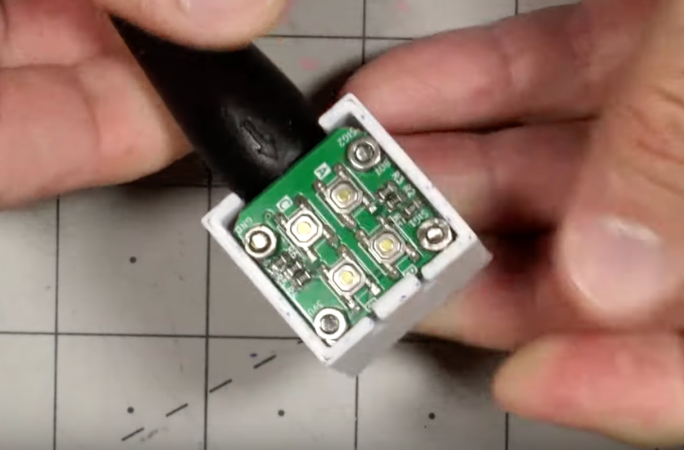
Fitting into a cubic inch of space, the tiny instrument’s volume is mostly taken up by the MIDI connector itself which was perhaps an acceptable size by 1980s standards but seems rather bulky today. A two-layer PCB split into three sections sandwiches the connector in place and boasts an ATtiny85 microcontroller and all the associated electronics needed to implement MIDI. Small threaded screws hold the platform together and provide each layer with a common ground. Four small pushbuttons at the top of the device act as the instrument’s keys.
The project’s creator (and Hackaday alum!) [Jeremy Cook] has it set up to play notes from a piano right now, but has also made the source code available so that any musical action can be programmed onto these buttons. Flexibility is perhaps MIDI’s greatest strength and why the standard has lasted for decades now, as it makes it fairly straightforward to build more comprehensive, easy-to-learn musical instruments or even musical instruments out of retro video game systems.
2024 Business Card Challenge: Tiny MIDI Keyboard
The progress for electronics over the past seven decades or so has always trended towards smaller or more dense components. Moore’s Law is the famous example of this, but even when we’re not talking about transistors specifically, technology tends to get either more power efficient or smaller. This MIDI keyboard, for example, is small enough that it will fit in the space of a standard business card which would have been an impossibility with the technology available when MIDI first became standardized, and as such is the latest entry in our Business Card Challenge.
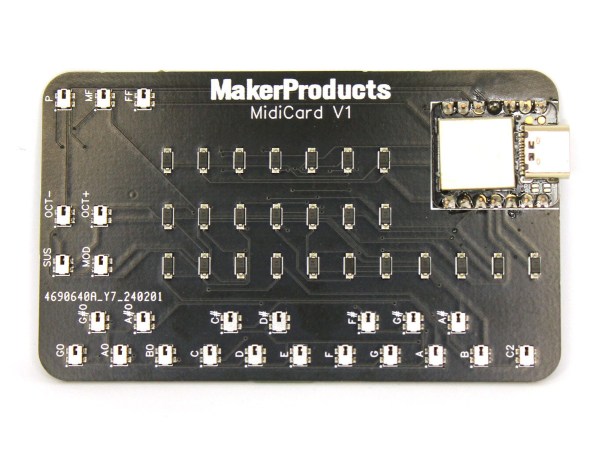
[Alana] originally built this tiny musical instrument to always have a keyboard available on the go, and the amount of features packed into this tiny board definitely fits that design goal. It has 18 keys with additional buttons to change the octave and volume, and has additional support for sustain and modulation as well. The buttons and diodes are multiplexed in order to fit the IO for the microcontroller, a Seeed Studio Xiao SAMD21, and it also meets the USB-C standards so it will work with essentially any modern computer available including most smartphones and tablets so [Alana] can easily interface it with Finale, a popular music notation software.
Additionally, the project’s GitHub page has much more detail including all of the Arduino code needed to build a MIDI controller like this one. This particular project has perhaps the best size-to-usefulness ratio we’ve seen for compact MIDI controllers thanks to the USB-C and extremely small components used on the PCB, although the Starshine controller or these high-resolution controllers are also worth investigating if you’re in the market for compact MIDI devices like this one.
Continue reading “2024 Business Card Challenge: Tiny MIDI Keyboard”
This MIDI BoomBox Takes Floppies
You might have had a boombox back in the 1990s, but probably not like the Yamaha MDP-10. As [Nicole] explains, the odd little device played MIDI files from a floppy disk. Technically, it wasn’t truly a boombox because it lacked batteries, but it sure looks like one.
The box also had a MIDI input jack, but no output. For an antique gadget, it is pretty impressive, but maybe not much by today’s standards. Of course, what we really wanted to see was what was inside. [Nicole] doesn’t disappoint.
The boombox brains are a pair of Hitachi H8 3000-series CPUs. The boards actually looks surprisingly modern until you notice the lack of integration. There are separate ROMs, RAMs, a floppy drive controller, and, of course, MIDI chips. Apparently, opening the box up is a challenge so [Nicole] suggests not doing it unless necessary. We assume it went back together with no problems.
There are lots of tidbits about peculiarities in the device. There are also, of course, recordings of the output and some comparisons from other devices. A great look into an old and odd piece of gear.
Since it has an input jack, you could connect it to — oh, we don’t know — maybe some spoons? Or a hurdy-gurdy.