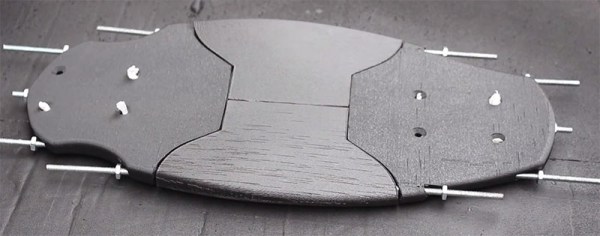
[Julian] has been wanting a tiny little skateboard for a while now, and decided to make something useful on his 3D printer. A little more than twenty hours later a tiny and cute printed skateboard popped out.
[Julian] got the files for his 3D printed skateboard from Thingiverse and printed them off on a MakerGear M2. The parts printed easily, each part taking about six hours to print. The parts are bolted together with five threaded rods, the trucks were screwed on, and the wheels popped into place.
While a normal skateboard probably wouldn’t stand up to the 3D printed parts and threaded rod construction, this Pennyboard is tiny, and most of [Julian]’s weight is right over the trucks at all times. This is also not a board that’s going to see a lot of tricks; it’s basically a micro longboard for moving from one place to another, not something you’ll need to find an abandoned in-ground pool to use properly.
There’s just something about the holidays and man’s best friend that brings out the best in people. [Tara Anderson], Director of CJP Product Management at 3D Systems, fostered a husky mix named Derby. Derby was born with a congenital defect: his forelegs were underdeveloped with no paws. This precluded the poor fellow from running around and doing all of the things dogs love to do. [Tara] had fitted him with a wheel cart, but she still felt that Derby deserved more mobility and freedom. Deciding that 3D-printed prosthetics was the answer, she turned to her colleagues and collaborated with Derrick Campana, a certified Animal Orthotist, to create a new set of forelegs for Derby.
The design is different from typical leg prosthetics; Tara felt that the typical “running man” design would not work for a dog, since they’d just sink right into the ground. Instead, the “loop” design was used, allowing for more playful canine antics. They were constructed using MultiJet Printing on the 3DS’ ProJet 5500X. MultiJet Printing enabled the prosthetics to be printed with firm and soft parts, both needed for comfort and durability.
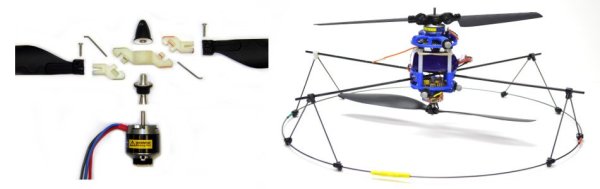
Personal UAV’s are becoming ubiquitous these days, but there is still much room for improvement. Researchers at [Modlab] understand this, and they’ve come up with a very unique method of controlling pitch, yaw, and roll for a coaxial ‘copter using only the two drive motors.
In order to control all of these variables with only two motors, you generally need a mechanism that adjusts the pitch of the propeller blades. Usually this is done by mounting a couple of tiny servos to the ‘copter. The servos are hooked up to the propellers with mechanical linkages so the pitch of the propellers can be adjusted on the fly. This works fine but it’s costly, complicated, and adds weight to the vehicle.
[Modlab’s] system does away with the linkages and extra servos. They are able to control the pitch of their propellers using just the two drive motors. The propellers are connected to the motors using a custom 3D printed rotor hub. This hub is specifically designed to couple blade lead-and-lag oscillations to a change in blade pitch. Rather than drive the motors with a constant amount of torque, [Modlab] adds a sinusoidal component in phase with the current speed of the motor. This allows the system to adjust the pitch of the blades multiple times per rotation, even at these high speeds.
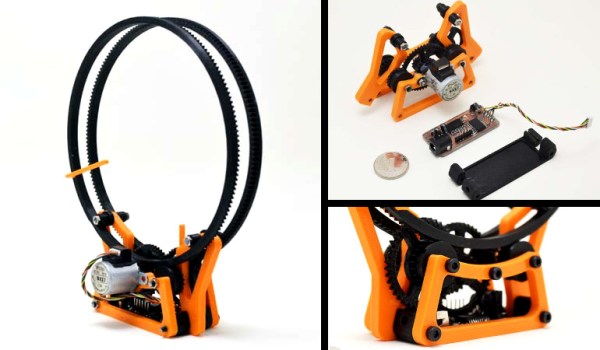
[ekaggrat] designed a 3d-printed clock that’s fairly simple to make and looks awesome. The clock features a series of 3d-printed gears, all driven by a single stepper motor that [ekaggrat] found in surplus.
The clock’s controller is based around an ATtiny2313 programmed with the Arduino IDE. The ATtiny controls a Darlington driver IC which is used to run the stepper motor. The ATtiny drives the stepper motor forward every minute, which moves both the hour and minute hands through the 3d-printed gears. The hour and minute are indicated by two orange posts inside the large gears.
[ekaggrat] etched his own PCB for the microcontroller and stepper driver, making the build nice and compact. If you want to build your own, [ekaggrat] posted all of his design files on GitHub. All you need is a PCB (or breadboard), a few components, and a bit of time on a 3D printer to make your own clock.
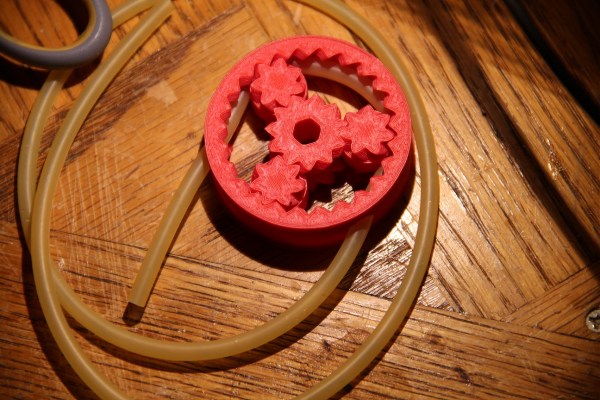
After getting access to a Lulzbot 3D printer, [Tim] designed a 3D printable peristaltic pump. The design was done in OpenSCAD, which makes it parametric and easy to modify.
Peristaltic pumps work by squeezing a length of tubing to push fluids. This mechanism is similar to how your intestines work. The pump provides an isolated fluid path, which is why they’re commonly used in medical and food grade applications. Like many products in the medical space, these pumps tend to be rather expensive. Being able to print one for your own projects could save quite a bit of cost.
The pump is based on [emmett]’s gear bearing design. One nice thing about this design is that it is printed preassembled. Pop it out of the printer, add some tubing, and you’re ready to pump fluids.
On top of the isolated fluid path, this pump gives accurate volume measurement. For that reason, we can imagine it moving booze for a robotic bartender build. After the break, a video of the pump moving some fluid.
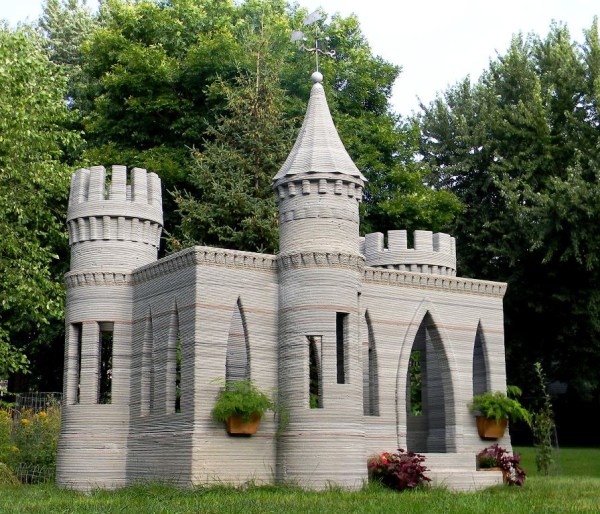
After two years of dreaming, designing, and doing, [Andrey Rudenko] has finally finished 3D printing his concrete castle. We’re sure a few readers will race to the comments to criticize the use of “castle” as an acceptable descriptor, but they’d be missing the point. It’s been only three months since he was testing the thing out in his garage, and now there’s a beautiful, freestanding structure in his yard, custom-printed.
There are no action shots of the printer setup as it lays down fat beads of concrete, only close-ups of the nozzle, but the castle was printed on-site outdoors. It wasn’t, however, printed in one piece. [Andrey] churned out the turrets separately and attached them later. He won’t be doing that again, though, because moving them in place was quite the burden. On his webpage, [Andrey] shares some insight in a wrap-up of the construction process. After much experimentation, he settled on a layer height of 10mm with a 30mm width for best results. He also discovered that he could print much more than his original estimation of 50cm of vertical height a day (fearing the lower layers would buckle).
With the castle a success, [Andrey] plans to expand his website to include a “posting wall for new ideas and findings.” We’re not sure whether that statement suggests that he would provide open-source access to everything or just feature updates of his future projects.
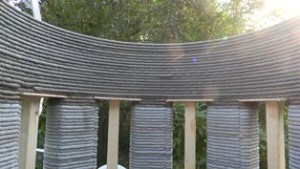
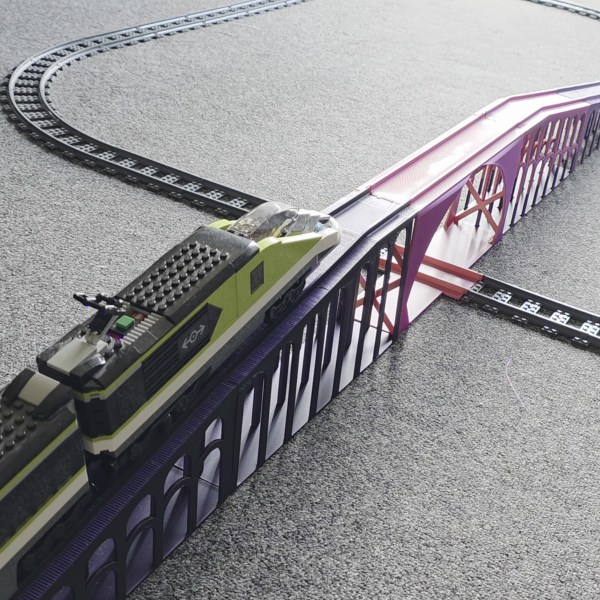
[Andrey] used wooden supports to print concrete bridges.We hope the former. You can check out its current format as the Architecture Forum, where he explains some of the construction capabilities and tricks used to build the castle.
His next project, a full-scale livable structure, will attempt to print 24/7 (weather permitting) rather than the stop-start routine used for the castle, which turned out to be the culprit behind imperfections in the print. He’ll have to hurry, though. [Andrey] lives in Minnesota, and the climate will soon cause construction to take a 6-month hiatus until warm weather returns. Be sure to check out his website for more photos and a retrospective on the castle project, as well as contact information—[Andrey] is reaching out to interested parties with the appropriate skills (and investors) who may want to help with the new project.
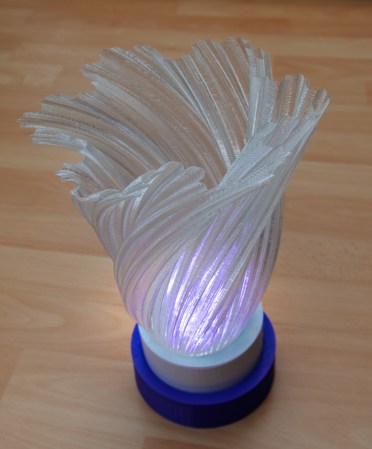
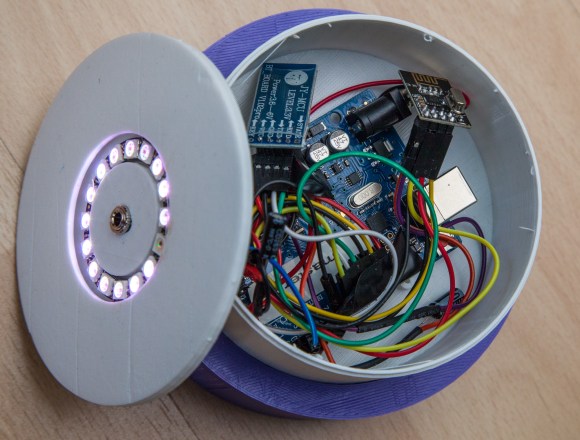
[Rob] created these amazing Bluetooth controlled LED lights for his daughter’s wedding adding a colorful ambient glow to the ceremony. Each item held a Neopixel ring and an Arduino microprocessor with a wireless module that could be individually addressed over a ‘mini-network.’ The main master station would receive commands from a Windows Phone. Usually we see Arduino-based projects being run with Android apps, so it’s nice to see that Microsoft is still present in the maker community.
The enclosures and translucent vases that sit atop the devices were 3D printed. All eight of the matrimonial units synchronized with each other, and the colors could be changed by sliding the settings bar on the app. [Rob] says that it was a lot of fun to build, and jokingly stated that it kept him “out of all the less important aspects of the ceremony. (food choice, decor, venue, who to marry etc etc).” The outcome was a beautiful arrangement of tabletop lighting for the wedding. A demo of [Rob]’s setup can be seen in the video below.