DIY Ultrasonic Plastic Welding

Here’s something that may be of interest to all the reprappers, vacuum formers, and other plastic fabbers out there: ultrasonic welding of plastics. If you’ve ever wanted to join two pieces of plastic without melting them together with acetone or screwing them together, [circuitguru] is your guy.

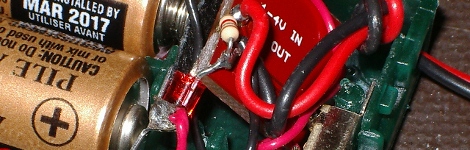
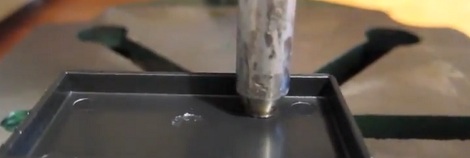
Ultrasonic welder setups are usually reserved for companies that don’t mind spending tens of thousands of dollars on a piece equipment. There are smaller versions made for heat staking – melting plastic pillars into rivets on the work piece – and [circuitguru] was lucky enough a somewhat reasonable price.

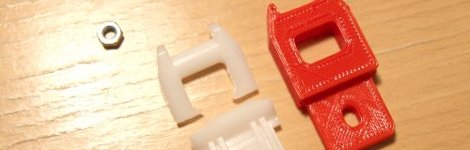
Because the heat staking gun was a handheld unit, a rotary tool drill press was put to work. The end result is a relatively inexpensive way to join two plastic parts without screws, glue, or solvents. The bond is pretty strong, too. Check out the video after the break to see [circuitguru] join two pieces of a plastic enclosure and try to tear them apart.

Continue reading “DIY Ultrasonic Plastic Welding”

3D Printed Zoetrope

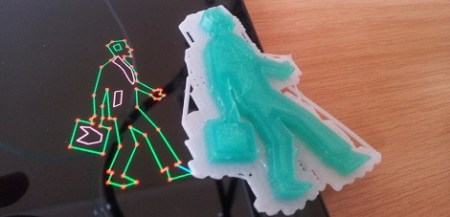
Normally, 29 men walking around in an endless circle would be the stuff  of an [M.C. Escher] engraving. [Tobias] turned this into a reality with a little help from some LEDs and a 3D printer.

Like his earlier project, [Tobias] built himself a nice little strobing zoetrope that maintains the illusion of movement by flashing LEDs at precise intervals. Instead of a flat 2D image, [Tobias] went for a walking 3D figure that marches to the beat of a timer circuit. The figures themselves were printed via Shapeways.

The electronics were improved for this iteration. Formerly, [Tobias] used a 555 and a whole bunch of auxiliary components. The circuit was improved for this version to uses Schmitt triggers and an optical encoder. The easy-to-build-on-perfboard schematics and layouts are available, so feel free to build one for yourself.

[Tobias]’ zoetrope isn’t much different from the gigantic Charon sculpture seen at last year’s Burning Man. Sure, it’s not 40 feet tall but it’s still a nice piece of work.

Continue reading “3D Printed Zoetrope”

Welding And Casting ABS

Anybody who has a 3D printer always has a ton of useless plastic lying around. Some of that plastic may be from useless baubles, but most of it is in bad prints, short bits of filament, and general scraps. [Luke] found an interesting way to put those ABS scraps to use, and ended up turning trash into valuable plastic parts.

Commonly sold as nail polish remover, acetone will turn anything made out of ABS into a puddle of plastic. [Luke] makes glue using the same process – he fills a small container half full of acetone and half with small bits of ABS. After a day or so, he has a nice thin glue that dries into solid ABS. [Luke] used this to create a 400mm long piece of extruded t-slot. We don’t know if it would be suitable to build a child RepRap from, but it would sure be an interesting experiment.

[Luke] also did a little bit of casting with his ABS glue. With a thicker solution of ABS and Acetone, he managed to make this ‘thing’. The entire process is explained over at Thingiverse, We can’t wait to see what can be done with this stuff.

4Track Robot Gets Around With Ease

4track-robot

[Jon] has been developing a slick little RC robot in bits and pieces over the last year or so, which can constructed by anyone with access to a 3D printer. Servos and electronics aside, the entire thing can be put together in short order using the plans he posted on Thingiverse.

The robot makes use of four “caterpillar” type bots, which are all connected via a central frame. Once [Jon] had the general design for a single caterpillar bot down, he moved forward to create the robot you see above. His friend [Julián] lent a hand in the form of electronics and code, which allows the robot to be driven using a standard USB gamepad.

As you can see in the video below, the robot gets around nicely, climbing over obstacles with relative ease. While it is a bit loud, [Jon] says that’s due to the undersized servos they happen to be using at the moment. We think it looks great so far, but [Jon] already has plans to beef up the motors and add wireless control in the near future – we can’t wait to see it then!

Continue reading “4Track Robot Gets Around With Ease”

An Interview With Bre Pettis, Founder Of MakerBot Industries

For those of you that don’t know, the Makerbot is a 3D printer created by Bre Pettis. It is probably the best-known 3D printer that you can buy at a price point meant for the hobbyist. Although this article doesn’t go into how the MakerBot is made, it focuses instead about the business itself and the man behind it. Bre was a hobbyist maker just like many of our readers, but decided to turn his passion into a successful business.

Although not all businesses are a success, Bre has made quite a start at becoming one. His company now employs 50 people and is currently hiring (like this posting for a “Web Warrior”) and has just secured $10 million in venture capital funding! Check out the full interview for all the details. It may inspire others to go from “hobby maker” to “professional.”

For other 3D printing-related posts, check out this one about the RepRap printer which is capable of replicating itself. For other ways to make your own parts, this rotomold machine may be of interest or this semi-DIY CNC router.

Solar-powered RepRap Prints Even When The Power Is Out

solar_powered_3d_printer_reprap

[Mark] wrote in to share a little creation that he is calling the first solar-powered 3D printer in existence. While we can’t say that we totally agree with him on that title, we will give him the benefit of the doubt that this is the first solar-powered RepRap we have seen thus far.

You might remember [Mark] from his previous exploits, but rest assured that there’s little possibility of anyone losing an eye with this one. He has taken his RepRap outdoors, and with the help of a solar panel plus a few batteries from Harbor Freight, he has the world’s first solar-powered RepRap*.

The trick behind keeping the RepRap running for such a long time with the sun as its only power source lies in the RAMPS board [Mark] uses. He has the 1.3 revision of the shield, which enables him to print objects loaded from an SD card rather than requiring a computer to be connected at all times.

So, if you happen to need the ability to print 3D objects where an extension cord cannot possibly reach, check out [Mark’s] setup and get to building!

* Maybe. Perhaps.

Continue reading “Solar-powered RepRap Prints Even When The Power Is Out”

3D Printed Turtle Shell Racers Bring Mario Kart To Life

skimbals_3d_printed_turtle_shell_racers

Every once in awhile a project comes along that makes us say, this is why we want a 3D printer!”

[Skimbal] is pretty well known in 3D printing circles for the incredibly detailed designs he has put out in the past. This time around, his focus is on motoring, Mario Kart style.

His Turtle Shell Racers are ripped right out of the Mario Kart series of games, and are built in the form of the multi-colored turtle shells with which most of us have a love/hate relationship. Constructed atop cheap RC trucks, the Shell Racers require 20-some odd printed parts apiece, but looking at the final results we think the time and money spent would be well worth it.

After watching the videos below, we think you’ll agree that these things look like a blast to play with. The Shell Racers were actually so impressive that they managed to land [Skimbal] a permanent gig with MakerBot Industries.

If you want to try making a set of your own, there are extensively detailed build instructions and all the STL files you can shake a stick at over at Thingiverse.

Continue reading “3D Printed Turtle Shell Racers Bring Mario Kart To Life”