Kilobuck Open Kinect Project Prize

Full of video and audio sensors, the newly released Kinect is Microsoft’s answer to Nintendo’s Wii MotionPlus and Sony’s PlayStation Move. Now there is money up for grabs to hack it. Adafruit is offering up a one thousand dollar prize to open source the driver for the Kinect. What do they want this driver to do? They want RGB and distance values. We’re excited to see the hacks that will come around because of this product, and now that prize money is involved, everything has been turned up a notch.

Update: The bounty has been raised to $2000 after a Microsoft response to CNET:

But Microsoft isn’t taking kindly to the bounty offer. “Microsoft does not condone the modification of its products,” a company spokesperson told CNET. “With Kinect, Microsoft built in numerous hardware and software safeguards designed to reduce the chances of product tampering. Microsoft will continue to make advances in these types of safeguards and work closely with law enforcement and product safety groups to keep Kinect tamper-resistant.”

Update: Progress toward a driver
Update: Winner of the Open Source Kinect contest
Solar Panel Charger Analysis With Ladyada

[vimeo = http://vimeo.com/13936259%5D

[Phillip Torrone], one of the original crew of HackaDay, now working with [LadyAda] tipped us off to this video of her explaining the device they built for configuring the charging circuits to be used with their solar panels. Unlike most of their tutorials, this one is not intended to be a final product sold on their store. Rather, this is a project that helps them deliver the best quality they can.

The unit itself is built around an Arduino and can log the statistics to an SD card, show battery voltage, panel voltage, and current from panel to charger. You can see in the video above how she uses this to refine her design in real time for optimal results.

DS1307 Breakout Board

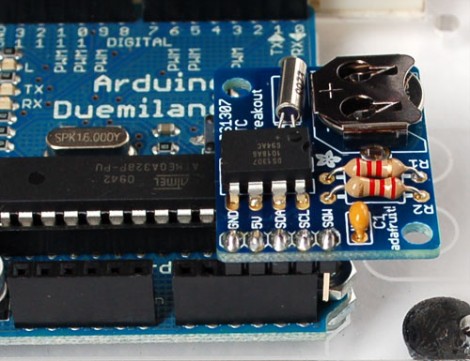
Adafruit’s got a handy breakout board for the DS1307 RTC available. This chip isn’t nearly as accurate as the DS3231 used in the Chronodot but it’s quite a bit cheaper. The breakout makes this easy to breadboard or plug into an Arduino and has everything you need; clock crystal, a backup battery, filtering capacitor, and pull-up resistors. Our favorite part is that Adafruit designs are open source so you can etch the board yourself if you checkout the files from their git repository. This will make a great addition to our prototyping hardware collection.

Incidentally, we were surprised to see the choice of 2.2k resistors for the I2C bus pull-ups. We were under the impression that 4.7k was a standard value here. We’d love to hear your thoughts on this in the comments.

[via Dangerous Prototypes]

Space Invaders Clock 6 Years Ahead Of Pong Clock

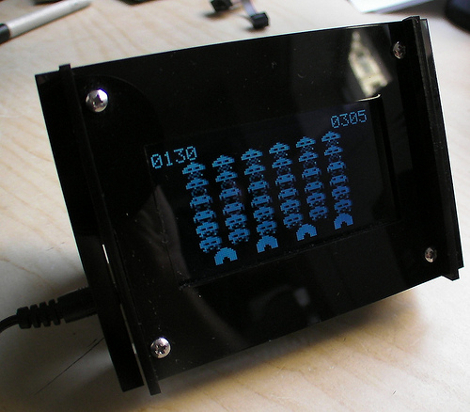
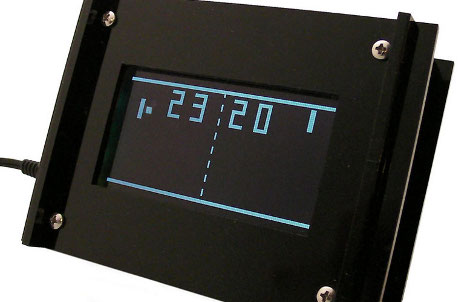
Space Invaders came out in 1978, six years after Pong. That means this Space Invaders clock uses newer technology, right? Nope, it’s the same hardware as the Adafruit Pong Clock with some updated firmware. Still, as you can see after the break, the effect is pretty nice. Pong was cool, but having a clock that scrolls through several classic games would be cooler.

[Dataman], the guy responsible for this firmware hack shared his code. It should be easy enough to alter it for any clock using a KS0108 graphic LCD screen. So what’s next? Can someone pull off a black and white Ms. Pac-Man that looks decent on the 128×64 display?

Continue reading “Space Invaders Clock 6 Years Ahead Of Pong Clock”

Yet Another Pong-clock

[PT] let us know that Adafruit Industries has just release a pong clock kit. The $80 price tag might seem a bit steep but it does come with a custom-ordered KS0108 display in order to get white on black like the classic video game, as seen after the break. Also included is the laser-cut case, an ATmega328 microcontroller, RTC, and all the other bits needed to get this working.

We just saw a pong clock built on a breadboard using a KS0108 display but that one used a PIC processor. Adafruit always open-sources their designs and code so you can head over to the kit details page if you already have the hardware on hand to throw this together.

Continue reading “Yet Another Pong-clock”

Update: Adafruit Eagle Library, Now With Arduino

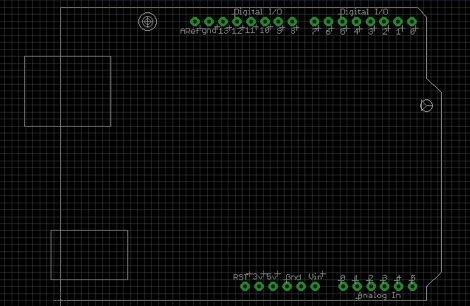
Adafruit Industries has just added an Arduino shield footprint to their EagleCAD library. If you don’t know, the Arduino headers use non-standard pin spacing. Learn to deal with it, there’s too many Arduino shields in production to have any hope for a change in the future. This footprint should make it a lot easier to design your own boards. If you use this package make sure you’re getting the library from their github, they’ve been adding parts regularly. Setting up version control will make sure you always have the latest libraries.

[Thanks pt]

Adafruit Eagle Library

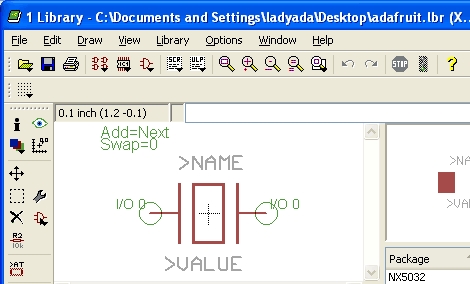
We love it when a PCB comes out right the first time. We’re careful enough with our designs that if something is wrong it’s usually a footprint problem, like we picked the wrong package for the components. Adafruit is helping to make the design process easier by sharing their Eagle library. Like the Eagle library version control we saw earlier in the month, this library is housed on github making it easy to stay up-to-date. The library includes many components (switches, crystals, IC’s, etc.), and fixes some prolbem-footprints, like 0805 surface mount pads.